Identify Your Devices By Their Unintentional Radiation

RFID was supposed to revolutionize asset tracking, replacing the barcode everywhere. Or at least that was the prediction once tags got under five cents apiece. They still cost seven to fifteen cents, even in bulk, and the barcode is still sitting pretty. [Chouchang (Jack) Yang] and [Alanson Sample] of Disney Research hope to change that.

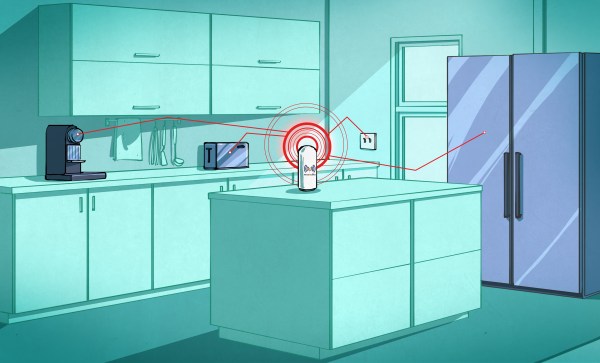
Instead of tagging every electronic device, they use whatever electromagnetic emissions the device currently produces when it’s powered up. What’s surprising is not that they can tell an iPhone from a toy lightsaber, but that they can tell the toy lightsabers apart. But apparently there’s enough manufacturing and tolerance differences from piece to piece that they appear unique most of the time.

The paper (PDF) goes through the details and procedure. The coolest bit? The sensor they use is an RTL-SDR unit with the radio-mixer front end removed and replaced with a simple transformer. This lets them feed baseband (tuning from 0 to 28.8 MHz) straight into the DAC ADC and on to the computer which does the heavy math. Sawing off the frontend of a TV tuner is a hack, for those of you out there with empty bingo cards.

If you like statistics, you’ll want to read the paper for details about how they exactly do the classification of objects, but the overview is that they first start by figuring out what type of device they’re “hearing” and then focusing on which particular one it is. The measure that they use ends up being essentially a normalized correlation.

While we’re not sure how well this will scale to thousands of devices, they get remarkably good results (around 95%) for picking one device out of five. The method won’t be robust to overclocking or underclocking of the device’s CPU, so we’re concerned about temperature and battery-voltage effects. But it’s a novel idea, and one that’s ripe for the hacker-rebuild. And for the price of an RTL-SDR, and with no additional per-tag outlay as with an RFID system, it’s pretty neat.

Thanks [Static] for the tip! Via Engadget.
3D Print It Or Fix It?

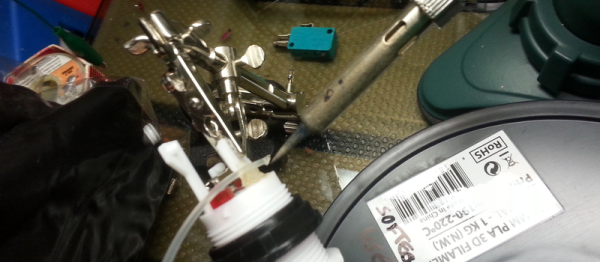
[Tim Trzepacz] is working on a pretty cool MIDI controller project over on Hackaday.io. It involves, naturally, a bunch of knobs and buttons. And it’s one of these nice arcade-style buttons that broke when he slammed on his car brakes and it went flying.

He tried gluing the plastic bits back together, but we all know how that works — temporarily. Next, he thought that maybe he could 3D-print a model of the arcade button’s housing. Besides being a lot of work, [Tim] didn’t have a reliable printer on hand. But he did have filament and a soldering iron.

The rest of the story is a slightly ugly mess, but it looks like it’ll work. (And it’s on the inside of the case, after all.) A working part is a good part.

The irony here is that the original choice of 3 mm ABS filament as a printing material is that it’s cheap and available because it’s commonly used in plastic welding. And there are more elegant ways to melt the plastic than with a soldering iron. And more ways to get it melted than direct heating, like ultrasonic welding and friction welding, for instance.

But we still like to see the occasional quickly hacked together effort, at least one per day. What’s your craziest plastic welding success or failure?

Beautiful Kegerator, Built The Hard Way

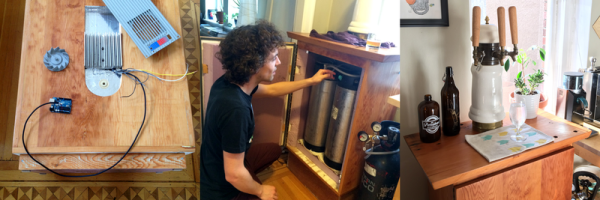
[Luke] brews his own beer. And like all beer brewers, he discovered that the worst part of homebrewing is cleaning out all the bottles. Time for a kegging system! And that means, time for a kegerator to keep the brew cold.

Normal kegerators are just a few holes drilled in an appropriate refrigerator. Most fridges have a step in the back where the compressor lives, which makes kegs an awkward fit, so [Luke] decided to build his own refrigerator.

He used beautiful wood and plenty of insulation. He failed, though, because he succumbed to the lure of the Peltier cooler. If there’s one problem with Peltier projects, it’s building first and looking up the specs second. They never have enough cool-juice. To quote [Luke]:

“… a comment I had seen somewhere on the Internet began to sink in: all projects involving peltier devices ultimately end in disappointment.

(Bolding and italics from the original.) But at least he learned about defrosting, and he had a nice wood-paneled fridge-box in the basement.

Rather than give up, he found a suitable donor fridge, ripped out its guts, and transplanted them into his homemade box. A beautiful tap head sitting on top completes the look. And of course, there’s an ESP8266 inside logging the temperature and controlling the compressor, with all the data pushed out over WiFi. Try doing that with your Faraday Cage metal fridge!

We’ve seen kegerator builds before. Some of our favorites include this one that has a motorized retracting tap tower, and one that’s built into the walls of the house.

Electromagnetic Field’s Badge Hanging In The Balance

Making conference badges is a tough job. Unless you’re sitting on a gold mine, you have to contact a whole bunch of sponsors for help, work the parts that you can get into a coherent design, and do it all on the quick for a large audience. The EMF team is this close to getting it done, but they need some sponsorship for the assembly. If you know anyone, help them out! If they can’t line something up in the next two weeks, they’ll have to pull the plug on the badge entirely.

Electromagnetic Field is a summer-camp hacker convention / festival that takes place in England and is now in its third iteration. As with other big cons, the badge is a good part of the fun.

The 2016 EMF badge looks to be amazing. It’s powered by an ST STM32L4 low-power micro, a color LCD screen, a TI CC3100 WiFi radio module onboard, and a ridiculous number of other features including a gyro and magnetometer, and a giant battery. It’s also a testbed for the brand-new MicroPython, which aims to bring everyone’s favorite scripting language to embedded processors. In fact, they’ve largely built the MicroPython WiFi drivers for the badge.

If they can’t get a sponsor, all is not lost because everything is open source. We’ll all reap the benefits of their hard work. But that’s not the point. The point is that hundreds of hackers will be standing around in a field outside of London without the most audacious badge that we’ve seen designed dangling from their necks.
If you know anyone who can help, get in touch?

Thanks [schneider] for the tip!

Navid Gornall Eats His Own Face

Navid Gornall is a creative technologist at a London advertising agency, which means that he gets to play with cool toys and make movies. That also means that he spends his every working hour trying to explain tech to non-technical audiences. Which is why he was so clearly happy to give a talk to the audience of hardware nerds at the Hackaday Belgrade conference.

After a whirlwind pastiche of the projects he’s been working on for the last year and a half, with tantalizing views of delta printers, dancing-flame grills, and strange juxtapositions of heat sinks and food products, he got down to details. What followed was half tech show-and-tell, and half peering behind the curtain at the naked advertising industry. You can read our writeup of the highlights after the video below.

Continue reading “Navid Gornall Eats His Own Face”

Minimal MQTT: Networked Nodes

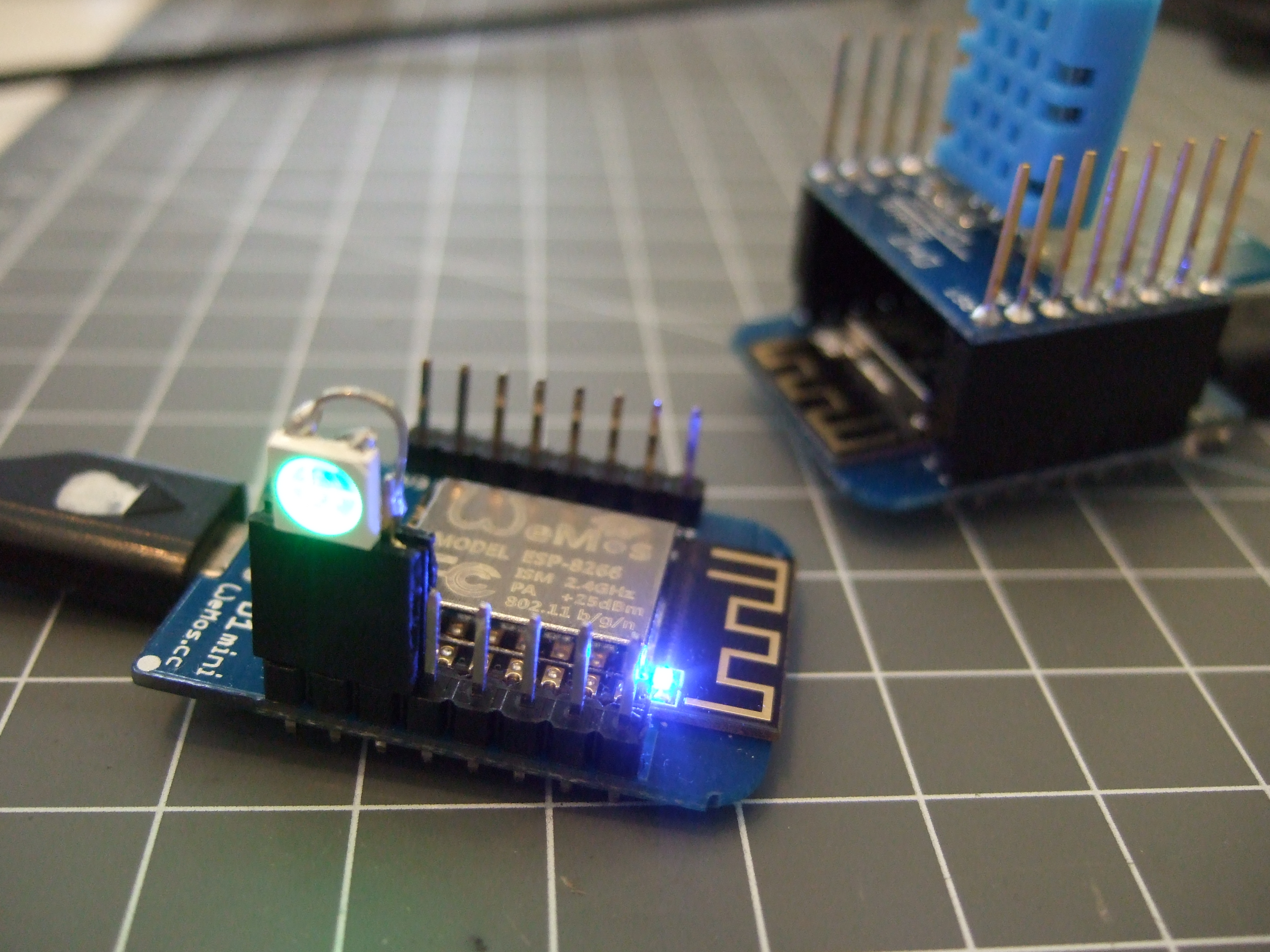
Last time on Minimal MQTT, we used a Raspberry Pi to set up an MQTT broker — the central hub of a home data network. Now it’s time to add some sensor and display nodes and get this thing running. So pull out your ESP-8266 module of choice, and let’s get going.

DSCF8443For hardware, we’re using a WeMos D1 Mini because they’re really cute, and absolutely dirt cheap, but basically any ESP module will do. For instance, you can do the same on the simplest ESP-01 module if you’ve got your own USB-serial adapter and are willing to jumper some pins to get it into bootloader mode. If you insist on a deluxe development board that bears the Jolly Wrencher, we know some people.

NodeMCU: Getting the Firmware

We’re using the NodeMCU firmware because it’s quick and easy to get running. But you’re not stuck with NodeMCU if you want to go it alone: MQTT has broad support. [TuanPM] ported over an MQTT library to the native ESP8266 SDK and of course there’s espduino, a port for an Arduino-plus-ESP combo. He also ported the MQTT module to NodeMCU that we’ll be using today. Thanks, [TuanPM]!

Continue reading “Minimal MQTT: Networked Nodes”

3D Printing And Modelling On The Fly

3D printing is supposed to be about rapid prototyping. Design, print, use, re-design, print, test — iterate until happy. But when you’re laying down filament at 60 mm/s, it can seem anything but rapid.

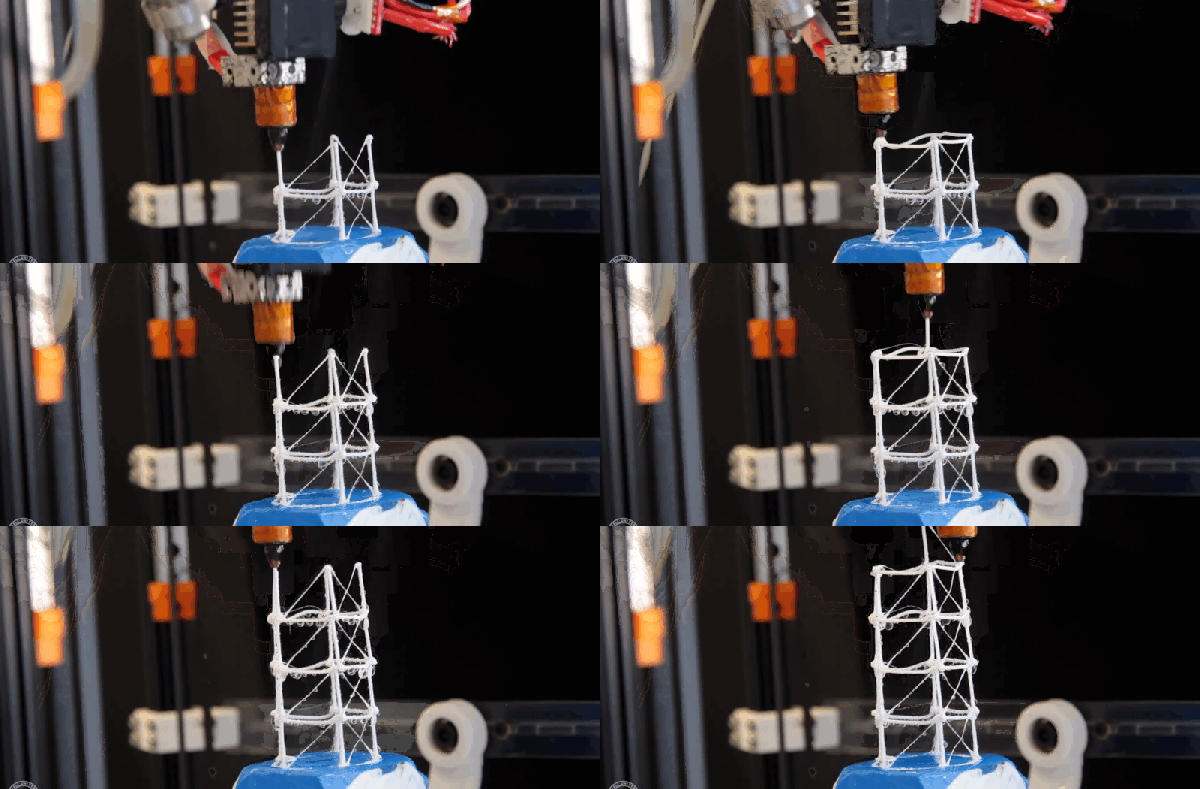
[Huaishu Peng], [Rundong Wu], and their supervisors at Cornell have come up with a 3D printer that can print almost as fast as you can model, and is able to add and subtract from the model on the fly. The goal is to get an initial model out so quickly that designing and printing can be truly interactive. They look to have succeeded — check out the video below.

3ders.org has a brilliant writeup of the machine that you should also go read once the video’s magic has worn off. There’s a lot going on to make this all work. The printer adds two extra degrees of freedom and a cutter head so that it can make additions and subtractions from the side, and is not constrained to layer-by-layer construction. To get the ABS to cool fast enough to make solid strands, water jets mist it down to temperature just after it’s printed.

Continue reading “3D Printing And Modelling On The Fly”