CoreXY On The Pi Pico

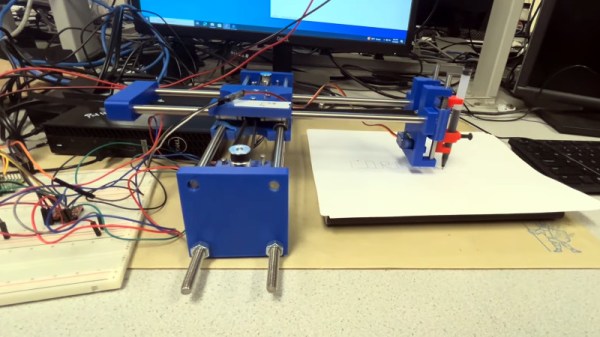
There are enough off-the-shelf CoreXY mechanisms out there that for the cost of an AliExpress order it’s possible to quickly and cheaply make yourself a plotter. But [Koushani Das], [Mahathi Andavolu] and [Dengyu Tu] are completing their project for Cornell University’s ECE 5730 course, so of course they have designed one from the ground up. Happily for us it seems to be fairly easy to replicate, so you can build one too if it takes your fancy.

The write-up makes for an interesting dive into the nitty-gritty of design, for which we hope they managed to secure a decent grade. The hardware itself seems pretty straightforward as does the pair of stepper controllers and RP2040 they use to run the thing, and their explanation of the math behind the CoreXY coordinate system is genuinely interesting for those of us who’ve never taken the time to consider it.

All the good stuff can be found in a GitHub repository if you’d like to take this further, and meanwhile they’ve also put up a demo video which you can see below the break. We like this little plotter, and we hope others will take its design and run with it.

Want more CoreXY explanation? We’re happy to oblige.
Continue reading “CoreXY On The Pi Pico”

A High-End Studio Multiplexer Surrenders To An Arduino

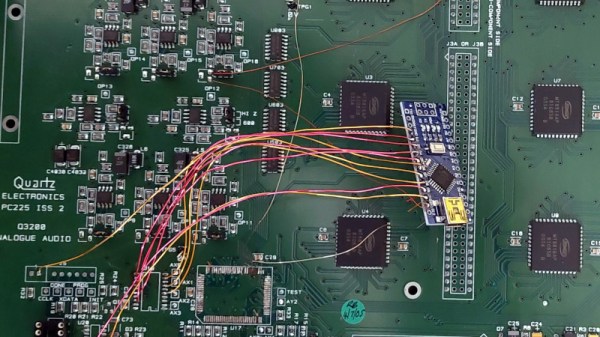
The equipment used in professional radio and TV studios is both extremely high quality and very expensive indeed, and thus out of the reach of an experimenter. Happily as studios are refurbished there’s a steady supply of second-hand equipment which can be surprisingly cheap, but as [Nathan] found out with a Quartz audio router, comes with no control software. What’s to be done with what’s essentially a piece of junk? Remove its brain and replace it with one that can be controlled, of course!

On the PCB alongside a bank of switch matrices is an FPGA which does the heavy lifting. That’s “heavy” in a limited sense, because all it does is handle the chip select lines for the matrices and write data to their registers. This is a task that can be handled by a microcontroller, so in goes an Arduino Nano, which along with a few other board modifications delivers a serial-controlled studio router.

The interesting part for us in this project comes from a look at the date codes on the board, they’re from the early 2000s. This is (roughly) contemporary with the ATmega chip on the Arduino, so we’re curious as to why the designers saw fit to use an FPGA when the microcontrollers of the day were clearly up to the task for much less outlay. We suspect a touch of millennium-era price inflation, but we can’t be sure.

Meanwhile, old broadcast kit has featured here before.

An RC Tank Chassis That’s Not Messing About

It’s not uncommon to see a tracked robot build on these pages, but it’s fair to say that many of them are somewhat on the small side. That was where [iforce2d] started, but the idea of making a more capable version just wouldn’t go away. Thus, he’s come back and made what looks to be a very promising, fully capable outdoor RC tank chassis, one that, within reason, we think should eventually be able to go anywhere.

For plenty of power, he’s using a pair of hoverboard motors with a chain reduction drive and in turn, a couple of shafts to the tracks. The chassis is a TIG-welded aluminium affair, while the tracks are an early incarnation with machined MDF drive wheels and a homemade tread. The suspension is a work of machined-aluminium art, though, and while there are teething troubles as he takes it for a spin, we can see plenty of potential as its deficiencies are ironed out.  Take a look at it in the video below the break.

If large-size R/C tanks are your thing, we have another for you to look at.

Continue reading “An RC Tank Chassis That’s Not Messing About”

It’s Switch Mode, But Not As You Know It

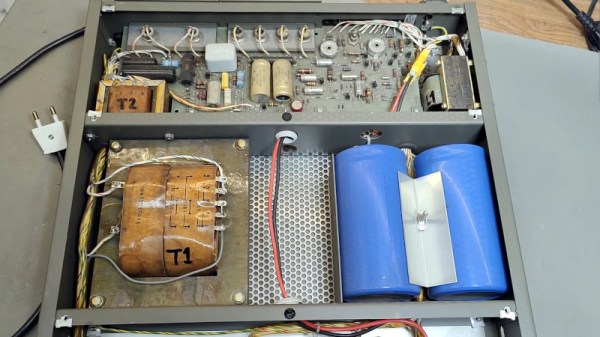
The switch-mode power supply has displaced traditional supplies almost completely over the last few decades, being smaller, lighter, and more efficient. But that’s not to say that it’s a new idea, and on the way to today’s high-frequency devices there have been quite a few steps. An earlier one is the subject of a teardown video from [Thomas Scherrer OZ2CPU], as he takes a look at a 1960s HP power supply with a slightly different approach to regulation for the day. Instead of a linear regulator on its conventional transformer and rectifier circuit, it has a pair of SCRs in the mains supply that chop at mains frequency. It’s a switch mode supply, but not quite as you’re used to.

In fact, these circuits using an SCR or a triac weren’t quite as uncommon as you might expect, and could at one point be found in almost every domestic TV set or light dimmer. Sometimes referred to as “chopper” supplies, they represented a relatively cheap way to derive a regulated DC voltage from an AC mains source in the days before anyone cared too much about RF emissions, and though few were as high quality as the HP shown in the video below, they were pretty reliable.

If older switchers interest you, this is not the first one we’ve shown you from that era.

Continue reading “It’s Switch Mode, But Not As You Know It”

A Web Server, The Sixteen Bit Way

If you were to talk about sixteen bit computing in retrocomputing circles, misty-eyed reminiscences of the ST or Amiga would emerge. Both fine platforms, but oddly the elephant in the 16-bit room has become a victim of its own success. DOS, the granddaddy of all PC operating systems, seems oddly overshadowed by its 68000-based competitors in a way it certainly wasn’t back in the day. Perhaps it’s the often-atrocious graphics when cards designed for business graphics were pressed into gaming service, but it’s easy to forget that DOS PCs were the powerhouses of their day. They still pack a punch even in 2023, as [Lunduke] is here to show us by running a DOS web server. Take that, nginx! Continue reading “A Web Server, The Sixteen Bit Way”

It’s An Audio Distortion Analyzer, Just Not The One You Were Hoping For

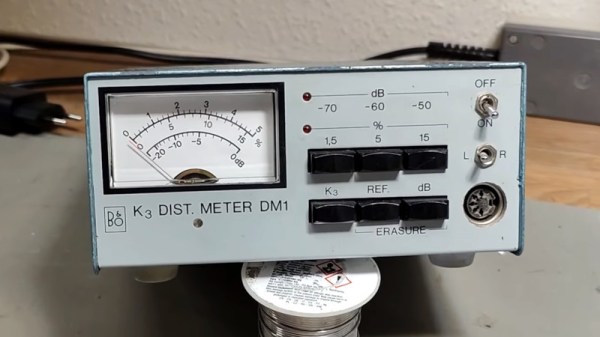
An audio distortion analyzer is a specialist piece of analogue test equipment that usually costs a lot of money and can be hard to track down on the second hand market. Finding one is a moment of luck for the average engineer then, but [Thomas Scherrer OZ2CPU]’s discovery isn’t quite what he might have hoped for. Nonetheless, his Bang and Olufsen K3 Distortion meter DM1 from 1979 is still an interesting and high quality piece of test equipment, and the video below the break makes for a worthwhile watch.

Bang and Olufsen are best known for high-end design Hi-Fi units, thus it’s a surprise to find that in the past they also manufactured test equipment. This distortion meter isn’t a general purpose one, instead it’s designed to measure tape recorders in particular, and it uses an elegant technique. Instead of injecting a sine wave and removing it from what comes out in order to measure the products of the distortion, it records a 333 Hz sine wave onto a tape, then measures the strength of its 3rd harmonic at 1 kHz as an indication of distortion. It’s a working distortion meter made with clever analogue circuitry for a fraction of the cost of the more conventional models that HP would have sold you at the same time, even if it doesn’t give the same THD figure you might have been looking for.

If distortion interests you, it’s a subject we’ve looked at in the past.

Continue reading “It’s An Audio Distortion Analyzer, Just Not The One You Were Hoping For”

When Is An Engineer Not An Engineer? When He’s A Canadian Engineer

In medieval Europe, many professions were under the control of guilds. These had a monopoly over that profession in their particular city or state, backed up with all the legal power of the monarch. If you weren’t in the guild you couldn’t practice your craft. Except in a few ossified forms they are a thing of the past, but we have to wonder whether that particular message ever reached Western Canada.

An electoral candidate with an engineering degree who practices what any sane person would call engineering, has been ordered by a judge to cease calling himself an engineer. The heinous crime committed by the candidate, one [David Hilderman], is to not be a member of the guild Association of Professional Engineers and Geoscientists of B.C. We get it that maybe calling a garbage truck driver a waste collection engineer may be stretching it a little, but here in the 21st century we think the Canadian professional body should be ashamed of themselves over this case. Way to encourage people into the engineering profession!

Here at Hackaday, quite a few of us writers are engineers. Stepping outside our normal third person, I, [Jenny List], am among them. My electronic engineering degree may be a little moth-eaten, but I have practiced my craft over several decades without ever being a member of the British IEE. No offence meant to the IEE, but there is very little indeed they have to offer me. If the same is true in Canada to the extent that they have to rely on legal sanctions to protect their membership lists, then we think perhaps the problem is with them rather than Canadian engineers. You have to ask, just how is an engineering graduate who’s not a guild member supposed to describe themselves? Some of us need to know, in case we ever find ourselves on holiday in Canada!

Header: Joe Gratz, CC0.