Wooden Wide-Angle Wonder Wows World

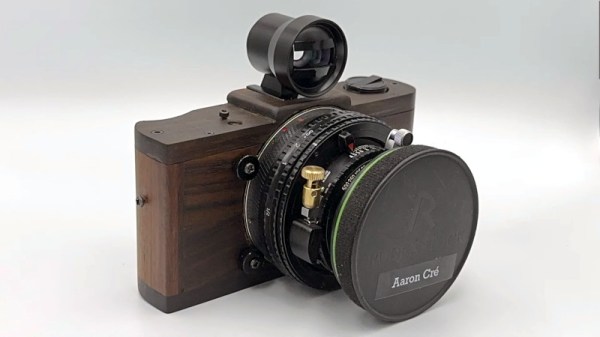
An old-fashioned film camera can be an extremely simple device to make, in that as little as a cardboard box with a pin hole in it will suffice. But that simplicity at heart leaves endless scope for further work, and a home-made camera can be every bit as much a highly-engineered object of beauty as its commercial stablemate. A great example comes from [Aaron Cré], whose desire for something close to a Hasselblad XPan panoramic camera led him to build his own equivalent out of wood.

The video below the break shows in detail how the wooden case is crafted, and how a lens mount ring sawn from a lens adapter is mounted on the front of it. He’s skipped making all the tiresome parts of the camera associated with winding and film transport and instead taken them from a cheap plastic snapshot camera. The original aspect ratio is stretched by cutting the guts of the snapshot camera apart, and extended to make a 75 mm long negative which also exposes over the sprocket holes.

The final camera is carefully finished to the point at which it really looks the part as well as taking those striking wide-angle photographs. We’re not photography buffs enough to identify the lens and shutter combination he’s using, but we can’t help envying him the results. Fancy making your own 35 mm camera too? Here’s another, in case you need inspiration.

Continue reading “Wooden Wide-Angle Wonder Wows World”

Liberté, égalité, Fraternité: France Loses Its Marbles On Internet Censorship

Over the years we’ve covered a lot of attempts by relatively clueless governments and politicians to enact think-of-the-children internet censorship or surveillance legislation, but there’s a law from France in the works which we think has the potential to be one of the most sinister we’ve seen yet.

It flew under our radar so we’re grateful to [0x1b5b] for bringing it to our attention, and it concerns a proposal to force browser vendors to incorporate French government censorship and spyware software in their products. We’re sure that most of our readers will understand the implications of this, but for anyone not versed in online privacy and censorship  this is a level of intrusion not even attempted by China in its state surveillance programme. Perhaps most surprisingly in a European country whose people have an often-fractious relationship with their government, very few French citizens seem to be aware of it or what it means.

It’s likely that if they push this law through it will cause significant consternation over the rest of the European continent. We’d expect those European countries with less liberty-focused governments to enthusiastically jump on the bandwagon, and we’d also expect the European hacker community to respond with a plethora of ways for their French cousins to evade the snooping eyes of Paris. We have little confidence in the wisdom of the EU parliament in Brussels when it comes to ill-thought-out laws though, so we hope this doesn’t portend a future dark day for all Europeans. We find it very sad to see in any case, because France on the whole isn’t that kind of place.

Header image: Pierre Blaché CC0.

Only 8 Chips Make A CPU

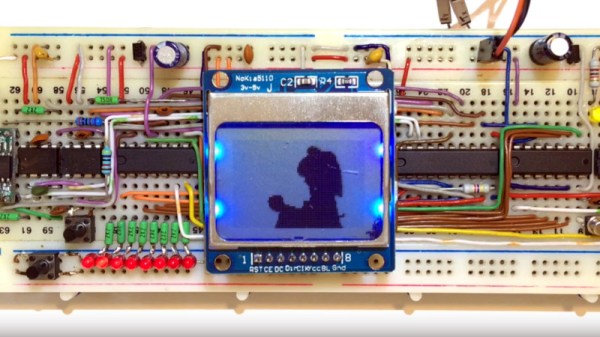
We’re no stranger to homemade CPUs on these pages, but we think that [Jiri Stepanovsky]’s 16-bit serial CPU might be a little special. Why? It has an astonishingly low chip count, with only 8 ICs in total. How on earth does he do it?

While a traditional TTL CPU has a relatively high chip count due to a parallel data bus, registers, and discrete ALU, this one takes a few shortcuts by opting for a one-bit serial bus with serial memory chips and an EPROM serving as a look-up-table ALU. Perhaps the most interesting result of this architecture is that it also allows the CPU to dispense with registers, like the Texas Instruments 16-bit chips back in the day. They all live in memory. You can see it below the break in action, streaming a video to a Nokia-style LCD.

Such a CPU would indeed have been unlikely to have been made back in the day due to the prohibitive cost of buying and programming such a large EPROM. However, old computers like the EDSAC also used a serial data path and mercury delay line memory to manage complexity. But for a solid-state CPU in 2023, we think the design is innovative. We think it would be challenging to reduce the chip count further — and no, we’re not counting designs that use a microcontroller to replicate a block of circuitry; that’s cheating — but we’re sure that somewhere there’s a designer with ideas for slimming the design further.

Continue reading “Only 8 Chips Make A CPU”

Linux, Running On Not A Lot

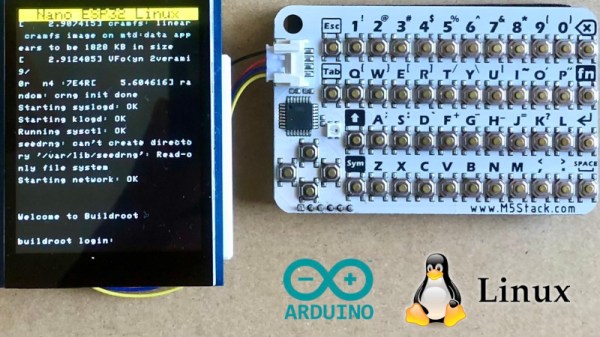
There are many possible answers to the question of what the lowest-powered hardware on which Linux could run might be, but it’s usually a pre-requisite for a Linux-capable platform to have a memory management unit, or MMU. That’s not the whole story though, because there are microcontroller-focused variants of the kernel which don’t require an MMU, including one for the Xtensa cores found on many Espressif chips. It’s this that [Naveen] is using to produce a computer which may not be the Linux computer with the lowest processor power, but could be the one consuming the least electrical power.

The result is definitely not a Linux powerhouse, but with its Arduino-sourced ESP32 board stacked on an UNO and I2C keyboard and display, it’s an extremely lightweight device. The question remains, though, is it more than a curiosity, and to what can it do? The chief advantage it has over its competitors such as the Raspberry Pi Zero comes in low power consumption, but can its cut-down Linux offer as much as a full-fat version? We are guessing that some commenters below will know the answer.

If you’re curious about the Xtensa version of Linux, it can be found here,

A Time-Lapse Film, Not A Time-Lapse Video

We’re used to time-lapse photography being merely a feature of our smartphone camera app, but of course it has its origins in film. A movie camera would be triggered frame by frame at fixed intervals, with the result being the timelapse. A dead art, you might wonder, were it not for [Kevin Santo Cappuccio], who is capturing his work in timelapse on 16mm film, with a vintage Bolex camera.

For those of us with a penchant for film the camera alone makes it worth a second look, but the actuation mechanism is at the heart of the project. It uses a slightly unusual but nevertheless strangely ubiquitous actuator, in the form of a car door central locking actuator. This in turn is triggered by an Arduino Nano, and he has the ultimate dream of using a 16mm film timelapse as part of a fully-16mm submission video for the Hackaday prize.

We think it’s a pity that more film-based projects don’t end up on these pages, so we’re very pleased indeed to see this one. If you’re curious about the other side of the 16mm system, well we’ve introduced you to the inner workings of a projector before, too.

A Quarter Century Of The IMac

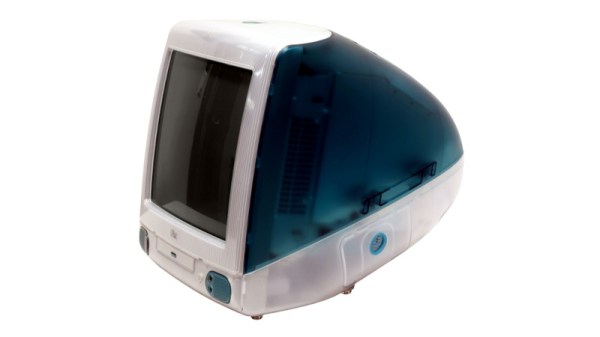
Growing older as an engineer turns out to be a succession of moments in which technologies and devices which you somehow still imagine to be cool or exciting, reveal themselves in fact to be obsolete, indeed, old. Such a moment comes today, with the25th anniversary of the most iconic of 1990s computers, Apple’s iMac. The translucent all-in-one machine was and remains more than simply yet another shiny Mac, it’s probably the single most influential home computer ever. A bold statement to be sure, but take a look at the computer you’re reading this on, indeed at all your electronic devices here in 2023, before you dismiss it.

Any colour you want, as long as it's beige
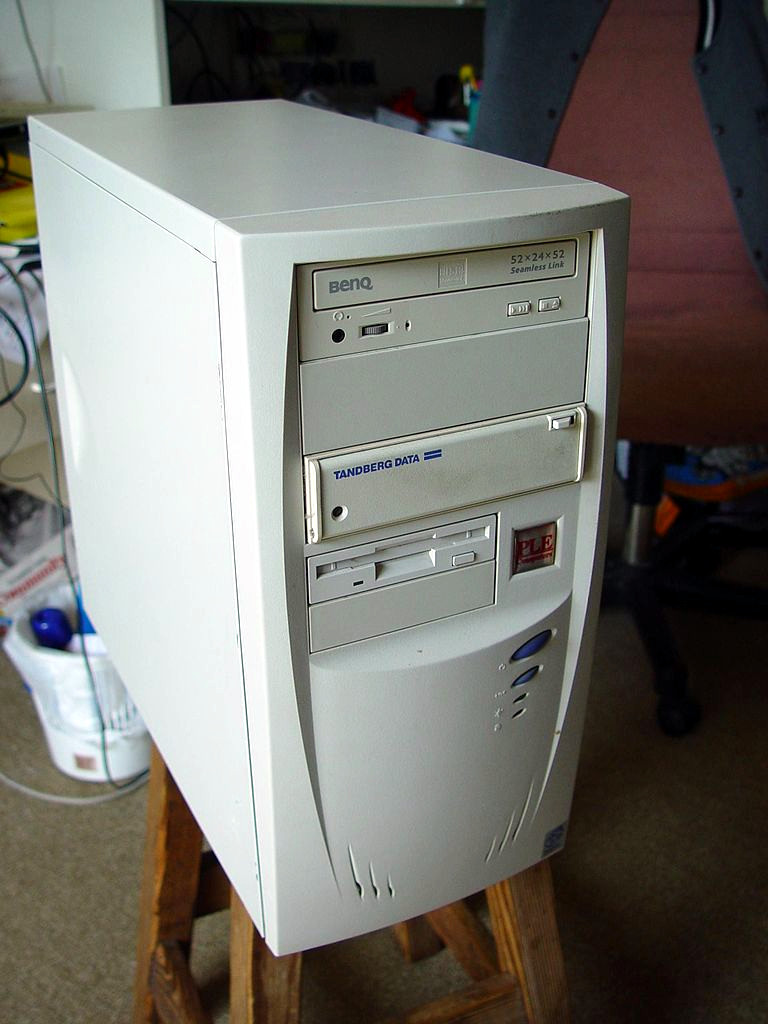
Any colour you want, as long as it’s beige. Leon Brooks, Public domain.

Computers in the 1990s were beige and boring. Breathtakingly so, a festival of the generic. If you had a PC it came in the same beige box as every single other PC, the only thing breaking the monotony being one of those LED 7-segment fake-MHz displays. Apple computers took the beige and ran with it, their PowerMac range being merely a smoother-fronted version of all those beige-box PCs. This was the period following the departure of Steve Jobs during which the company famously lost its way, and the Bondi blue Jonny Ive-designed iMac was the signature product of his triumphant return.

That’s enough pretending to have drunk the Apple Kool-Aid for one article, so  why are we marking this anniversary? The answer lies not in the iMac’s hardware, though its 233MHz PowerPC G3 and ATI graphics driving a 15″ CRT were no slouch for the day, nor even in its forsaking of all their previous proprietary interfaces for USB. Instead it’s the design influence of this machine, as it ushered in a new era of technological devices whose ethos lay around how they might be used rather than in simply showering the interface with features. At the time the iMac spawned a brief fashion for translucent blue in everything from peripherals to steam irons, but in the quarter century since your devices have changed immeasurably in its wake. We still don’t like that weird round mouse though.

Header image: Rama, CC BY-SA 4.0.

A Digital Camera For The 1984 Market

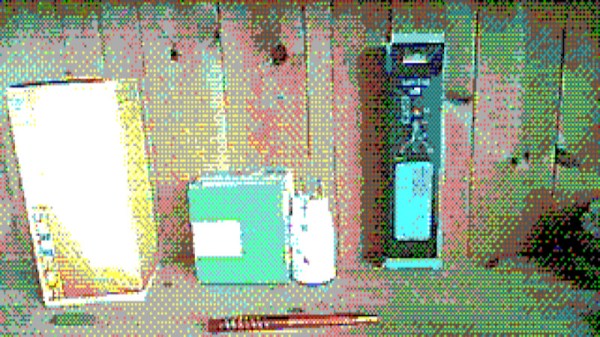
Digital cameras are a ubiquitous consumer and professional product here in 2023, and because of the wide availability of parts it’s relatively straightforward to construct one for yourself. Four decades ago though, film was king, but that hasn’t stopped [Georg Lukas] from building a digital camera for the 1984 market. The hardware is definitely from recent years, the extremely affordable ESP32-cam board that many of us will have worked with already. Meanwhile the 1984 part lies in the recording format, it makes EGA 16-colour low-res pictures and stores them in the archaic TGA file format.

A low-res camera is fun, but there are two other angles on this which are definitely worth some time. The first is that his description and code are worth a read for anyone with an interest in programming an ESP32 camera, while the second invites us to consider whether such a camera could have been made using parts available in 1984. We remember camera peripherals for 8-bit microcomputers which were a C-mount lens positioned over a decapped RAM chip, and thus we can’t help wondering whether an RGB split to three of those sensors could have been constructed. Whether a 6502 or a Z80 with 64k of memory could have processed the three images into one is another matter, but at least if any of you want to try there’s a handy 1984 computer still popping up on eBay.