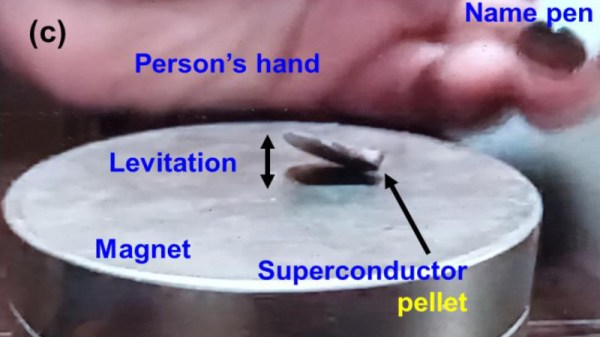
“Room Temperature Superconductor” LK-99, Just Maybe It Could Be Real

To have been alive over the last five decades is to have seen superconductors progress from only possible at near-absolute-zero temperatures, to around the temperature of liquid nitrogen in the 1980s and ’90s, and inching slowly higher as ever more exotic substances are made and subjected to demanding conditions. Now there’s a new kid on the block with an astounding claim of room-temperature and pressure superconductivity, something that has been a Holy Grail for physicists over many years.

LK-99 is a lead-copper-phosphate compound developed by a team from Korea University in Seoul. Its announcement was met with skepticism from the scientific community and the first attempts to replicate it proved unsuccessful, but now a team at Huazhong University of Science and Technology in China claim to have also made LK-99 samples that levitate under a magnetic field at room temperature and pressure. This is corroborated by simulation studies that back up the Korean assertions about the crystal structure of LK-99, so maybe, just maybe, room temperature and pressure superconductors might at last be with us.

Floating on a magnetic field is cool as anything, but what are the benefits of such a material? By removing electrical resistance and noise from the equation they hold the promise of lossless power generation and conversion along with higher-performance electronics both analogue and digital, which would revolutionize what we have come to expect from electronics. Of course we’re excited about them and we think you should be too, but perhaps we’ll wait for more labs to verify LK-99 before we celebrate too much. After all, if it proves over-optimistic, it wouldn’t be the first time.

Jenny’s Daily Drivers: FreeBSD 13.2

Last month I started a series in which I try out different operating systems with the aim of using them for my everyday work, and my pick was Slackware 15, the latest version of the first Linux distro I tried back in the mid 1990s. I’ll be back with more Linux-based operating systems in due course, but the whole point of this series is to roam as far and wide as possible and try every reasonable OS I can. Thus today I’m making the obvious first sideways step and trying a BSD-based operating system. These are uncharted waters for me and there was a substantial choice to be made as to which one, so after reading around the subject I settled on FreeBSD as it seemed the most accessible.

First, A Bit Of Context

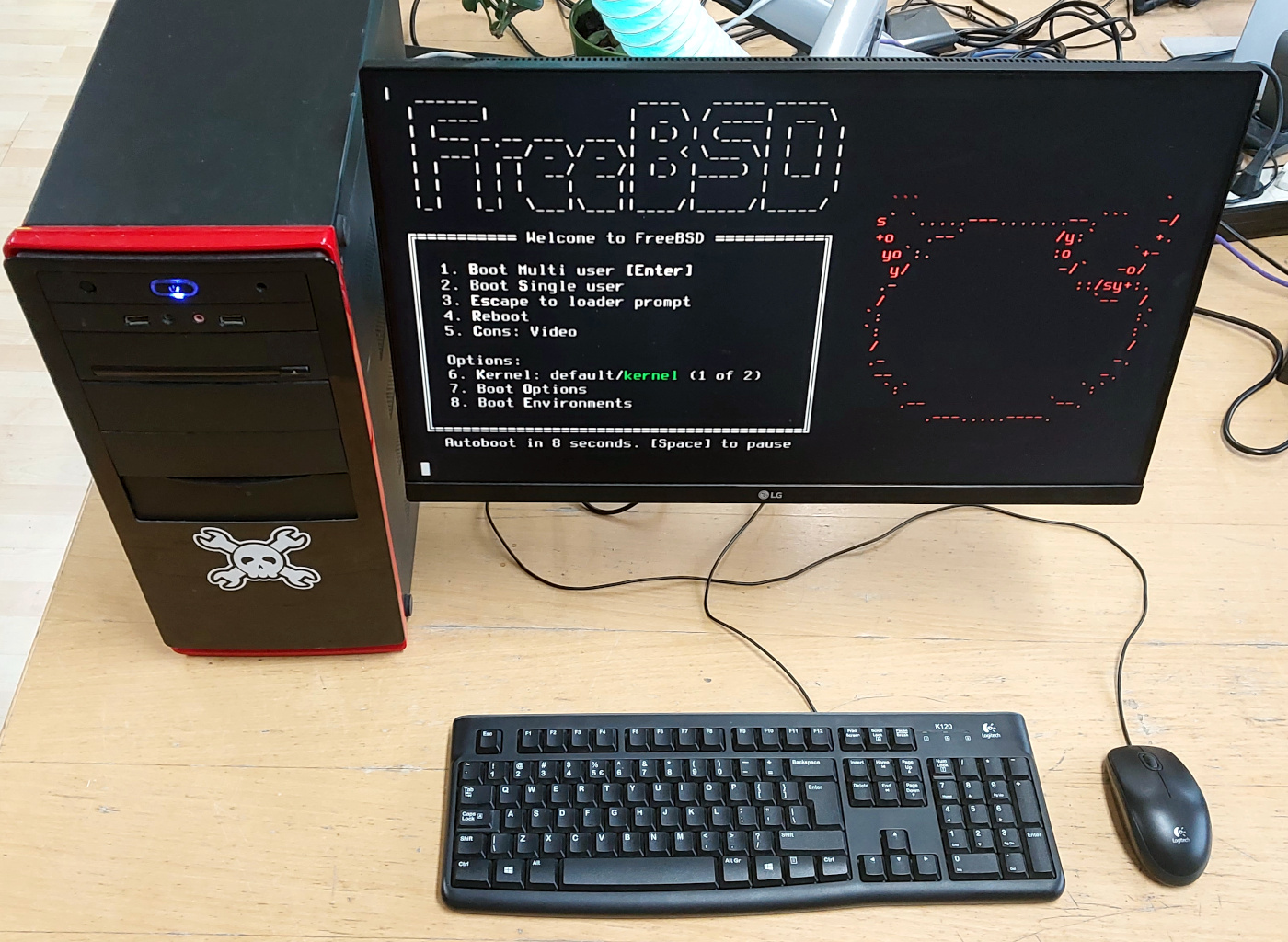
A PC with the FreeBSD boot screen
Success! My first sight of a working FreeBSD installation.

Most readers will be aware that the BSD operating systems trace their heritage in a direct line back to the original AT&T UNIX, while GNU/Linux is a pretty good UNIX clone originating with Linus Torvalds in the early 1990s and Richard Stallman’s GNU project from the 1980s onwards. This means that for Linux users there’s a difference in language to get used to.

Where Linux is a kernel around which distributions are built with different implementations of the userland components, the various BSD operating systems are different operating systems in their own right. Thus we talk about for example Slackware and Debian as different Linux distributions, but by contrast NetBSD and FreeBSD are different operating systems even if they have a shared history. There are BSD distributions such as GhostBSD which use FreeBSD as its core, but it’s a far less common word in this context. So I snagged the FreeBSD 13.2 USB stick file from the torrent, and wrote it to a USB Flash drive. Out with the Hackaday test PC, and on with the show. Continue reading “Jenny’s Daily Drivers: FreeBSD 13.2”

Just How Is Voyager 2 Going To Sort Out Its Dish Then?

Anybody who has set up a satellite TV antenna will tell you that alignment is critical when picking up a signal from space. With a satellite dish it’s a straightforward task to tweak the position, but what happens if the dish in question is out beyond the edge of the Solar System?

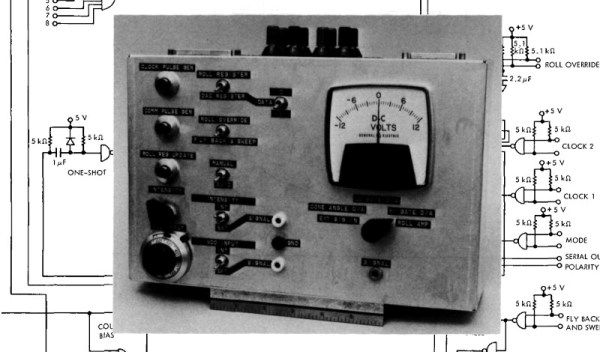
We told you a few days ago about this exact issue currently facing Voyager 2, but we’re guessing Hackaday readers will want to know a little bit more about how a 50+ year old spacecraft so far from home can still sort out its antenna. The answer lies in NASA Technical Report 32-1559, Digital Canopus Tracker from 1972, which describes the instrument that notes the position of the star Canopus, which along with that of the Sun it can use to calculate the antenna bearing to reach Earth. The report makes for fascinating reading, as it describes how early-1970s technology was used to spot the star by its specific intensity and then keep it in its sights. It’s an extremely accessible design, as even the part numbers are an older version of the familiar 74 logic.

So somewhere out there in interstellar space beyond the boundary of the Solar System is a card frame full of 74 logic that’s been quietly keeping an eye on a star since the early 1970s, and the engineers from those far-off days at JPL are about to save the bacon of the current generation at NASA with their work. We hope that there are some old guys in Pasadena right now with a spring in their step.

Read our coverage of the story here.

The British Government Is Coming For Your Privacy

The list of bad legislation relating to the topic of encryption and privacy is long and inglorious. Usually, these legislative stinkers only affect those unfortunate enough to live in the country that passed them. Still, one upcoming law from the British government should have us all concerned. The Online Safety Bill started as the usual think-of-the-children stuff, but as the EFF notes, some of its proposed powers have the potential to undermine encryption worldwide.

At issue is the proposal that services with strong encryption incorporate government-sanctioned backdoors to give the spooks free rein to snoop on communications. We imagine that this will be of significant interest to some of the world’s less savoury regimes, a club we can’t honestly say the current UK government doesn’t seem hell-bent on joining. The Bill has had a tumultuous passage through the Lords, the UK upper house, but PM Rishi Sunak’s administration has proved unbending.

If there’s a silver lining to this legislative train wreck, it’s that many of the global tech companies are likely to pull their products from the UK market rather than comply. We understand that UK lawmakers are partial to encrypted online messaging platforms. Thus, there will be poetic justice in their voting once more for a disastrous bill with the unintended consequence of taking away something they rely on.

Header image: DaniKauf, CC BY-SA 3.0.

A Game Boy Camera, Without The Game Boy

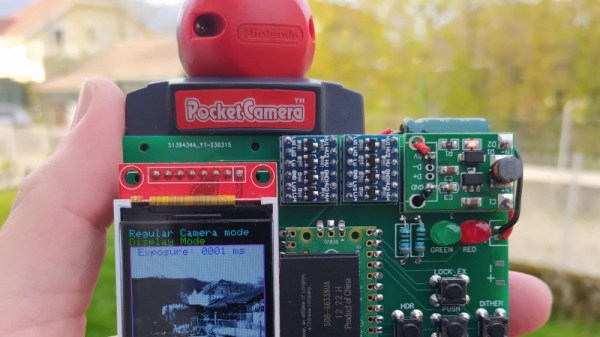
We all know the Nintendo Game Boy camera peripheral, and we’ve seen plenty of hacks for it on these pages over the years. We like [Raphael Boichot]’s camera then, as instead of including a Game Boy or emulating one, it talks directly to the sensor from an RP2040. The result is a standalone camera with slightly better quality than the original, and with near-limitless storage and easy retrieval of pictures.

For us the interesting revelation from this project comes in the light it sheds on the sensor module, the Mitsubishi M64282FP, but it’s no slouch as a camera beside that. There are motion sensor and timelapse modes, as well the ability to take high dynamic range pictures, and as if that’s not enough it also has all the tweakable things you’d expect from a “proper” camera. The oldest adage in photography is that the best camera in the world is the one in your hand, and we’d say that this one’s better than a real Game Boy Camera should the once-in-a-lifetime picture come while you’re holding it.

Of course, a better Game Boy camera needs a better lens, right?

Grab Your ‘Scope’s Screen From The Command Line

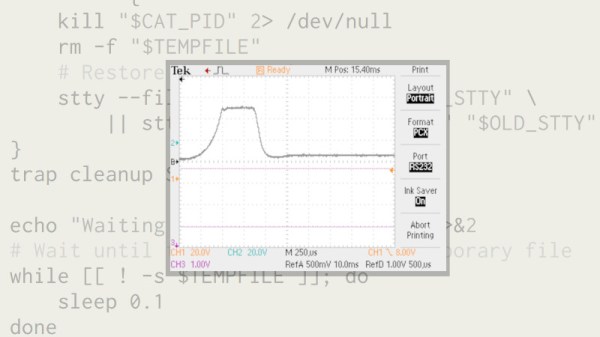
Many of us have oscilloscopes and other instruments with built-in digital interfaces, but how many of us use them? [Andrej Radović] has a Tektronix TDS2022 which can print its screen to any of its various interfaces, and he set about automating the process of acquisition with a Bash script.

The easiest interface to use was the trusty serial port — hardly the fastest but definitely the best supported. But how does one retrieve an image fired down a serial port? Most of the post is devoted to spotting file headers in a Bash script monitoring the serial port, and streaming the result to a local file. There’s a discussion of the various formats supported by the Tek, with an ancient PCX bitmap format being chosen over Postscript for speed. The result is a decent quality screen grab, making the ‘scope that little bit more useful and perhaps extending its life.

Perhaps your instrument isn’t a TEK, but the chances are you can still make it bend to your will from a PC. Try it, with the magic of VISA.

A Vintage Transistor Radio Gets A Repair

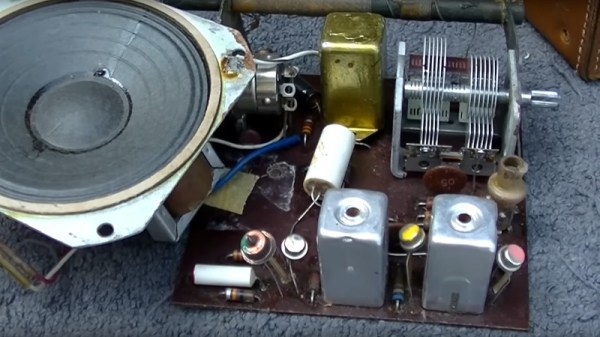
Here in 2023 the field of electronics covers a breathtaking variety of devices and applications, but if we were to go back in time far enough we’d enter an age in which computers were few and far between, and any automated control systems would have been electromechanical at best. Back in the 1950s the semiconductor industry was in relative infancy, and at the consumer end electronics were largely synonymous with radio. [Shango066] brings us a transistor radio from that era, a Jewel TR1 from about 1958, that despite its four-transistor simplicity to our eyes would have been a rare and expensive device when new.

As you’d expect, a transistor radio heading toward its 70th birthday requires a little care to return to its former glory, and while this one is very quiet it does at least work after a fashion. The video below the break is a long one that you might wish to watch at double speed, but it takes us through the now-rare skill of fault-finding and aligning an AM radio receiver. First up are a set of very tired electrolytic capacitors whose replacement restores the volume, and then it’s clear from the lack of stations that the set has a problem at the RF end. We’re treated to the full process of aligning a superhet receiver through the relatively forgiving low-frequency medium of a medium-wave radio. Along the way, he damages one of the IF transformers and has to replace it with a modern equivalent, which we would have concealed under the can from the original.

The video may be long, but it’s worth a look for the vintage parts if not for the quality of radio stations on the air today in California. For many readers, AM broadcast is becoming a thing of the past, so we’re not sure we’ll see this very often.

Continue reading “A Vintage Transistor Radio Gets A Repair”