It’s Difficult To Read An Audiophile Guide As An Analogue Engineer

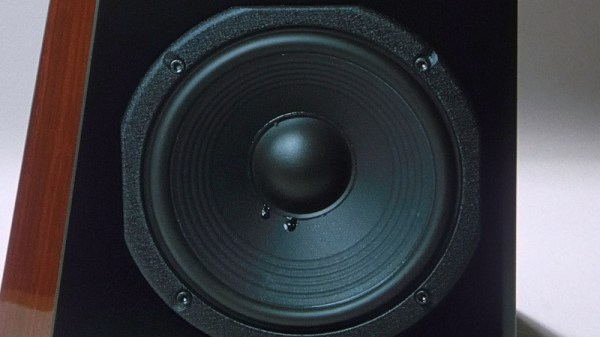
Sitting on a train leaving the Hackaday Berlin conference, and Hacker News pops up Julian Shapiro with a guide to HiFi. What Hackaday scribe wouldn’t give it a click, to while away the endless kilometres of North European Plain!

It’s very easy as an analogue electronic engineer, to become frustrated while reading audiophile tracts, after all they have a tendency to blur superficial engineering talk with pseudoscience. There’s a rich vein of parody to be found in them, but nevertheless it’s interesting to read them because just sometimes the writer gets it and doesn’t descend into the world of make-believe. Continue reading “It’s Difficult To Read An Audiophile Guide As An Analogue Engineer”

Gordon Moore, 1929 — 2023

The news emerged yesterday that Gordon Moore, semiconductor pioneer, one of the founders of both Fairchild Semiconductor and Intel, and the originator of the famous Moore’s Law, has died. His continuing influence over all aspects of the technology which makes our hardware world cannot be overstated, and his legacy will remain with us for many decades to come.

A member of the so-called “Traitorous Eight” who left Shockley Semiconductor in 1957 to form Fairchild Semiconductor, he and his cohort laid the seeds for what became Silicon Valley and the numerous companies, technologies, and products which have flowed from that. His name is probably most familiar to us through “Moore’s Law,” the rate of semiconductor development he first postulated in 1965 and revisited a decade later, that establishes a doubling of integrated circuit component density every two years. It’s a law that has seemed near its end multiple times over the decades since, but successive advancements in semiconductor fabrication technology have arrived in time to maintain it. Whether it will continue to hold from the early 2020s onwards remains a hotly contested topic, but we’re guessing its days aren’t quite over yet.

Perhaps Silicon Valley doesn’t hold the place in might once have in the world of semiconductors, as Uber-for-cats app startups vie for attention and other semiconductor design hubs worldwide steal its thunder. But it’s difficult to find a piece of electronic technology, whether it was designed in Mountain View, Cambridge, Shenzhen, or wherever, that doesn’t have Gordon Moore and the rest of those Fairchild founders in its DNA somewhere. Our world is richer for their work, and that’s what we’ll remember Gordon Moore for.

You can read our thoughts on Moore’s famous law. If you ever wondered how Silicon Valley became the place for electronics, the story is probably much older than you think.

A LEGO Camera You Just Might Own Yourself

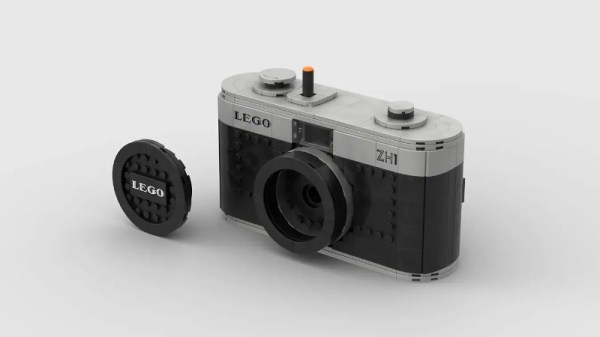
A camera makes for an interesting build for anyone, because it’s an extremely accessible technology that can be made from materials as simple as cardboard. More robust cameras often require significant work, but what if you could make a usable camera from LEGO? It’s a project taken on by [Zung92], who hasn’t simply made a working 35 mm camera from everyone’s favorite construction toy — he’s also managed to make it exude retro style. Best of all, you can vote for it on the LEGO Ideas website, and you might even get the chance to have one for yourself.

Frustratingly there’s little in the way of in-depth technical detail on the Ideas website, but he does mention that it was a challenge to make it light proof. Even the lens is a LEGO part, and if diffraction-based photography isn’t for you there’s also a pinhole option. We look forward to seeing this camera progress, and we hope we’ll see it advance to becoming a LEGO Ideas kit.

This is an extremely polished design, but surprisingly, it’s not our first LEGO camera.

Thanks [Michael] for the tip.

Digitizing Sound On An Unmodified Sinclair ZX81

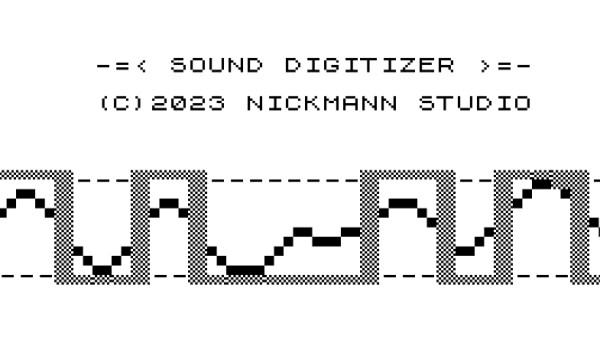
Whatever the first computer you used to manipulate digital audio was, the chances are it came with dedicated sound hardware that could play, and probably record, digitized audio. Perhaps it might have been a Commodore Amiga, or maybe a PC with a Sound Blaster. If you happen to be [NICKMANN] though, you can lay claim to the honor of doing so on a machine with no such hardware, because he managed it on an unmodified Sinclair ZX81.

For those of you unfamiliar with the ZX, it embodied Clive Sinclair’s usual blend of inflated promises on minimal hardware and came with the very minimum required to generate a black-and-white TV picture from a Zilog Z80 microprocessor. All it had in the way of built-in expansion was a cassette interface, 1-bit read and write ports exposed as 3.5 mm jacks on its side. It’s these that in an impressive feat of hackery he managed to use as a 1-bit sampler with some Z80 assembler code, capturing a few seconds of exceptionally low quality audio in an ’81 with the plug-in 16k RAM upgrade.

From 2023 of course, it’s about as awful as audio sampling gets, but in 1980s terms it’s pulling off an almost impossible feat that when we tried it with a 1-bit PC speaker a few years later, we didn’t succeed at. We’re impressed.

The ’81 may be one of the simplest of the 8-bit crop, but in its day it set many a future software developer on their career path. It’s still a machine that appears here today, from time to time.

A Studio Condenser Microphone For A Constrained Budget

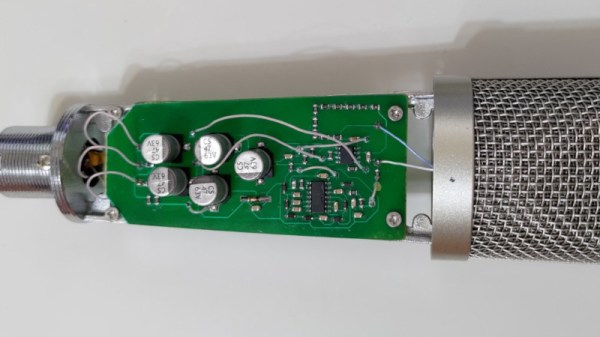
As the Internet has turned so many of us into content creators, we’ve seen the quality of webcams and microphones steadily increase to the point at which even a fairly modestly-equipped YouTuber now captures their wisdom at a quality far exceeding that you might have found in some broadcast studios not so long ago. Still, decent quality costs money, and for that reason [Spirit532] has built his own high quality condenser microphone for less expenditure.

The capsule and body are off-the-shelf items — what he’s produced is the bias voltage supply and preamplifier. In both cases these are the interesting parts of a condenser microphone, so their circuit bears a second look.

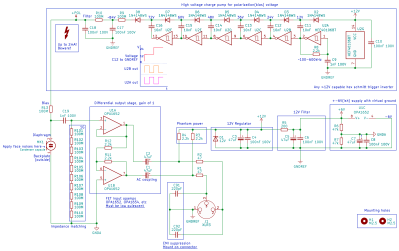
The condenser microphone takes a diaphragm and turns it into one side of a capacitor. If you apply a charge to this capacitor, the voltage over it changes minutely with the capacitance as the diaphragm vibrates. Thus to have a usable audio signal level a high-voltage bias supply is required to provide the charge, and a very high impedance preamplifier circuitĀ  to catch the signal without draining the capacitor.

His bias supply is a charge pump using a string of diodes and capacitors fed by a chain of CMOS inverters, with an RC filter and resistor chain to provide that super-high impedance. The preamplifier meanwhile is a unity gain high-impedance op-amp with an inverting stage to provide a balanced connection. For good measure the circuit also includes a phantom power supply.

This is an interesting project for anyone with an interest in audio. if you’re further interested in condenser microphones, how about also looking at electret microphones?

Info Sought On A Forgotten Cuban Radio

Some of the daily normalities of life in the Cold War seem a little surreal from our perspective in 2023, when nuclear bombers no longer come in to land just down the road and you can head off to Poland or Czechia on a whim. Radio amateurs were one of the few groups of civilians whose activities crossed the geopolitical divide, and even though an operator on the other side from ours couldn’t buy a shiny Japanese radio, their homebrew skills matched anything we could do with our Western soldering irons.

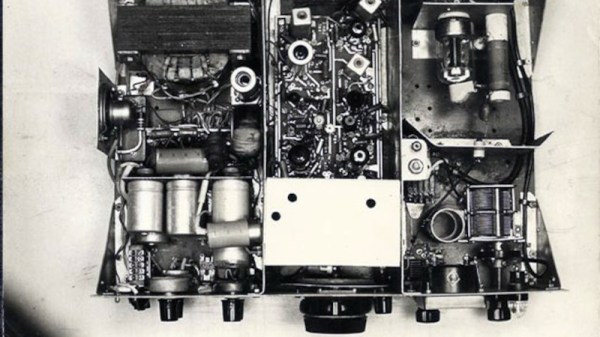
[Bill Meara N2CQR] is particularly interested in one line of Cold War-era Communist homebrew radios, the tube-based Cuban “Islander” and its solid-state “Jaguey” sibling. It’s a homebrew double-sideband transceiver design built using readily-available Soviet TV parts, and though he’s published what he can find, he’s on the lookout for more info about these interesting rigs.

The mechanics of a DSB transceiver are simple enough, in that an oscillator and balanced mixer can serve as both modulator and as direct conversion receiver. The fuzzy black and white photographs give frustratingly little detail, but we’re impressed by the quality of what we can see. We have readers all over the world (including we hope, some in Cuba), so perhaps if you know something about these radios you can give Joe a hand. It’s a design that deserves to be appreciated.

For more epic Cold War hackery on the Communist side, read our colleague [Voja Antonic]’s story of his personal computer odyssey.

New Part Day: TI Jumps In To The Cheap MCU Market

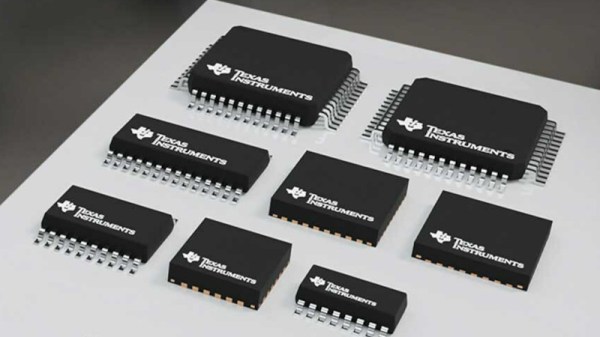
One of the interesting areas in the world of new parts recently has been at the lower end of the microcontroller market. Not because the devices there have new capabilities or are especially fast, but because they are cheap. There are now quite a few parts from China under 10 cents apiece, but have the Western manufacturers been able to follow suit? Not quite, but Texas Instruments has a new line of ARM Cortex M0+ parts that get under 40 cents in volume in their cheapest form.

That bottom-of-the-range chip is the MSPM0L1105, a single-core 32 MHz part with 32k of Flash and 4k of RAM. It’s got all the usual peripherals you’d expect on a small microcontroller, but the one which made our heads turn was the on-board 1.45-Msps ADC. On a cheap chip, that’s much faster than expected.

So there’s another microcontroller, and it’s not as cheap as some of its competition, so what? Aside from that ADC there are several reasons to be interested, it has TI’s developer support if you’re in that ecosystem, and inevitably it will find its way on to the dev boards and SBCs we use in our community. It remains to be seen how it will fare in terms of the chip shortage though.

Meanwhile, here’s a reminder of that cheaper competition.

Thanks to the several friends who delivered this tip.