This week’s Hackaday podcast is a European affair again, as Elliot Williams is joined by Jenny List on a summer evening to review the week. And we have a feast of hacks for your delectation.
As the title above says, one of the stand-out hacks this week was a set of airless mountain bike tyres 3D printed in glorious fluorescent TPU. They look as though they shouldn’t work but in fact they showed real promise, and we discuss the process behind their design. Then we take a look at a hybrid of a UV printer and an SLA 3D printer, capable of making high-resolution and robust 3D prints. The prospect of new Amigas intrigues us for a while, then carbon-fibre fabric in 3D prints.
Finally we’re in awe of the tech behind the Las Vegas Sphere, and we’re there for some radio at the Danish BornHack hacker camp. Follow that one up and you’ll find a bonus, an unofficial extra Hackaday podcast.
All the usual links are below, but before you head on down to have a listen, don’t forget we’ve got a mailbag for the podcast and we’d love to hear from you!
The story of Commodore, the famous manufacturer of home computers, is a murky one at best. Commodore fans will decry their woeful marketing and dismal product roadmap, while former employees such as our Hackaday colleague [Bil Herd] have shone a bit of light on the goings-on behind the scenes. The company’s final demise in the collapse of the German company Escom scattered its parts to the four winds, but now we find a potential return to clarity.
Amiga Corporation, holders of much of the Commodore and Amiga IP, have reached agreements with Commodore International Corporation, the recently formed face of the Commodore brand, and Hyperion Entertainment BV, who have been behind a series of Amiga developments over recent decades.
The press release provides a fascinating map of the Commodore and Amiga ecosystem as it stands in the 21st century, something which has sometimes eluded fans. As we understand it the rights to the 8-bit IP reside alongside the rights to the Amiga IP with Amiga Corporation, and it’s these 8-bit rights, or at least the software and documentation within them, that have been licensed to Commodore International Corporation. Meanwhile in a separate agreement the rights to continued development of AmigaOS 4.x remain with Hyperion, while the AmigaOS 3.x versions for the 68k Amigas will revert to Amiga Corporation at the end of 2027.
As far as we can see then, this should enable Commodore International Corporation to produce their line of 8-bit Commodore 64s and other machines, while Hyperion continue to serve the AmigaOS 4.x community. The interesting part comes in the AmigaOS 3.x versions, for which Amiga Corporation say they will continue to direct the development and evolution. Does that mean we’ll eventually see a 68k Amiga of some kind licensed through a company such as Commodore International Corporation? It’s an interesting prospect, and a story we’ll follow.
It’s time to return to our no-punches-pulled look at food manufacture, and this time we’re looking at the humble loaf of bread. As before, we’re approaching the subject with a look at breadmaking both in the traditional sense that marketing people would like you to imagine, and in the modern sense of the loaf you’ll find on your supermarket shelf.
A Food Of Great Cultural Significance
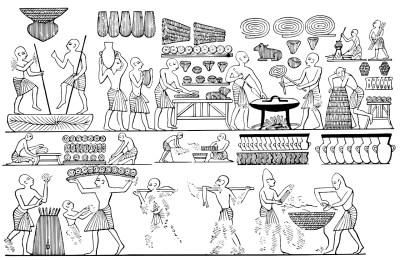
An ancient Egyptian bakery, depicted in the reign of Ramesses III. Scanned by Peter Isotalo, CC BY-SA 4.0.
Perhaps there are few foods with as much cultural significance as bread. If your distant ancestors took the path of growing grain as their major subsistence carbohydrate, the chances are there will be some form of bread woven into your identity. Where this is being written for example were I to head for the cathedral of a Sunday morning I would recite the Lord’s Prayer as part of the service, Give us this day our daily bread. Whether your culture leavens its bread or not, or whatever grain it uses, the chances are that there will be something similar about the humble foodstuff within it.
Over the years I have been to many hacker camps and done a lot of very cool things, but BornHack 2026 brought me something entirely new: Radio. By which I don’t mean radio in terms of amateur radio, LoRa, or whatever, but Radio. Broadcast radio, because the camp had a special event FM radio station for the first time. And because in a previous life I spent an inordinate amount of time in my university’s student radio station and have the Radio Voice to prove it, I was totally there for it.
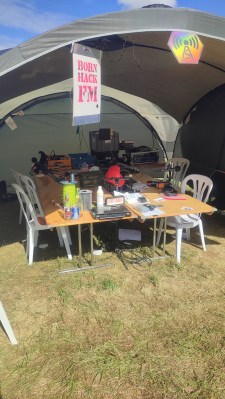
The BornHack Radio nerve centre.
For a hacker camp, one of the special things about BornHack Radio was unexpected, that it was entirely analogue. No online streams, the only broadcast was over the air, 5 watts ERP from a vertical antenna stuck on a mast at the highest point of the Hylkedam scout camp site. I don’t know whether any of the residents of the isle of Funen listened, or what they made of it, but it certainly reached as far as the two closest towns.
The other unexpected feature of the station was that it had no music licensing. Personally I viewed this as an asset, because it forced the programming to be hacker-focused rather than suit the musical tastes of whichever people are enthusiastic enough to be DJs. I sincerely hope they don’t get a music licence at future events, speech-only gives it a special quality.
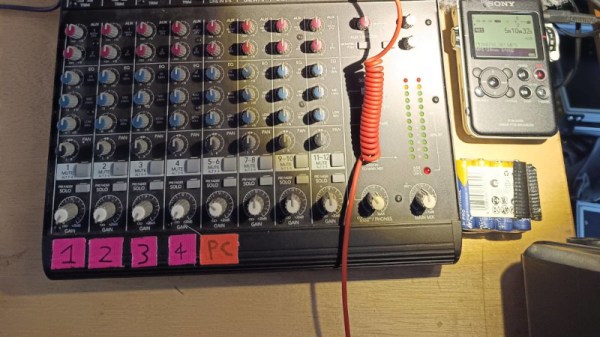
The studio for an analogue station like this one can be surprisingly simple, in that it’s a mixing desk to bring all the different microphones and other inputs together and set the levels, and not a lot else. the whole thing was in a Coleman shelter on the main drag through the camp, so as studios go it could have been quieter. Programming varied from talk shows through interview shows, a live feed from the speaker tent — is this the first ever Hacker Jeopardy broadcast? — and a beautifully done robotic numbers station which I suspect may also have been part of one of the on-camp games.
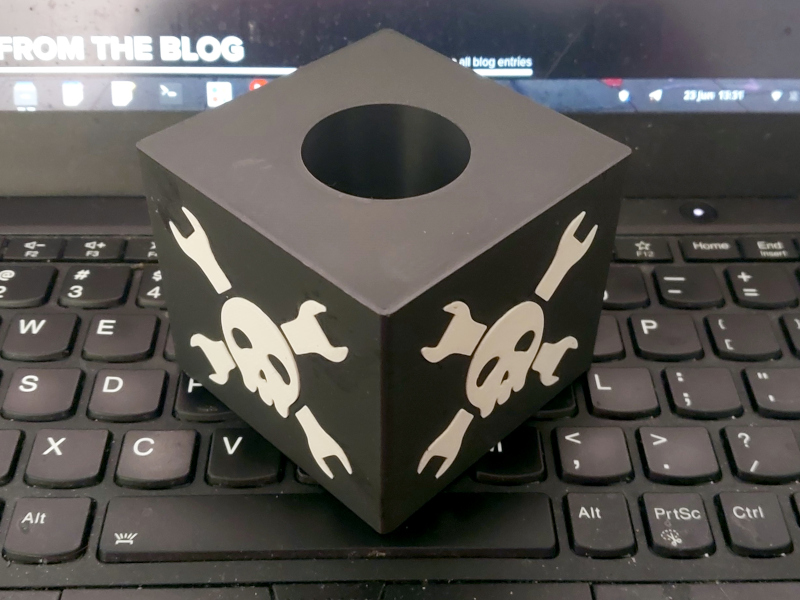
The thing that struck me most in my first foray into radio journalism was how straightforward it was. Wander the camp with microphone (complete with fluffy windshield and 3D-printed Hackaday cube), drop the results into Audacity, and a remarkably straightforward editing process compared to video. Last time I did this it involved 1/4″ tape and a razor blade.
So that was BornHack Radio, a new experience at a hacker camp both for those of us who ventured forth on the airwaves, and I hope also for the listeners. A format in which the live shows disappeared into the aether rather than having an online afterlife gave the whole thing a freedom rarely found in 2026. I really hope this isn’t the last time I break out the fluffy microphone at a hacker camp.
In the 1980s, France was the stage for one of the boldest public computing projects of the era. Minitel was the French take on viewdata, and instead of making it an expensive and unattainable luxury, they made the terminals universally available. Many Minitel services cost extra to use, but despite this it was a runaway success that lingered on into the 21st century.
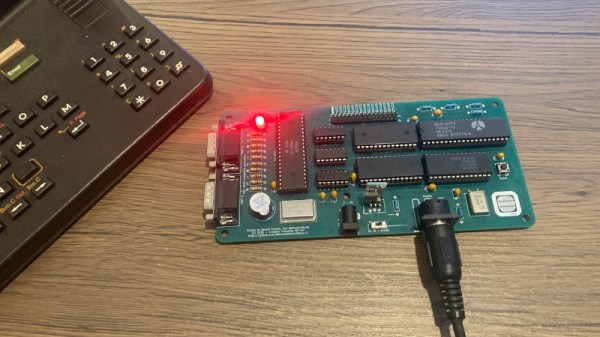
The ubiquitous terminals are now surplus to requirements, but that’s not to say they are useless. [MemoireMorte] has proved this with the Memo-1, a 6502-based computer designed to plug into a Minitel-1 terminal. It’s just the accessory your Minitel needs!
Hardware wise it’s a relatively conventional device with the usual RAM, ROM, and BASIC. There’s an expansion port, and a 6522 to provide a couple of Atari joystick ports. The serial port uses a a 6551 ACIA rather than the more usual W65C51 because of an incompatibility between the latter chip and the Minitel-1.
We like this computer, not because of novelty, after all it’s hardly the first 6502 we’ve seen, but because of its use of the Minitel terminal. These devices are magnificent, and deserve more love. We subjected another terminal to a teardown a year or two ago.
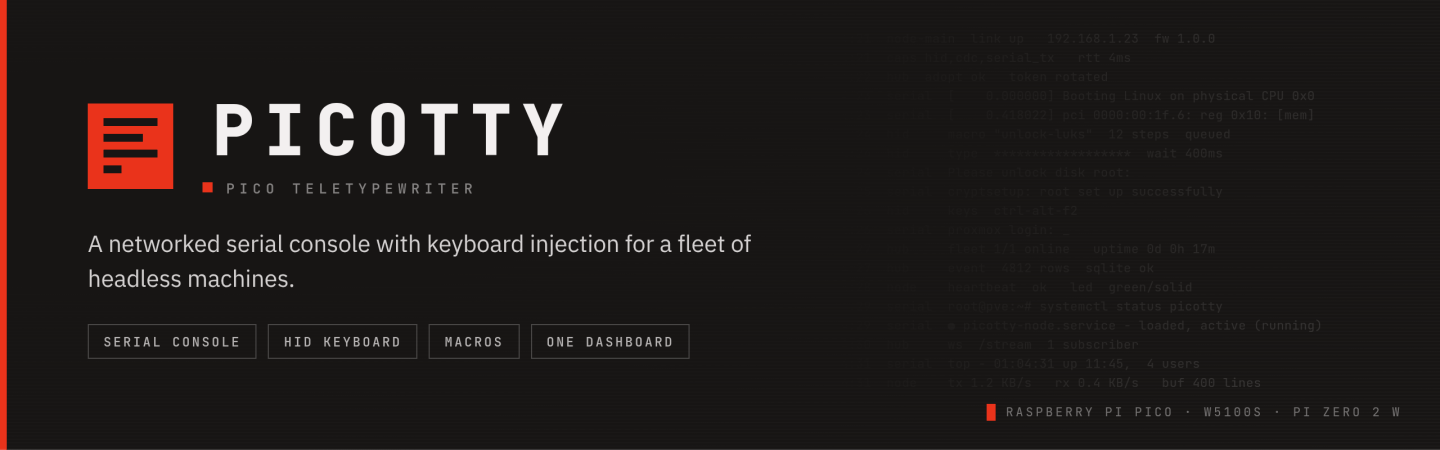
Many of us will be used to the idea of a KVM, a device that pipes keyboard, video, and mouse over the network from a remote machine to your own. But many remote machines don’t run a GUI, so there’s not always the need for a full video experience. Enter [morpheuslord] with the PicoTTY. It’s somewhere between an old-fashioned serial terminal and a KVM.
The system has two components, a Pi Pico which plugs in to the USB port of each client machine and connects to the network with a WIZnet W5100S Ethernet Hat, and a Pi Zero 2 W which forms the hub. The Pico acts as both a keyboard and a serial terminal, and streams both to the user via a web interface on the Zero.
We can see the use of a machine like this, but we have a few questions. Why for instance is the keyboard needed, given that the serial terminal could provide input in itself. But however it works we can see it might have a use in cases where a terminal can’t be accessed over the network directly, and we especially like it that a single USB peripheral does the job that a conventional KVM would use a bunch of cables for.
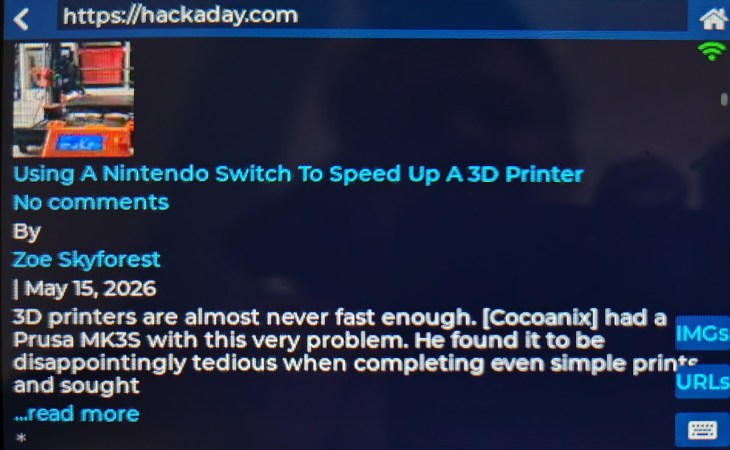
At the Hackaday Europe conference in Italy earlier in the year, we were shown a rather interesting device. The work of [Alun Morris], it was an ESP32-powered Cheap Black Display board, and it was running a web browser. Definitely an achievement.
Lest you imagine that it was sporting the latest and greatest in browser technology, we must disappoint you. The browser in question is a very basic text mode device, but it did happily retrieve Hackaday, which should be the only test a browser should need to pass.
Under the hood it’s running FreeRTOS, with separate HTML retrieval and tokenizing, and UI processes. It can fetch web pages directly, but there’s also a server-side proxy for difficult sites, and for creating image thumbnails.
An ESP32 is a powerful microcontroller, but it’s fair to say it’s not in the league of running a web browser and as far as we can remember this is the first one we’ve seen. We’re sure it’s a field with further progress to be made though, particularly with the more powerful recent chips in the series. This project however is a good start, and more importantly it can be yours for a few dollars on Ali to buy a dev board. What are you waiting for?