Fail Of The Week: This SD Card Won’t Slot

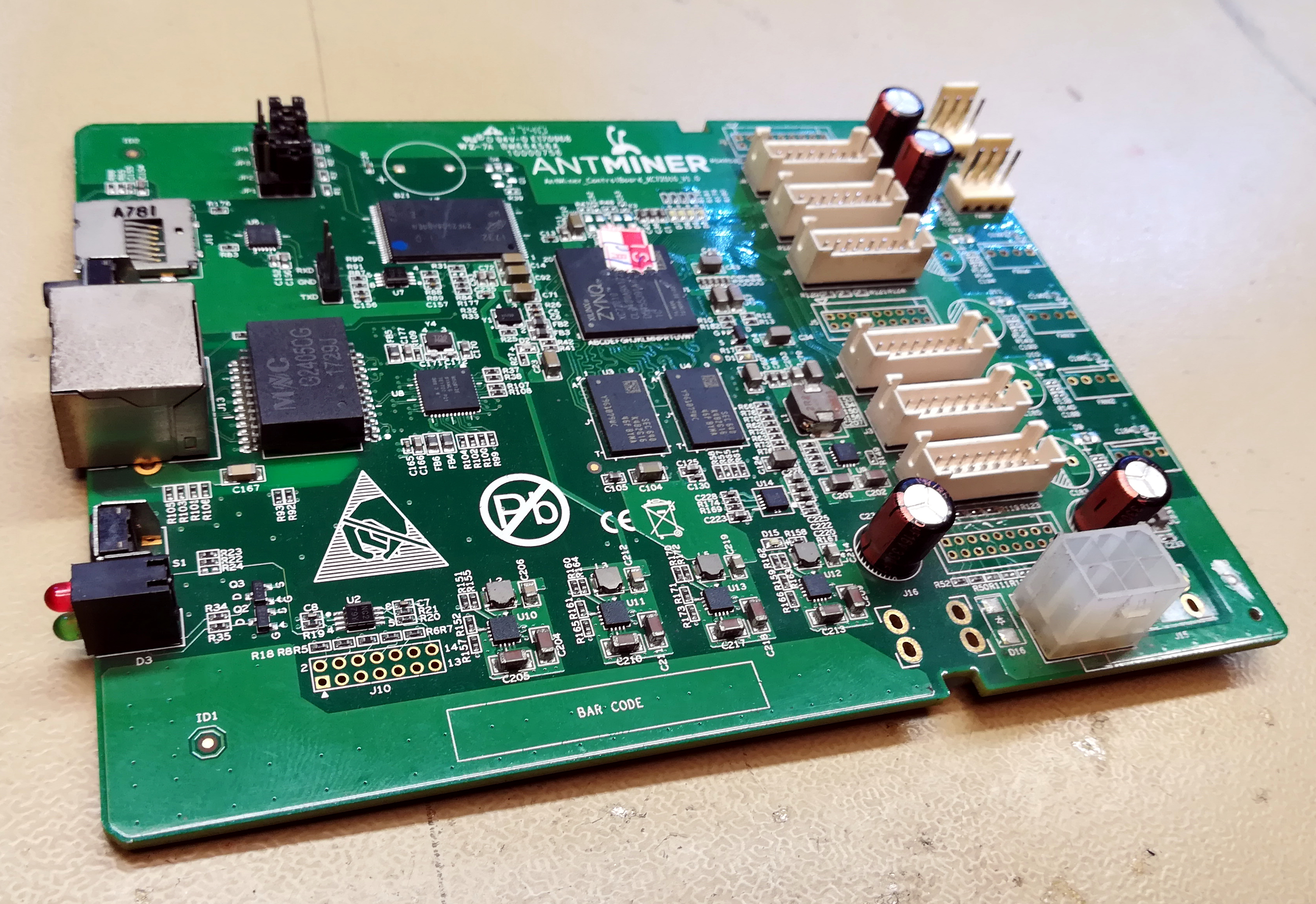
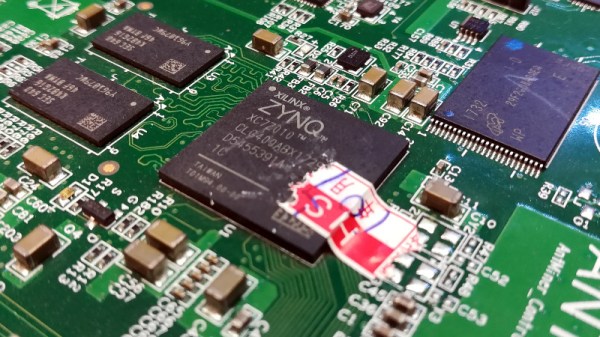
If you’ve got a few self-designed PCBs under your belt, you probably know the pain of missing some little detail and having to break out the bodge wires to fix it. So we feel for [Arsenio Dev], who placed an SD card slot next to an SoC, only to find that it was the wrong way round. Rather than tossing it in the bin, he decided to employ a particularly crafty set of bodge wires that curve over the board and connect to an SD card adapter on the other side.

Our attention was taken by the board itself, he’s posted little information about it and taken pains to conceal one of the pieces of text on it. Since it has an Octavo Systems BeagleBone-on-chip, a slot for a cellular modem, and a connector marked “CONNECT AERONET HERE” which we are guessing refers to the Aeronet sun photometry network, we’re guessing it might be a controller for remotely-sited nodes for that system. Either way it’s enough to have us intrigued, and we wish him every success with the next spin.

Meanwhile, this certainly isn’t the first PCB CAD fail we’ve brought you.

An Affordable Home Made Vacuum Chamber

The term “vacuum” means many different things depending whether you are working on space equipment, scientific instruments, or even internal combustion engines. In our sphere it is so often used as a means to draw bubbles out of resin castings, for which it is a relatively easily achievable partial vacuum. It’s something [Fab] is using, in a vacuum chamber made from Plexiglass.

A simple Plexiglass box would collapse under the air pressure on its own, so to mitigate that it’s made from a piece of tube, and with an internal frame of aluminium extrusion with 3D printed joints to strengthen it from the inside. A pressure sensor allows regulation of the pump that drives the vacuum, and connections are made to the chamber using pneumatic hose connectors. It’s not immediately clear how it is sealed, whether there are nay gaskets or other sealant, or whether air pressure pushing the parts together provides enough of a seal.

We’ve featured a lot of vacuum chambers made for this purpose over the years, and we’d be interested to know what vacuum pump is being used here. If  you’re curious too and want to build your own, perhaps you could try a fridge compressor.

A Dead Macbook GPU Shouldn’t Stop You, With This BGA Soldering Hack

On some 2011 Macbook Pro models, there is a tendency for the Radeon GPU to fail. This should mean game over for the computer, but surprisingly salvation is offered by its having not one but two GPUs on board. The Intel processor also has a GPU, and Apple use a pile of logic in an FPGA to switch at will between them. The community have produced fresh FPGA code to revive a dead Mac on its Intel GPU, but at the expense of losing brightness control. [Ayilm1] has brought back the brightness with a clever BGA reworking hack that gains access to a brightness control line present on the Intel BD82HM65 Platform Controller Hub chip but not used in the Macbook.

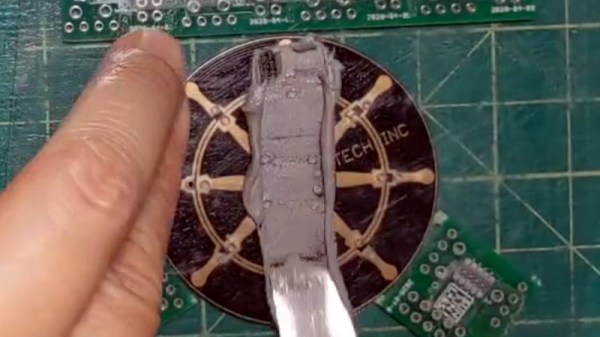
We’re used to impressive soldering work here at Hackaday, and we’ve seen our share of wiring direct to the balls on an upturned BGA chip. This is a similar idea but at another level, as a section of the top insulation on an in-place BGA is removed to expose the microvia above the ball carrying the required signal. A tiny wire is soldered to the exposed pad and taken to a piece of copper tape stuck down to provide mechanical strength, and a piece of enameled copper wire is run from that to the other side of the PCB where lies its destination. It comes with FPGA code to take advantage of it, but even for non-Macbook owners, it’s an extremely impressive piece of work. It’s not the first fine-soldering Macbook fix we’ve seen, either.

Thanks [lightpink784] for the tip.

433 On A Stick

Cheap 433 MHz wireless switches are a tempting way to enter the world of home automation, but without dedicated hardware, they can be less easy to control from a PC. That’s the position [TheStaticTurtle] was in, so the solution was obvious. Build a USB 433 MHz transceiver.

At the computer end is a CH340 USB-to-serial chip and the familiar ATmega328 making this a compact copy of the Arduino. At the RF end are a pair of modules for transmit and receive, unexpectedly with separate antennas. This device is a second revision, after initial experiments with a single antenna connector and an RF switch proved not to work. On the software side the Arduino uses the rc-switch library, while on the PC side there’s a Python library to make sense of it all. The code and hardware files are all on GitHub, should you wish to experiment.

The problem of making a single antenna transceiver is not for the faint-hearted RF engineer, as while diode switches seem on paper to deliver the goods, they can be extremely difficult to get right and preserve linearity. We’re curious that a transceiver module wasn’t used instead, but we’re guessing that cost played a significant part in the equation.

Over the years we’ve featured quite a few fascinating 433 MHz projects, like this TP-Link router conversion.

The Trouble With Tamagotchis…

The must-have toy of a couple of decades ago was the Tamagotchi, a virtual pet in an LCD screen on a keyring, that demanded your attention and which would die were you to neglect it. Fortunately it had a reset button on the back through which it could be resuscitated, but even so it lacked a satisfying tactile experience. [Nadine] has done something about this with her Tamagotchi-style Tribble, an anthropomorphic ball of fluff that demands attention and purrs when it receives some.

Inside the ball of fake fur is an Adafruit Circuit Playground with a capacitive touch pad and a haptic motor. After a random time with no attention it “cries”, and its owner strokes it, after which it responds with a purring vibration. It’s quite cute as you can  see in the Twitter video below, and fortunately it won’t multiply and fill up your starship. We wonder whether a small resistive heater to give it a body temperature would complete its appeal as a virtual pet.

Given the popularity of Star Trek TOS among Hackaday readers perhaps it’s surprising that we don’t see more Tribble related projects. They have made a notable appearance as a DEF CON badge though.

Continue reading “The Trouble With Tamagotchis…”

Double The RAM Of A Dreamcast Console For A Cool 32 MB

The Sega Dreamcast is the forgotten orphan of the console wars, an extremely capable machine never able to escape the shadow of its PlayStation rivals and because it marked the end of Sega’s console line, never redeemed in reputation by a more popular successor. It retains a significant following a couple of decades after its heyday though, and still sees hardware hacks such as [Tsowell]’s doubling of its available RAM to 32 MB.

The console shipped with 16 MB of memory in two banks, but while the SH4 processor can address twice that figure the designers at Sega never brought the required address line out from under the BGA. So it should be impossible to give it a memory expansion, but when hardware hackers are at work nothing should be ruled out. The hack involves manipulation of the bank switching addressing, and took several careful readings for us to fully understand. The new RAM chips have two address lines tied together and wired to another, a job for some fine but ultimately not impossible soldering. To take advantage of the extra RAM there are a set of patched BIOS images.

So, if you either have a spare Dreamcast you care little enough about to risk, or you consider your console hacking skills to be so advanced that it will be a piece of cake, you can now double the platform’s RAM. Extra points if you also make it portable.

Thanks [John Little] for the tip.

Header: Evan-Amos / CC BY-SA 3.0

Ask Hackaday: Is Our Power Grid Smart Enough To Know When There’s No Power?

Just to intensify the feeling of impending zombie apocalypse of the COVID-19 lockdown in the British countryside where I live, we had a power cut. It’s not an uncommon occurrence here at the end of a long rural power distribution network, and being prepared for a power outage is something I wrote about a few years ago. But this one was a bit larger than normal and took out much more than just our village. I feel very sorry for whichever farmer in another village managed to collide with an 11kV distribution pole.

What pops to mind for today’s article is the topic of outage monitoring. When plunged into darkness we all wonder if the power company knows about it. The most common reaction must be: “of course the power company knows the power is out, they’re the ones making it!”. But this can’t be the case as for decades, public service announcements have urge us to report power cuts right away.

In our very modern age, will the grid become smart enough to know when, and perhaps more importantly where, there are power cuts? Let’s check some background before throwing the question to you in the comments below.

Continue reading “Ask Hackaday: Is Our Power Grid Smart Enough To Know When There’s No Power?”