High Power LoRa And Tropospheric Reflection Experiments

We’re used to LoRa as a free-to-use digital radio protocol allowing not-very-high data rate communications over distances of a few miles. It’s made all kinds of distributed sensor systems a breeze, and some experimenters have made an art of achieving communication over hundreds of miles. But what would happen if you took a brute-force approach to LoRa and simply wound up the power?

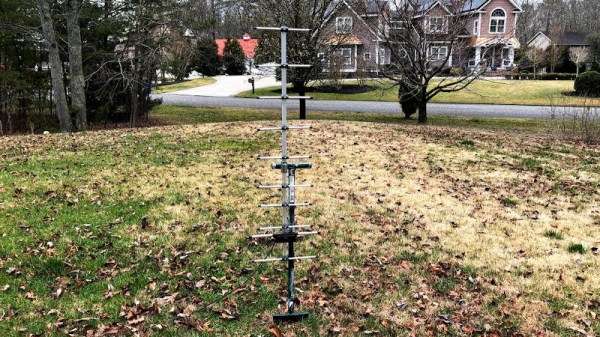
In a bid to test its efficiency at bouncing off the troposphere in normal conditions, [Inductive Twig] hooked up a HamShield 70cm LoRa shield to an 80W power amplifier and a high-gain Yagi antenna pointing directly upwards mounted with ingenuity on a spade, and drove around looking at the received result. With an effective radiated power of 1500W this wasn’t your normal LoRa, instead being operated with LoRa as an amateur radio mode.

For those not familiar with radio propagation, radio waves bounce off some surprising things. In this case the aim was to bounce them off the troposphere, but while radio amateurs and LoRa distance chasers wait until weather conditions deliver a so-called “lift” in which the troposphere is especially reflective, here the experiment was performed under normal flat conditions. The result characterizes LoRa’s possibilities for everyday extreme-range mode rather than chasing records, and in that there were some interesting results. The reflected signal was receivable in bursts with low but consistent signal strength, with the limiting factor during the test as that they ran out of land upon which to drive in the southernmost peninsula of New Jersey. We’ve heard of War-Driving for open WiFi… does this car dashboard setup count as LoRa-Driving?

LoRa is designed as a protocol tolerant of low signal levels and some packet loss, so this experiment is an interesting demonstration of its possibilities when used at higher powers under a licensed transmission. It shouldn’t be possible to use the 70cm band for reliable tropospheric propagation under non-lift conditions, but this shows that it can be done. Meanwhile, take a look at a previous attempt to push LoRa using a balloon.

How Constant Is Your Choice Of Lights?

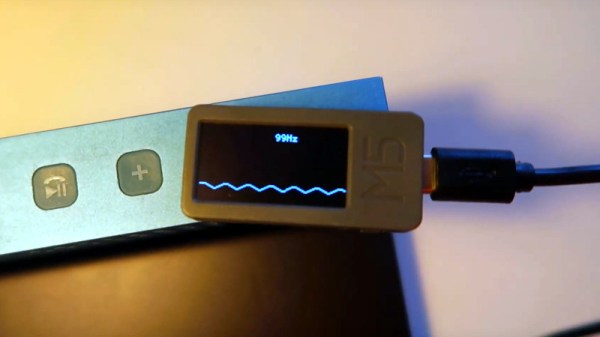
The move from incandescent filament lamps to fluorescent, and then LED lighting over the last couple of decades has delivered immense benefits in terms of energy saving, but had brought with it problems for people sensitive to flicker or to too much of a particular set of wavelengths. It’s not always easy to quantify the propensity of a particular light for flickering. So [kk99] has produced an instrument returning a visual indication of its quality.

At its heart is an M5Stick ESP32 development platform, and a TSL250R light sensor hooked up to one of the ESP’s internal ADCs. The flicker waveform is displayed on the screen as a simple oscillograph, and a Fourier transform is performed to extract its frequency. The result is an extremely accessible and compact instrument, showing the suitability of the M5Stick form factor for such designs. So far we’ve only brought you an M5Stick in a password keeper, but we look forward to seeing more projects featuring it.

You can see the light flicker meter in action in the video below the break.

Continue reading “How Constant Is Your Choice Of Lights?”

Thousands Of Internet-Connected Satellites Above Us, What Could Possibly Go Wrong!

Our skies are full of satellites, more full than they have been, that is, because SpaceX’s Starlink and a bevvy of other soon-to-launch operators plan to fill them with thousands of small low-earth-orbit craft to blanket the Earth with satellite Internet coverage. Astronomers are horrified at such an assault on their clear skies, space-watchers are fascinated by the latest developments, and in some quarters they’re causing a bit of concern about the security risk they might present. With a lot of regrettable overuse use of the word “hacker”, the concern is that such a large number of craft in the heavens might present an irresistible target for bad actors, who would proceed to steer them into each other can cause chaos.

Invest in undersea cables, folks, the Kessler Syndrome is upon us, we’re doomed!

Continue reading “Thousands Of Internet-Connected Satellites Above Us, What Could Possibly Go Wrong!”

A Practical Dual-Arm SCARA 3D Printer

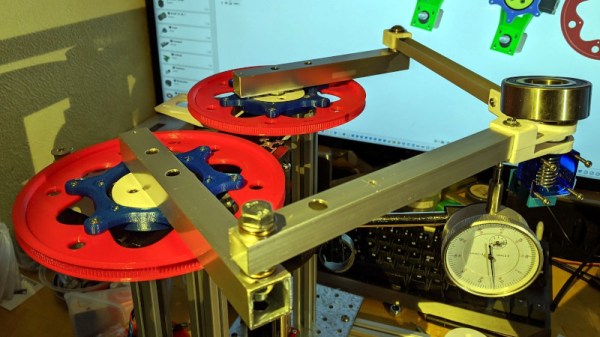
We see a lot of 3D printers here at Hackaday, but as over the years the 3D printer has moved from being an exciting item in its own right to being an everyday tool, it’s increasingly rare for us to feature a build of one as a project. It’s especially rare for us to see a 3D printer that isn’t a variation of either an XYZ Cartesian design or a delta printer, but that’s what [bondus] has done with a printer based upon a parallel SCARA mechanism. If SCARA isn’t something you’re familiar with, it’s a design used in the world of industrial robots in which an almost humanoid jointed arm works in two dimensions, with the third being provided by raising or lowering the whole construction. It has the advantage of greater speed than Cartesian designs, at the expense of higher quality joints being required to maintain accuracy of positioning.

This is the second SCARA printer he’s built, and has a sturdy set of aluminium arms and substantial bearings. Drive comes via a pair of belts to some very large pulleys, and calibration is extremely important to ensure that both arms are in exactly the same plane. The curcular bed is on a lead screw that provides the Z axis.

The results are certainly impressive, both is speed and in print quality. We’ve placed a video of it in action below the break. Whether or not SCARA printers improve to the point of being ubiquitous isn’t something we can supply an answer to, but we’ve featured a small number of them in the past. Particularly memorable is this one using an industrial robotic arm.

Continue reading “A Practical Dual-Arm SCARA 3D Printer”

Can A CPAP Fan Become A Ventilator?

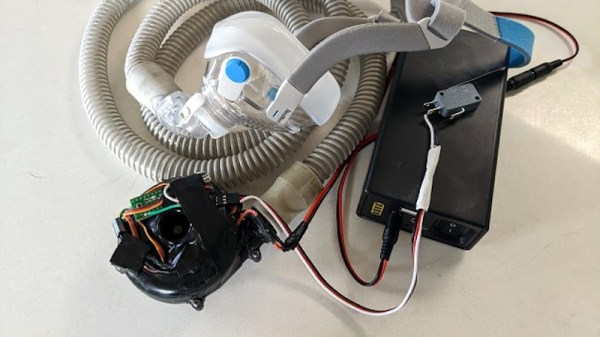
Watching the hardware community respond to the global pandemic is a fascinating process, because of the breadth of projects being considered, and also because of the differing experiences and perspectives being brought to the table. Components most of us might have been unaware of are appearing, such as the CPAP blower used by [Jcl5m1] in his ventilator design.

He starts with a very necessary disclaimer against trusting a random person on the Internet on the subject of medical equipment design, and since it must be possible to do damage with an inappropriate ventilator we can only echo that. But as a CPAP user he’s familiar with their operation and parts, and he’s taken the centrifugal blower from one of them and paired it with a speed controller and an Arduino to provide an adjustable pressure.

What we take away from this is not in any way a ventilator that’s ready to be hooked up to sick patients, but an interesting look at ventilators in general, CPAP components, and the possibility that this project and others like it might eventually form the basis of something more useful if they attract the attention of people with more experience in the field. We’ve already seen 3D-printing used to make valves for a respirator at a hospital in Italy.

Review: The Riden RD6006W DC Power Supply Module

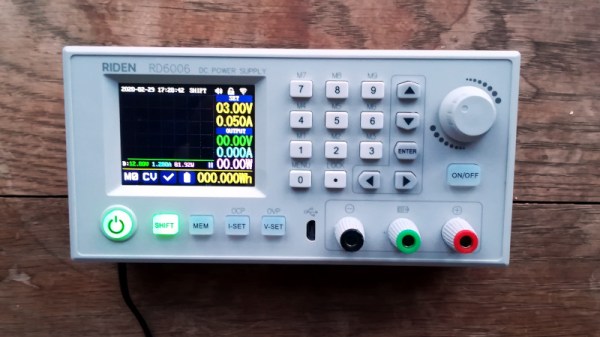
You may have seen the Ruideng range of programmable power supply modules from China: small and relatively inexpensive switch-mode buck converters, with microprocessor control and a front panel featuring a large colour OLED screen. Given 30 volts or so they can supply any lower voltage with the extra bonus of current limiting. They’ve been so successful over the several years they’ve been available that they’ve even spawned their own Chinese clones, and countless hacker projects, for instance on the DPS300X and DPS500X models.

Late last year a new module came from Ruideng, the Riden-branded RD6006 combines the basic idea of the previous modules with an extremely flexible front panel with full keypad and rotary encoder, creating something like the front panel to a decent bench power supply but without the accompanying power supply. I ordered one, waited for it to clear customs, took it to my bench, and reviewed it. Continue reading “Review: The Riden RD6006W DC Power Supply Module”

Manual To Hydraulic Press, With A Paint Sprayer

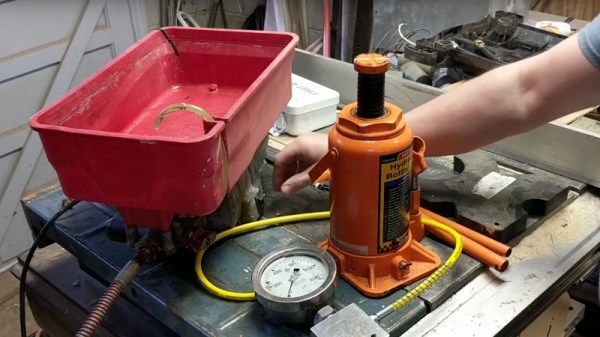
A press can be one of the most useful additions to a workshop, once you have one you will wonder how you ever coped beforehand when it came to all manner of pressing in and pushing out tasks. An arbor press with a big lever and ratchet is very quick to use, while a hydraulic pressĀ  gives much higher pressure but is extremely slow. [The Buildist] missed out on an arbor press, so turned his eye to improving the speed of his hydraulic one. The solution came from an unexpected source, an airless paint sprayer that had come his way because its valves were gummed up with paint.

An airless paint sprayer is simply a high pressure pump that supplies paint to a nozzle, and that pump is easily repurposed to pump oil instead of paint. Testing revealed it could produce a pressure of 3000 PSI, which would be plenty to move the hydraulic jack even if the hand pump would be needed to finish the job when higher force was required.

What follows over two videos is a masterclass in hydraulic jacks, as he strips down the jack from his press, and modifies it not only to take an input from the pump, but also to run inverted by the addition of an oil reservoir pick-up pipe. Along the way we learn a few useful gems such as the fact that a grease gun pipe is the same as a hydraulic pipe, but much cheaper.

The result is a jack that extends quickly, and has the pressure to do most pressing tasks without the hand assistance. He crushes a drinks can for effect, then pinches the end of a piece of pipe, because given a press, why wouldn’t you! Take a look at both videos below the break.

Continue reading “Manual To Hydraulic Press, With A Paint Sprayer”