How Low Can An ESP32 Go?

Many of us have experimented with the ESP32 microcontroller, attracted by its combination of WiFi and a powerful processor core, but how many of us will have explored all of its many on-board features? One of the more interesting capabilities of this chip comes in the form of its ultra-low-power (ULP) co-processor, an extra core that allows an ESP32 to function while sipping tiny quantities of power with the ever-hungry main cores turned off.

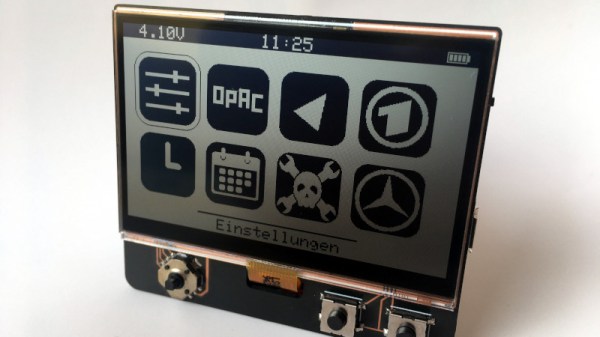
It’s a feature that [Max Kern] has used to great effect in his low power ESP32 handheld computer, where he’s paired the chip with a low-power Sharp Memory LCD and used the ESP32’s ULP core to keep the display alive while the ESP cores are sleeping. Software wise the device sports basic PDA and clock functionality including an RSS parser, all of which can be seen in the video below the break. Its inspiration came from Panic’s crank-equipped Playdate console, with which it shares the Sharp display.

Seeing this device reminds us of some of the badges featuring ESP32 power that we’ve seen over the last few years. An event badge creator has a constant battle to give the device enough battery life to last the distance. It’s a problem the designers of the SHA 2017 badge solved with an e-ink unit, but perhaps the Sharp display could offer a cost-effective alternative for new designs.

Continue reading “How Low Can An ESP32 Go?”

Organic Audio: Putting Carrots As Audio Couplers To The Test

[Boltz999]'s carrot interconnect.
[Boltz999]’s carrot interconnect.
If there’s one thing that gives us joy here at Hackaday it’s a story of audio silliness. There is a rich vein of dubious products aimed at audiophiles which just beg to be made fun of, and once in a while we oblige. But sometimes an odd piece of audio equipment emerges with another purpose. Take [Boltz999]’s interconnects for example, which were born of necessity when there were no female-to-female phono adapters to connect a set of cables. Taking a baby carrot and simply plugging the phonos into its flesh delivered an audio connectivity solution that worked.

Does this mean that our gold-nanoparticle-plated oxygen-free directional audio cables are junk, and we should be heading for the supermarket to pick up a bag of root vegetables instead? I set out to test this new material in the secret Hackaday audio lab, located on an anonymous 1970s industrial estate in Milton Keynes, UK.

Continue reading “Organic Audio: Putting Carrots As Audio Couplers To The Test”

Datacenter UPS Heads Home For Off-Grid Power Solution

The news sites seem never to be without stories of Elon Musk and his latest ventures, be they rapid transit tube tubes in partial vacuum, space flight, or even personal not-a-flamethrowers. Famous for electric vehicles, Musks’s Tesla also has a line of solar products and offers the Powerwall home battery power system. These are tantalizing to anyone with solar panels, but the price tag for one isn’t exactly a dream.

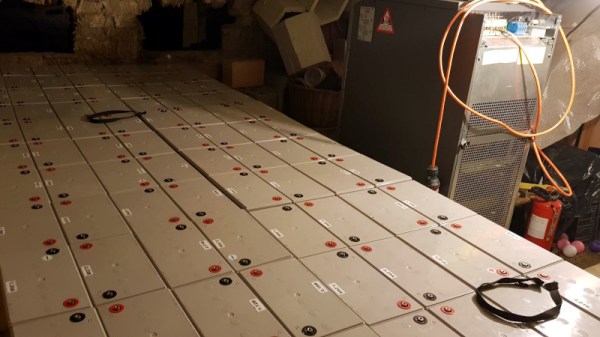
[Nathann]’s budget couldn’t stretch to a Powerwall, but he did have access to a hefty ex-datacentre uninterruptible power supply (UPS) and a large quantity of lead-acid cells. From this he built his own off-the-grid power in the cellar of the home. It’s not as elegant as a Powerwall, but it can power the house on moderate usage, so he claims, for up to ten days.

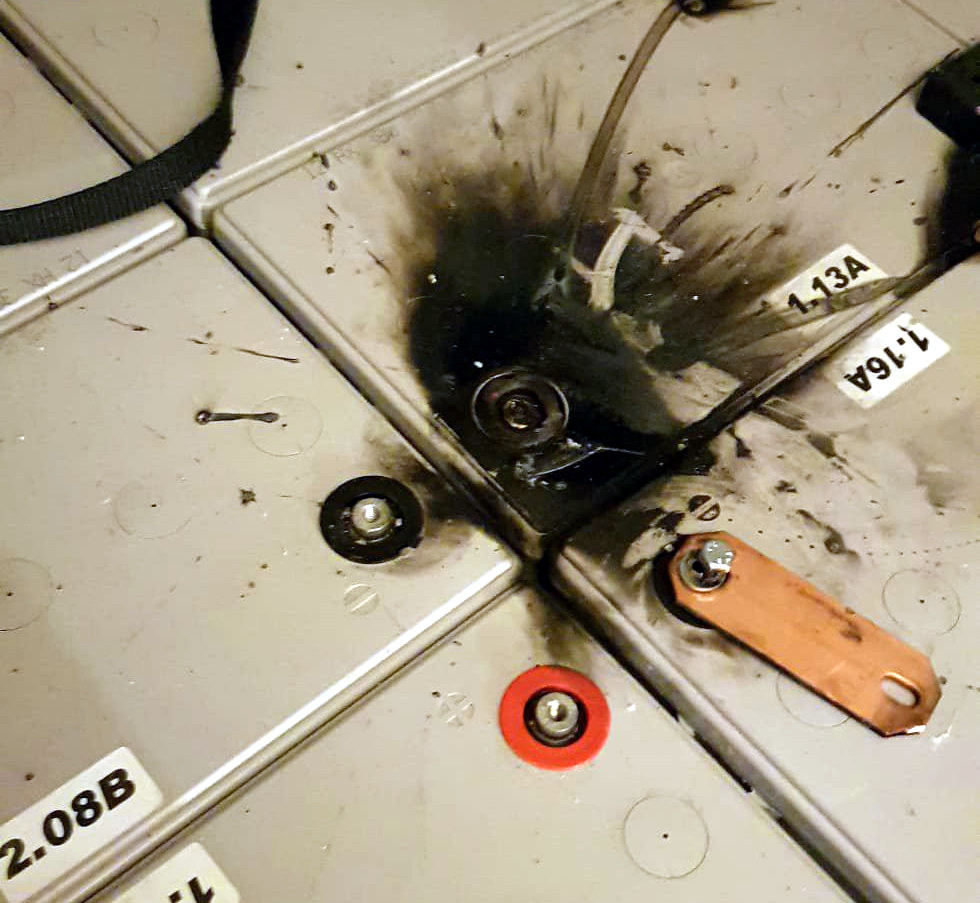
On one level the installation is more of a wiring job than one of high technology, but the logistics of dealing with nearly 100 lead-acid cells are quite taxing. The UPS takes four battery packs, each clocking in at 288 V. The cells are joined with copper straps, and the voltage and current involved is not for the faint-hearted. An accidental short vaporized a screw and a battery terminal; if this were our house we’d put fuses in the middle of the battery packs.

The batteries are stored on wooden pallets atop brick pillars in case the cellar floods. The basement installation now is ready for the addition of solar and wind-based off-grid sources. Maybe your battery power solution will be less hair-raising, but it’s unlikely to be cheaper. Meanwhile this isn’t the first such project we’ve seen, though others usually go for 18650 Li-Ion cells, the use of lead acid remains a viable and economical solution.

Ask Hackaday: How Do You Keep The 3D Printer From Becoming EWaste

One thing we sometimes forget in our community is that many of the tecniques and machines that we take for granted are still something close to black magic for many outsiders. Here’s a tip: leave a 3D printer running next time you take a group of visitors round a hackerspace, and watch their reaction as a Benchy slowly emerges from the moving extruder. To us it’s part of the scenery, but to them it’s impossibly futuristic and their minds are blown.

Just because something says it's a Prusa i3, doesn't mean it is a Prusa i3.
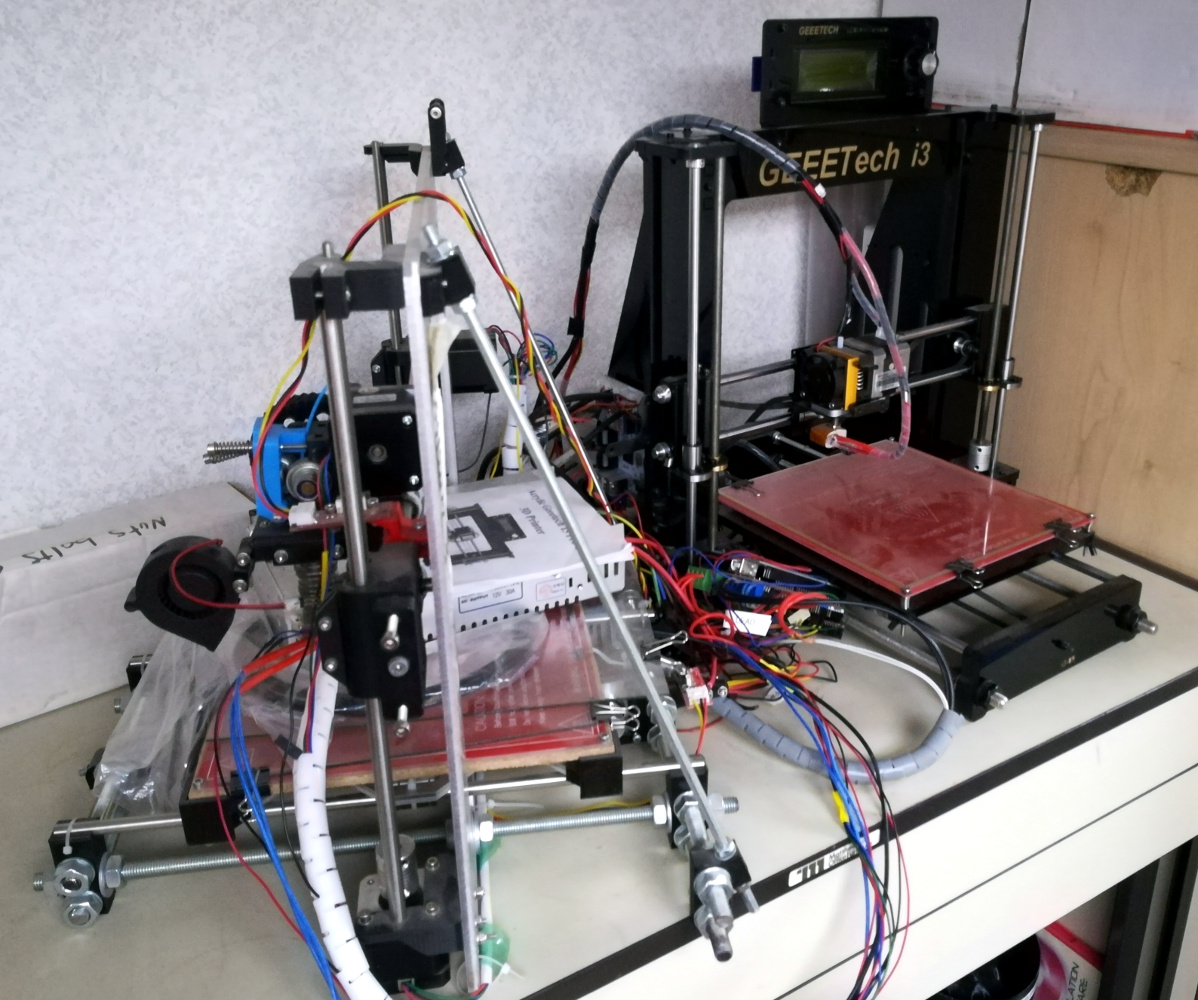
Just because something says it’s a Prusa i3, doesn’t mean it is a Prusa i3.

Nearly 15 years after the dawn of the RepRap project we have seen a huge advancement in the capabilities of affordable 3D printers, and now a relatively low three-figure sum will secure a machine from China that will churn out prints whose quality would amaze those early builders. We’ve reached the point in our community at which many people are on their third or fourth printer, and this has brought with it an unexpected side-effect. Where once a hackerspace might have had a single highly prized 3D printer, now it’s not unusual to find a pile of surplus older printers on a shelf. My hackerspaces both have several, and it’s a sight I’ve frequently seen on my travels around others. Perhaps it’s a sign of a technology maturing when it becomes ewaste, and thus it seems affordable 3D printing has matured. Continue reading “Ask Hackaday: How Do You Keep The 3D Printer From Becoming EWaste”

Catapult Your Best Wishes With This 3D-Printable Card

It’s the season to be surrounded by greeting cards of all shapes and sizes from friends old and new. News of their families and achievements, reminders that they exist, and a pile of cards to deal with sometime in January. Wouldn’t it be great if you could send something with a little more substance, something your friends would remember, maybe even hang on to?

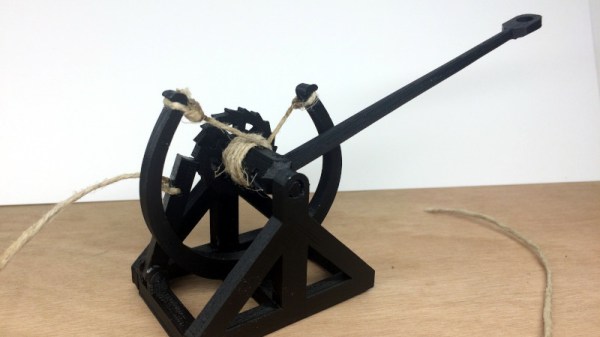
[Brian Brocken]’s 3D-printed Da Vinci catapult kit may not fill that niche for everyone, but we can guarantee it will be a talking point. The Da Vinci catapult design uses a pair of springs similar to an archer’s bow, to unwind a pair of ropes and thus turn the shaft upon which the catapult shaft itself is fitted. All these components are mounted in a single piece with sprues similar to an injection moulded model kit, allowing the whole to easily be posted in an envelope.

The parts are all available to print separately among the files on the Thingiverse page for those with no need to mail them. For the casual spectator he’s made a YouTube video that we’ve placed below the break, detailing the design and build process as well as showing the device in use.

Continue reading “Catapult Your Best Wishes With This 3D-Printable Card”

Happy 50th Birthday To All You Epoch Birthers

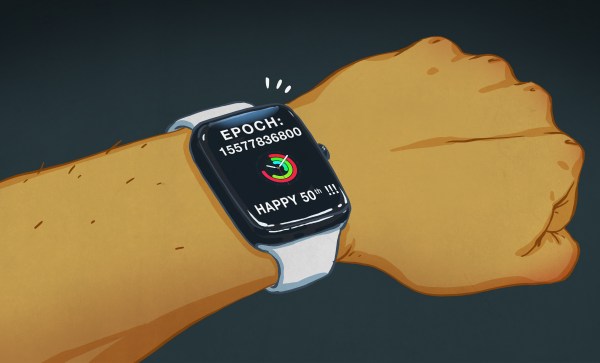
Good morning everyone, and what a lovely start to the new year it is, because it’s your birthday! Happy birthday, it’s your 50th! What’s that you say, you aren’t 50 today? (Looks…) That’s what all these internet databases say, because you’ve spent the last decade or so putting 1970-01-01 as your birth date into every online form that doesn’t really need to know it!

It’s been a staple for a subset of our community for years, to put the UNIX epoch, January 1st 1970, into web forms as a birth date. There are even rumours that some sites now won’t accept that date as a birthday, such is the volume of false entries they have with that date. It’s worth taking a minute though to consider UNIX time, some of its history and how its storage has changed over the years.

Continue reading “Happy 50th Birthday To All You Epoch Birthers”

PoE Powers Christmas Lights, But Opens Up So Much More

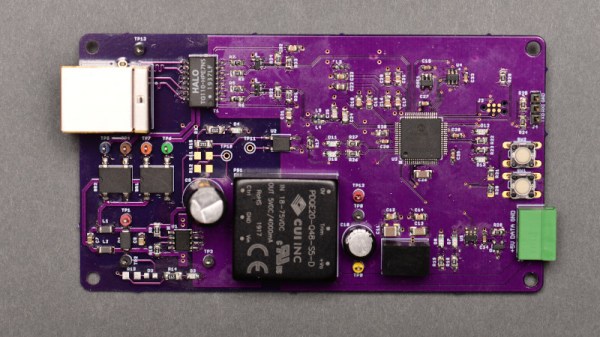
Addressable LEDs are a staple of homemade Christmas decorations in our community, as is microprocessor control of those LEDs. So at first sight [Glen Akins]’ LED decorated Christmas tree looks pretty enough, but isn’t particularly unusual. But after reading his write-up you’ll discover there’s far more to the project than meets the eye, and learn a lot about the technologies behind it that has relevance far beyond a festive light show.

The decoration is powered exclusively from power-over-Ethernet, with a PIC microcontroller translating Art-Net DMX-over-Ethernet packets into commands for the LED string. The control board is designed from the ground up and includes all the PoE circuitry, and the write-up  gives a very thorough introduction to this power source that takes the reader way beyond regarding PoE as simply another off-the-shelf black box. Along the way we see all his code, as well as learn a few interesting tidbits such as the use of a pre-programmed EEPROM containing a unique MAC address.

So if your house has CAT5 wiring and you want an extra dimension to your festive splendour, you’ve officially got a whole year to build your own version. He’s featured here before, with his buzzer to break the Caps Lock habit.

Continue reading “PoE Powers Christmas Lights, But Opens Up So Much More”