The Process Behind Manufacturing That Mac Pro Grille

Apple released a monitor stand not so long ago with an eye-watering price tag, and in the resulting fuss you might almost be forgiven for missing the news that they also released a new computer. The distinctive grille on the new Mac Pro caused some interest among Hackaday editors, with speculation rife as to how it had been machined. It seems we’re not alone in this, because [J. Peterson] sent us a link to his own detailed analysis.

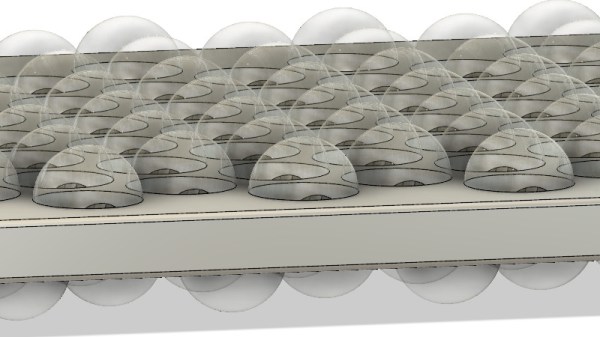
The key to the pattern lies in hemispherical holes milled part-way-through a piece of metal on a triangular tessellation, and intersecting with an identical set of holes milled at an offset from the other side. The analysis was done purely from online information as he doesn’t have a real Mac Pro, but using some clever trigonometry he is able to calculate the required offset as well as the hole depth. There are some STL files on Thingiverse, for the curious.

Should you wish to make your own copy of a Mac Pro grille you should therefore be able to use this information in programming a CNC mill to carve it from a piece of alloy plate. The interesting side of it from a manufacturing perspective though is that this is a complex shape that would be difficult to produce in numbers without either CNC or a very specialist one-off machine tool for this single purpose, and neither is a normal expenditure for a mere grille. Perhaps you might come close by rolling alloy plate between rollers whose profile matched the hole pattern, but in that event you would not equal the finish that they have achieved. Apple’s choice to use a relatively time-intensive CNC process in mass-production of a cosmetic part is probably in a large part a quality statement for their particular brand of consumer, but also sets a high bar to any would-be imitators. We applaud it for its engineering, even if we won’t be shelling out for that monitor stand.
Let A Spooky Owl Tell You The Weather

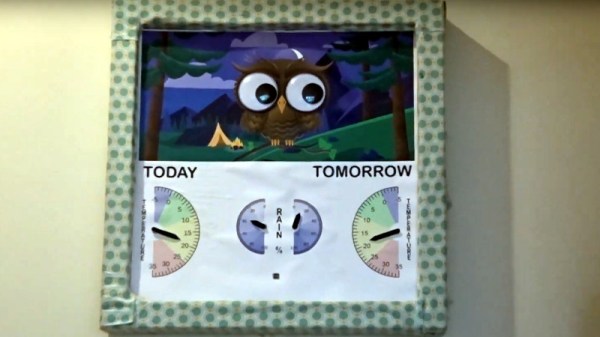
There can be few readers who were young in the 1970s who did not want to share in the adventures of the fearless animated ghost-hunting young crime-fighters of Scooby-Doo. What do you remember from the series though? The Mystery Machine van? Scooby snacks? Or perhaps the improbably haunted theme parks whose owners would have got away with it if it hadn’t been for those pesky kids? For [Alex Shakespeare] it seems to have been the trope of haunted pictures whose subject’s eyes would follow the protagonists around the room, because when he made a wall-mounted weather indicator he gave it an owl with eyes doing just that.

The weather part of the device is straightforward enough, an ESP8266 board drives a set of servos that move dial indicators according to data from the Dark Sky API. The owl’s moving googly eyes are the party piece though, for them the ESP takes input from an Adafruit AMG8833 thermal sensor array and drives a servo and lever arrangement to do the moving. Finally, the thermal camera’s output is available to see on the ESP’s web server. All the details of the project can be found via a GitHub repository.

The result is shown in the video below the break, and as you might expect in the spirit of its inspiration it’s more comedic than haunting. But maybe there’s the root of the popularity of artworks that follow the viewer, of which this is merely the latest in a long line.

Continue reading “Let A Spooky Owl Tell You The Weather”

The Smallest Hacker Camps Are The Most Satisfying, And You Can Do One Too

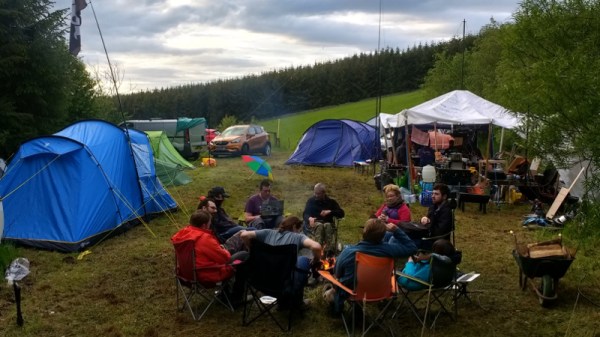
Two of my friends and I crammed into a small and aged European hatchback, drove all day along hundreds of miles of motorway, and finally through a succession of ever smaller roads. We were heading for a set of GPS co-ordinates in the north of Scotland, along with all of our camping gear.

There’s nothing like the hacker camp we’re looking for. After heading down a lane barely wider than the car, we drove through a farmyard with a sheepdog lying in the middle of the road (the reclining mutt seemed unconcerned as we edge the car around). We had arrived at GampGND, one of Europe’s smallest hacker camps.

Continue reading “The Smallest Hacker Camps Are The Most Satisfying, And You Can Do One Too”

Back To Where (For Most Of Us) It Started, The Intel 8080

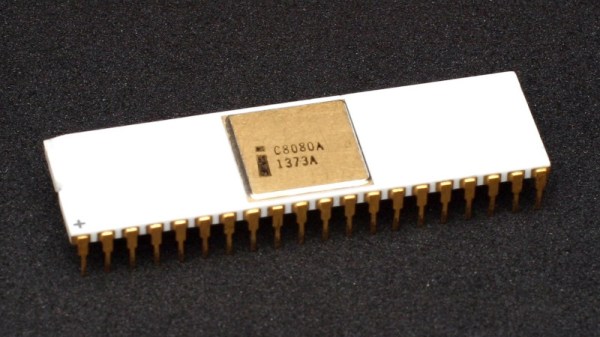
The early history of microprocessors is a surprisingly complex one, with more than one claimant for the prize of being the first, and multiple competing families. That the first commercially available part was the Intel 4004 is a matter of record, but it’s fair to say that few of us will have ever encountered one. Even its 8-bit sibling the 8008 would not have featured heavily in a 1974 version of Hackaday, such was its exotic nature. If there’s a microprocessor that can be claimed to have started it all for us then, it’s the Intel 8080. It established the 8-bit microporcessor with an 8-bit bus and a 16-bit address space, it had an order of maginitude more performance than its predecessors, and crucially it would become affordable enough for experimenters. It provided the guts of the MITS Altair 8800 microcomputer, and thus kickstarted the progression of home computers which led to the devices you use every day.

The 8080 is in our sights today, thanks to [DeviceGuru], who was sent down memory lane by thoughts of the 6502-based KIM-1 from his master’s thesis project. This led to memories of the 8080 Abie computer that he built for himself in 1979, for which he provides us some details and hand-drawn schematics. By then the 8080’s need for several support chips made it somewhat outdated, but from his perspective the chip could be had from Radio Shack without too much outlay. His tale of hand-assembling 8080 code and sending it to a friend for blowing onto a PROM might be familiar to some readers of a certain age.

Though the 8080 ceased volume production a quarter century ago (surprisingly there are still places you can get a new one though) it hasn’t entirely disappeared from our community’s consciousness. [DeviceGuru] tells us about the 8080 Microprocessor kit from [Wichit Sirichote] in Thailand which is a single board computer in the 1970s vein, hex keypad and all.

As you might expect, the 8080 hasn’t appeared in many projects here due to its rarity. Those that have seem more likely to feature its Eastern Bloc clones, such as this Polish model or this Russian one. It’s worth the reminder that if you fancy exploring some 8080 code of your own that you don’t even need an 8080 to run it on some silicon. The hugely popular Zilog Z80 as found in retrocomputers such as the RC2014 is fully mostly 8080 code compatible, indeed some of us learned about microprocessors that way because 8080 books were discounted in 1983 and Z80 ones weren’t.

Header image: Konstantin Lanzet [CC BY-SA 3.0].

This British 3D Printing Meetup Is On The Rise

Most people who are serious about designing, building, or improving 3D printers see the Midwest Reprap Festival as the place where the latest and greatest is on show for all to see. But if you live on the other side of the world as I do, chances are slim that you’ll be able to attend.

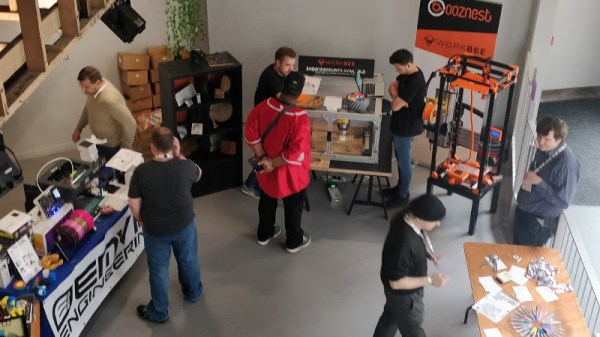
I live in the UK, and there haven’t traditionally been any events quite like MRRF, but that may be changing. The 3D Meetup UK in Birmingham is a community-organised event bringing together the 3D printing maker and hacker community for a couple of days of talks, demonstrations, and tours. I went along this year to see what was going on, and to take the temperature of the British side of this community.

Continue reading “This British 3D Printing Meetup Is On The Rise”

Hackaday Superconference: Rob Ryan Silva On Designing For Developing Environments

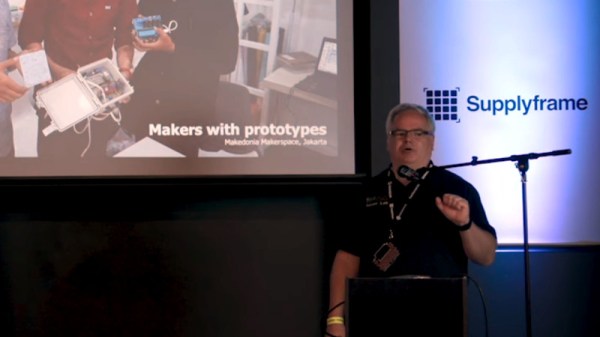
Throughout the six years of the Hackaday Prize we have seen a stream of projects tackling all manner of applications and challenges. Many of them have a goal of addressing issues faced by people in developing countries, and this was the topic upon which Rob Ryan Silva spoke at the Hackaday Superconference.

Rob’s perspective is an interesting one: he runs the maker lab at Development Alternatives Incorporated, or DAI, who are best described as a specialist contractor in the international development sector. Thus while many of the Prize entrants are hardware hackers who have become involved in development related projects, he is a development specialist who has made the opposite journey to becoming a hardware hacker.

Join me below for the video of Rob’s talk and a deep dive into it. Also of note, tickets for the 2019 Hackaday Superconference are now available, the Call for Proposals is now open, and of course, the 2019 Hackaday Prize is ready for your entry! Okay, now onto Rob’s talk.

Continue reading “Hackaday Superconference: Rob Ryan Silva On Designing For Developing Environments”

Blacksmithing For The Uninitiated: Your First Time At The Anvil

For the past few months we’ve been running this series of Blacksmithing For The Uninitiated posts, exploring the art of forge work for a novice. It’s based upon my experience growing up around a working blacksmith’s business and becoming an enthusiastic if somewhat inexpert smith, and so far we’ve spent our time looking at the equipment you might expect to need were you embarking on your own blacksmith work. Having assembled by now a basic forge of our own it’s now time to fire it up and take to the anvil for our first bit of smithing.

Lighting a forge is easy enough. Some people do it with a gas torch, but I break a piece of firewood into sticks using a hammer with the fuller set in the hardy hole on the anvil as an impromptu splitter. Making a small fire by lighting some paper under my pile of sticks placed on the hearth next to the tuyere I start the blower and then pile coke on top of the resulting conflagration. After about ten minutes I will have a satisfying roar and a heap of glowing coals, and as they burn there will be some slag collecting in the bottom of the fire that I will eventually need to rake out. Continue reading “Blacksmithing For The Uninitiated: Your First Time At The Anvil”