Alan Turing To Be The Face Of Fifty Quid

The Bank of England has announced that the new face of the £50 note is to be Alan Turing. This news follows a round of public nominations for a scientist to fill the space, and Turing was in the running with some stiff competition from the likes of Stephen Hawking and Ada, Countess Lovelace.

The fifty is not a note you’ll see very often even if you’re a Brit, it’s the one you’ll usually only come into contact with if you’ve bought a second-hand car, but the importance of this move goes beyond whether or not the note will be proffered at the bar for a foaming pint of mild ale. It’s not an honour that is handed out lightly, and it is particularly poignant in the case of Turing who despite his wartime codebreaking and genesis of the discipline of computer science was disgraced and pushed to suicide in the 1950s when he was discovered to be gay.

Will Hardware Pictured on the Bill Be as Famous as Turing Himself?

The bank has not yet set the engravers to work, but they have generated this mock-up that features alongside Turing himself a table from a Turing machine example superimposed on a picture of an early computer rack. We don’t think it’s EDSAC or Manchester Baby, it’s not a Bombe and it definitely shouldn’t be Colossus as he had little to do with it, but we are sure that among our readers will be someone who can provide a positive identification. We hope that whatever the final design may be, it does justice to Turing’s legacy.
Continue reading “Alan Turing To Be The Face Of Fifty Quid”

A Lot Of Volts For Not A Lot

There was a time when high voltage in electronic devices was commonplace, and projects driving some form of vacuum or ionisation tube simply had to make use of a mains transformer from a handy tube radio or similar. In 2019 we don’t often have the need for more than a few volts, so when a Geiger–Müller tube needs a bit of juice, we’re stumped. [David Christensen] approached this problem by creating his own inverter, which can produce up to 1 kV from a 12 V supply.

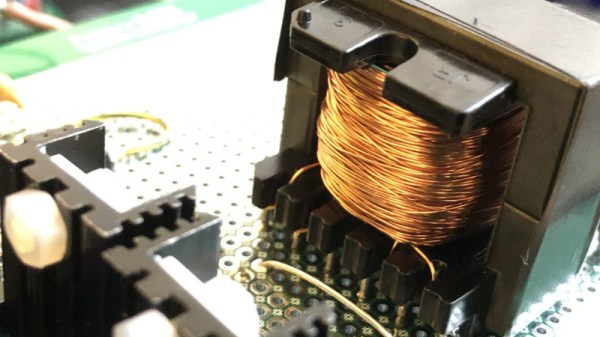
Instead of opting for a flyback supply he’s taken a traditional step-up approach, winding his own transformer on a ferrite core. It has a centre-tapped primary which he drives in push-pull with a couple of MOSFETS, and on its secondary is a voltage multiplier chain. The MOSFETs take their drive at between 25 kHz and 50 kHz from a 555 timer circuit, and there is no feedback circuit.

It’s fair to say that this is a somewhat hair-raising circuit, particularly as he claims that it is capable of delivering that 1 kV at 20 W. It’s usual for high-voltage supplies driving very high impedance loads to incorporate a set of high-value resistors on their outputs to increase their internal impedance such that their danger is reduced. We’d thus exercise extreme care around this device, though we can see a lot of value in his description of the transformer winding.

We can’t criticise this circuit too much though, because some of us have been known to produce far hackier high voltage PSUs.

A Wedding Gift Fit For A Hardware Hacker

If you read Hackaday on a regular basis, there are some names you will have seen more than once. People who continually produce fascinating and inventive projects that amaze and delight us, and who always keep us coming back for more. One such hacker is [Jeroen Domburg], perhaps better known in these pages by the handle [Sprite_TM], who has never failed to delight us in this respect.

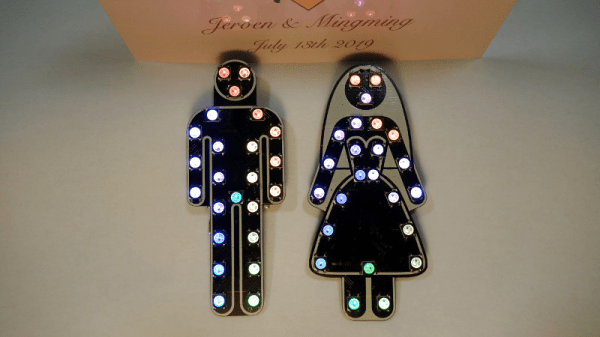
Today is a special day for [Jeroen] for it is his wedding day, and his friend [Maarten Tromp] has decided to surprise him and his wife [Mingming] with a special gift. At first sight it is simply a pair of blinky badges in the shape of a bride and groom, but closer examination reveals much more. The PCBs are studded with WS2812 addressable LEDs controlled by an ESP32 module and powered by a small LiPo battery, and the clever part lies in the software. The two badges communicate via Bluetooth, allowing them to both synchronise their flashing and flash ever faster as the couple come closer to each other.

The write-up is an interesting tale of the tribulations of designing a badge, from which we take away that buying cheap LEDs may be a false economy. A surprise was that the black-cased and white-cased versions of the LEDs had different timings, and they proved prone to failure.

We wish the happy couple all the best, thank [Sprite_TM] for all he has given us over the years, and look forward to seeing his future projects.

Make A Compatible Raspberry Pi Clone – But Your Pi Must Die

The world is awash with Raspberry Pi clones that boast fruity names, but those looking for a piece of the real thing will find their compatibility only goes so far. Shaky Linux distros abound and, with a few honourable exceptions, they are not for the faint-hearted. The reason that a market hasn’t emerged for fully-compatible clones is that the Pi people seem to have a monopoly on the world’s supply of the particular Broadcom SoCs that they use, forcing would-be competitors to source the brains of their outfit elsewhere.

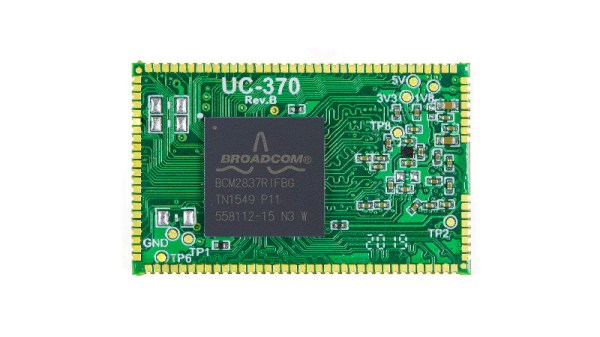
It’s easy to buy a Raspberry Pi SoC though, if you don’t mind receiving a Raspberry Pi along with it. So to make a compatible Pi clone for space-constrained applications, the folks at Arducam removed the SoC from a Pi 3 and designed a surface-mount module board for it, making a 40 mm x 25 mm postage-stamp style system-on-module. It’s not a Raspberry Pi, but it runs Raspbian.

Their board is not one that they will be selling, but it does open up interesting possibilities for others with an eye to creating Pi boards in different form factors. It would be fascinating for example were somebody to produce an open-source module board for a Pi SoC. Some of you might be asking why the existing Compute Module was not suitable for them; in the write-up they cite mechanical issues with the SODIMM socket.

This isn’t the first compatible Pi clone we’ve seen. Aside from the intriguing but short-lived Odroid W there was another even smaller Arducam offering that never made it to market.

BGA Hand Soldering Uses Tombstone Resistor Technique, Demands Surgical Precision

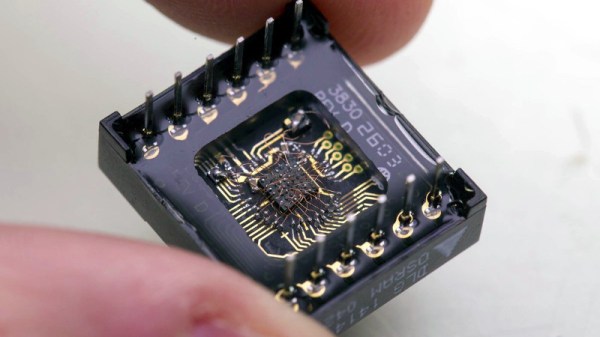
Most Hackaday readers will be a pretty dab hand with a soldering iron. We can assemble surface-mount boards, SOICs and TSSOPs are a doddle, 0402s we take in our stride, and we laugh in the face of 0201s. But a Twitter thread from [Greg Davill] will probably leave all but the most hardcore proponents of the art floundering, as he hand-wires a tiny FPGA in a BGA package to the back of a miniature dot-matrix LED display module.

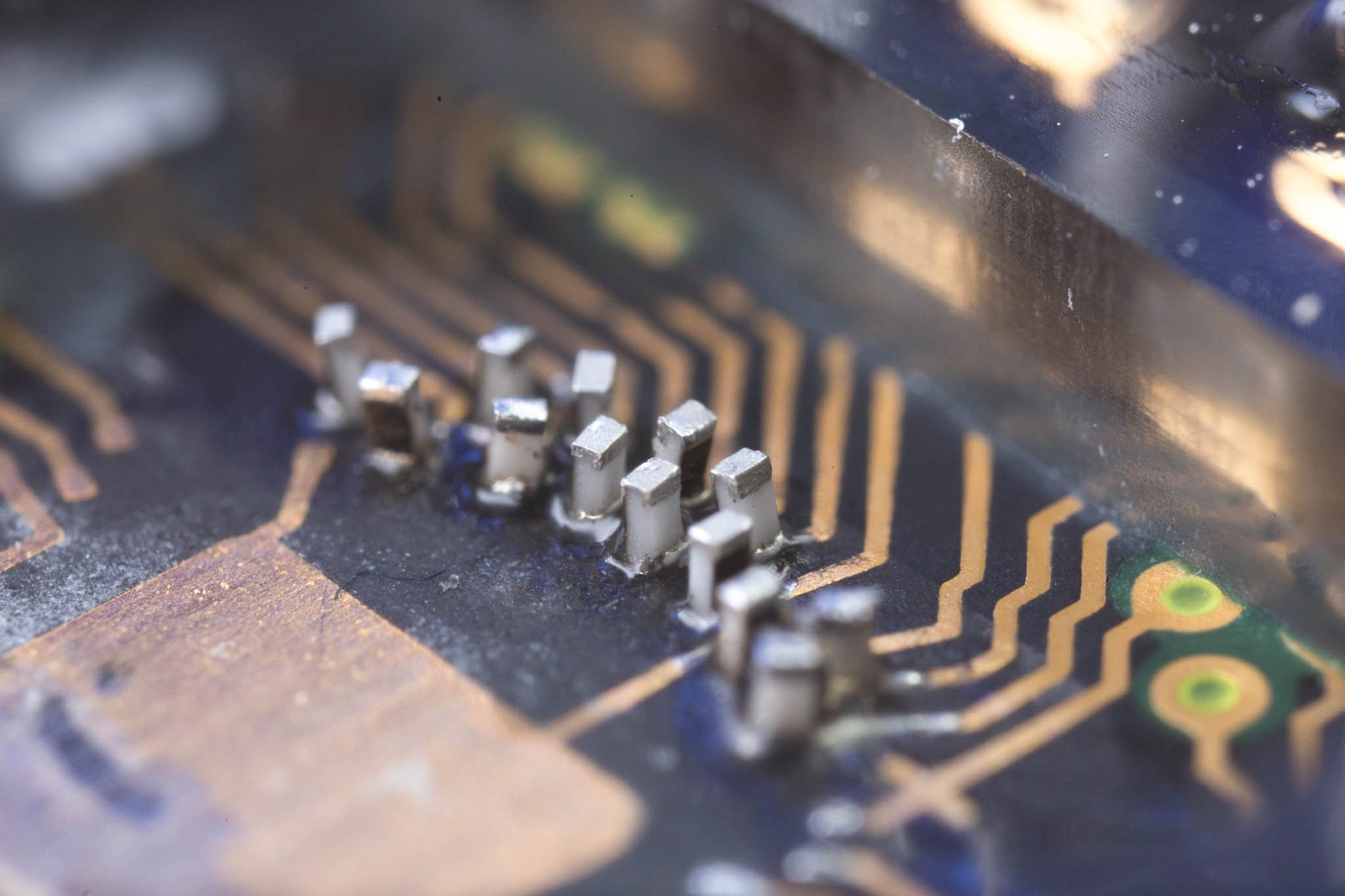
Resistors soldered on-end, awaiting wires to connect to the BGA microcontroller

As far as we can see the module must once have had its own microcontroller which has been removed. We’d guess it was under an epoxy blob but can’t be sure, meanwhile its pads are left exposed. The Lattice LP1k49 fits neatly into the space, but a web of tiny wires are required to connect it to those pads. First, [Greg] populates the pads with a set of “tombstoned” tiny (we’re guessing 0R) resistors, then wires them to the pads with 30μm wire. He describes a moment of confusion as he attempts to tin a stray hair, which burns rather than accepting the solder.

The result is a working display with a new brain, which surprises even him. We’ve seen more than one BGA wiring over the years, but rarely anything at this scale.

It’s worth mentioning that [Greg] was behind the FLIR frame grabber that was a runner-up in last year’s Hackaday Prize. We admire the photos he’s able to get of all of his projects and aspire to reach this level with our own. Take this as inspiration and then check out the Hackaday contest for Beautiful Hardware images happening right now.

Thanks [Sophi] for the tip.

Five Years Of The Raspberry Pi Model B+ Form Factor, What Has It Taught Us?

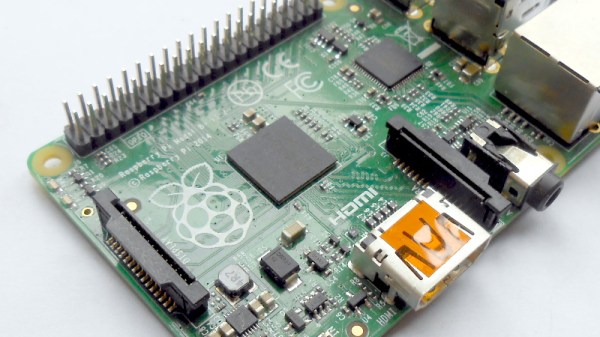
With all the hoopla surrounding the recent launch of the new Raspberry Pi 4, it’s easy to overlook another event in the Pi calendar. July will see the fifth anniversary of the launch of the Raspberry Pi Model B+ that ushered in a revised form factor. It’s familiar to us now, but at the time it was a huge change to a 40-pin expansion connector, four mounting holes, no composite video socket, and more carefully arranged interface connectors.

As the Pi 4 with its dual mini-HDMI connectors and reversed Ethernet and USB positions marks the first significant deviation from the standard set by the B+ and its successors, it’s worth taking a look at the success of the form factor and its wider impact. Is it still something that the Raspberry Pi designers can take in a new direction, or like so many standards before it has it passed from its originator to the collective ownership of the community of manufacturers that support it?

Continue reading “Five Years Of The Raspberry Pi Model B+ Form Factor, What Has It Taught Us?”

Vintage Philco Radio Looks Stock, Contains Modern Secret: A Raspberry Pi

Antique radio receivers retain a significant charm, and though they do not carry huge value today they were often extremely high quality items that would have represented a significant investment for their original owners. [CodeMakesItGo] acquired just such a radio, a Philco 37-11 made in 1937, and since it was it a bit of a state he set about giving it some updated electronics. Vintage radio purists, look away from the video below the break.

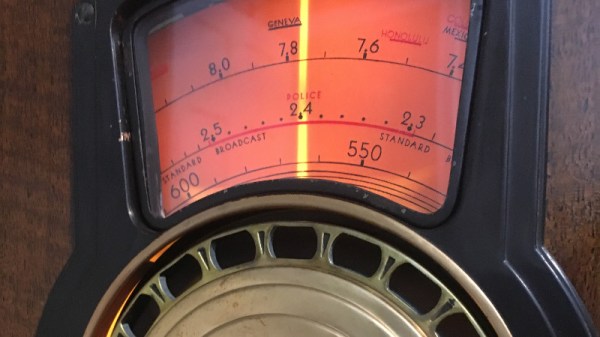
Stripping away the original electronics, he gave it a modern amplifier with Bluetooth capabilities, and a Raspberry Pi. Vintage radio enthusiasts will wince at his treatment of those classic parts, but what else he’s put into it makes up for the laying waste to a bit of ’30s high-tech.The original tuning dial was degraded so he’s given it a reproduction version, and behind that is an optical encoder and two optical sensors. This is used to simulate “tuning” the radio between different period music “stations” being played by the PI, and for an authentic feel he’s filled the gaps with static. The result is a functional and unusual device, which is probably better suited than the original to a 2019 in which AM radio is in decline.

If you think of a high-end set like this Philco as being the ’30s equivalent of perhaps an 8K TV set, you can imagine the impact of AM radio in those early days of broadcasting. We recently took a look at some of the directional antenna tricks that made so many AM stations sharing the band a possibility.

Continue reading “Vintage Philco Radio Looks Stock, Contains Modern Secret: A Raspberry Pi”