How Low Can You Go? Tiny Current Generator

Current limited power supplies are a ubiquitous feature of the bench, and have no doubt helped prevent many calamities and much magic smoke being released from pieces of electronics. But for all their usefulness they are a crude tool that has a current resolution in the range of amps rather than single digit milliamps or microamps.

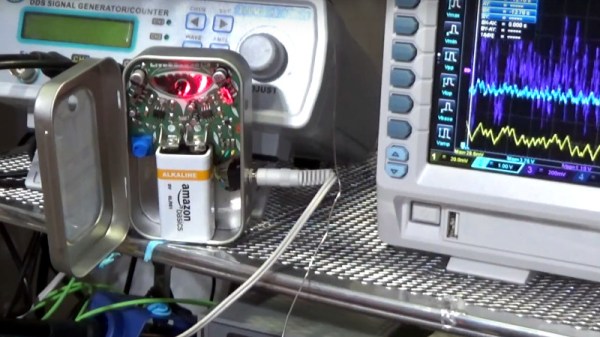
To address this issue, [Yann Guidon] has produced a precision current source, a device designed to reliably inject tiny currents. And in a refreshing twist, it has an extremely simple circuit in the form of a couple of PNP transistors. It has a range from 20 mA to 5 µA which is set and fine-tuned by a pair of pots, and it has a front-panel ammeter hacked from a surplus pocket multimeter, allowing the current to be monitored. Being powered by its own internal battery (and a separate battery for the ammeter) it is not tied to the same ground as the circuit into which its current is being fed.

[Yann] is a prolific builder whose work has featured here more than once. Take a look at his rubidium reference and his discrete component clocks, for example, and his portable LED flash.

Bomb Hoist Teardown Shows Cold-War-Era Big Iron

Buying surplus equipment lends a frisson of excitement as you eagerly await the package or crate containing your purchase. Did you buy a hidden treasure, or has some shyster succeeded in unloading a pile of garbage onto you, their mark? [Professor Churls] shelled out $49.99 for a military surplus bomb hoist which definitely falls into the former category. His teardown reveals it to be a beautifully over-engineered piece of Cold-War-era American hardware.

As the package with its extremely heavy contents is first inspected, he reminds us just what a bomb hoist does, it is clipped to an aircraft by ground crew and serves as a small but extremely powerful crane to lift up to a 6000-pound piece of ordnance onto the wing pylon of an aircraft. This particular example dates from the 1960s, and features a 28-volt DC motor coupled to a bulky gearbox assembly on a swivel mount for attachment.

His teardown is extremely detailed, but such is the engineering and complexity of the device you’ll want to read every part of it. The motor is a fairly traditional separately-excited brushed DC design such as you’d expect from that era, but with unusual features such as brushes on pivots rather than a slide. The multiple sets of gears are packed in aged and phenolic-smelling grease, and have unusual features such as stub-form teeth for high torque at low durations. There is even an entirely separate gear train for the hex drive provided so that crews could keep the bombers rolling even when the power was out.

He leaves us with the tantalising information that there is a project awaiting this device, but doesn’t tell us what that might be. We hope we’ll get to see it, whatever it is. Meanwhile it’s great to see that this kind of item can still be found from military surplus suppliers, where this is being written they have degenerated into little more than stockists of camouflage-printed camping gear. Our colleague [Brandon Dunson] lamented in 2015 on the slow decline of the electronic surplus business in his location.

Review: SMD Tweezer Meter Or Tweezer Probes For Your Multimeter?

It’s remarkable how tiny electronics have become. Heaven knows what an old-timer whose experience started with tubes must think, to go from solder tags to SMD in a lifetime is some journey. Even  the generation that started with discrete transistors has lived through an incredible shift. But it’s true, SMD components are tiny, and that presents a challenge aside from the one you’ll face when soldering them. Identifying and measuring the value of a chip component too small to have any writing upon it becomes almost impossible with a pair of standard test probes.

Happily the test equipment manufacturers have risen to the challenge, and produced all sorts of meters designed for SMD work that have a pair of tweezers instead of test prods. When I was looking for one I did my usual thing when it comes to Hackaday reviews. I looked at the budget end of the market, and bought an inexpensive Chinese model for about £16($21). And since I was browsing tweezers I couldn’t resist adding another purchase to my order. I found a pair of tweezer test probes for my multimeter which cost me just over a pound ($1.30) and would provide a useful comparison. For working with SMD components in situ, do you even need the special meter?

Continue reading “Review: SMD Tweezer Meter Or Tweezer Probes For Your Multimeter?”

It’s 1984, And You Can’t Afford A Computer. Never Mind, Have This Pop-Up Paper One Instead!

It’s an oft-derided sentiment from a Certain Type of Older Person, that the Youth of Today don’t know how lucky they are with their technology. Back when they were young they were happy with paper and string! Part of the hilarity comes from their often getting the technology itself wrong, for example chastising the youngsters for their iPods and Game Boys when in reality those long-ago-retired devices are edging into the realm of retrotechnology.

But maybe they have a point after all, because paper and string could be pretty good fun to play with. Take the example presented  in a Twitter thread by [Marcin Wichary]. A pop-up book from 1984 that presents the inner workings of a computer in an astounding level of detail, perhaps it stretches the pop-up card designer’s art to the limit, but along the way it makes a fascinating read for any retrocomputing enthusiast. Aside from the pop-up model of the computer with an insertable floppy disk that brings text onto the screen we see at  first, there is a pop-up keyboard with a working key, a peer inside the workings of a floppy disc, a circuit board complete with a paper chip that the reader can insert into a socket, and a simulation of a CRT electron bean using a piece of string. A Twitter thread on a book is not our normal fare, but this one is something special!

Did any of you have this book when you were younger? Perhaps you still have it? We’d love to hear from you in the comments. It’s probably not the type of book we normally review, but we’ve been known to venture slightly outside tech on that front.

Drive Big Servos With Ease

CNC machines of all types are a staple here at Hackaday, in that we have featured many CNC builds over the years. But the vast majority of those that we see are of relatively modest size and assembled in a home workshop, using small and readily available components such as small stepper motors. These drives are a world away from those used in industrial CNC machines, where you will find high-voltage servos packing a much greater punch. With good reason: driving a small low-voltage motor is easy while doing the same with a high-voltage servo requires electronics that have hitherto been expensive.

STMBL (for STM32 microprocessor and BrushLess motor) is a servo driver for STM32F4 microcontrollers that is specifically designed to use in retrofit projects to industrial CNC machines that have those high-voltage servos. When assembled, it takes the form of two PCBs arranged in a T configuration over a heatsink, with high-power connectors for the motor terminals, and RJ45s for feedback and serial control. In fact each of the boards has its own STM32, one on the high voltage side and the other on the low voltage, to enable only the simplest of isolated serial connections between them.  A significant variety of combinations of motor and feedback system is supported, making it as versatile as possible a module for those whose CNC needs have escaped their home bench setup. We’re sure we’ll see this module pop up in quite a few builds we show you over the coming years.

Thanks [Andy Pugh] for the tip.

A Tale Of More Than One Amiga 1500

If you were an Amiga enthusiast back in the day, the chances are you had an Amiga 500, and lusted after a 2000 or maybe later a 3000. Later still perhaps you had a 600 or a 1200, and your object of desire became the 4000. The amusingly inept Commodore marketing department repackaged what was essentially the same 68000-based Amiga at the bottom end of the range through the platform’s entire lifetime under their ownership, with a few minor hardware upgrades in the form of chipset revisions that added a relatively small number of features.

We’ve probably listed above all the various Amigas you’ll be familiar with, with a few exceptions you either didn’t have or only saw in magazines. The original A1000, the chipset-upgraded A500+, the CDTV multimedia  platform, or the CD32 games console as examples. But there’s one we haven’t listed which you may never have seen unless you hail from the United Kingdom, and it’s an Amiga behind which lies a fascinating tale that has been unearthed by [RetroManCave].

In the late 1980s, Commodore sold the A500 all-in-one cased Amiga to consumers with marketing based heavily upon gaming, and the A2000 desktop Amiga to businesses with the promise of productivity software. Both machines had a 16-bit Motorola 68000 running at the same speed, with the A2000 having a lot of extra memory and a hard drive lurking within that case. The price difference between the two was inordinately high, creating a niche for an enterprising British company called Checkmate Computers to fill with their provocatively named A1500, a clever case for an A500 mainboard that gave it an expansion slot and space for that hard drive and memory.

This machine’s existence angered Commodore, to the extent that they vowed to eradicate the upstart by releasing their own UK-only A1500. The result, a comically badly concealed rebadge of an A2000 with two floppies and no hard drive, is something we remember seeing at the time, and dare we admit it, even lusting after. But the full story in the video below is well worth a watch for an engrossing insight into a little-known saga in one corner of the computing world during the 16-bt era. Towards the end it becomes a plug for the Checkmate Computers co-founder’s current Kickstarter project, but if that holds no interest for you then you are at least forewarned.

Of course, if you have either A1500 today, you might want an up-to-date graphics card for it.

Continue reading “A Tale Of More Than One Amiga 1500”

Behind The Pin: How The Raspberry Pi Gets Its Audio

Single board computers have provided us with a revolution in the way we approach computing as hardware creators. We have grown accustomed to a world in which an entire microcomputer has become a component in its own right rather than a complex system, and we interface to them as amorphous entities through their exposed interfaces. But every pin or socket on a single board computer has something behind it, so following up on a recent news-inspired item in which we took a look at what lies behind the Ethernet jack on a Raspberry Pi, we’d like to continue that theme by looking behind more pins and interfaces. So today we’ll stay with the Raspberry Pi, and start with an easy target by taking a look down its audio jack.

All the main Raspberry Pi board releases since 2012 with the exception of the Pi Zero series, have featured a 3.5mm jack carrying line-level audio. The circuits are readily accessible via the Raspberry Pi website, and are easy enough to understand because of course all the really hard work is done within the silicon of the Broadcom system-on-chip. Looking at the audio circuitry, we’ll start by going back to the original Pi Model B from 2012 (PDF) because though more recent models have seen a few changes, this holds the essence of the circuitry.

Continue reading “Behind The Pin: How The Raspberry Pi Gets Its Audio”