Fail Of The Week: Electromigration Nearly Killed This Xerox Alto

The Living Computers museum in Seattle has a Xerox Alto, the machine famous for being the first to sport a mouse-based windowing graphical user interface. They received it in working condition and put it in their exhibit, but were dismayed when a year later it ceased to operate. Some detective work revealed that the power supply was failing to reach parts of the machine, and further investigation revealed an unlikely culprit. Electromigration had degraded the contacts between the supply pins and the backplane traces.

If electromigration is new to you, don’t feel ashamed, it was a new one to us too. It’s “the transport of material caused by the gradual movement of the ions in a conductor due to the momentum transfer between conducting electrons and diffusing metal atoms“, got it? Okay, that’s just a long way to say that passing a sufficiently high current through a conductor for a long time can physically move the metal of that conductor.

This one just doesn’t pop up very often. But in the case of the Alto, an under-specified power distribution system caused a lot of current to flow through too few solder joints. Those joints were left without enough metal to make a decent connection, so they failed.

The fix came with a set of sturdy busbars freshly soldered to the pins, but the interest in this piece comes more from the unusual phenomenon that caused it. That soldered joints can seemingly flow away defies belief. It’s still something most of us will never encounter, but like tales of ball lightning it’s one for the “Fancy that!” collection.

We’ve covered the Alto before, most notably [Ken Shirriff]’s work in restoring the Computer History Museum’s example.

So You Bought A Raspberry Pi Compute Module. What Now?

The Raspberry Pi Compute Module hasn’t seen as much attention as it should have in our community, probably because the equivalents from the familiar consumer range can be so much cheaper. When a Raspberry Pi Zero is a similar size to a Compute Module and costs so much less, we can’t blame you for asking what would be the point of using the industrial version.

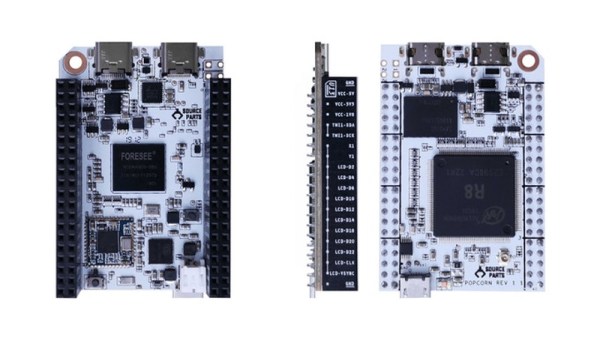
It’s interesting then to see an Instructables piece from [Manolis Agkopian] in which he takes the reader through the process of creating their own Compute Module project. Following hot on the heels of the recent launch of the latest in the range it’s come to us at an appropriate moment to take a fresh look at the fruity computer’s more obscure incarnation. He starts with a description of the Compute Module and its official development board, before taking us through setting up a module and putting an OS on it. Finally he shows us his board design, which he offers us as a jumping-off point for our own projects.

So given that it’s piqued your interest, why might you want to design a Compute Module project? The answer’s simple enough: the consumer boards only provide the subset of features the Pi foundation people deemed appropriate for their mission. A Compute Module project is the equivalent of designing a Raspberry Pi that does it your way, tailored exactly for your needs. If you want an example, look no further than this stereoscopic camera.

Via Hacker News.

Raspberry Pi’s Latest Upgrade: The Compute Module 3+

We’ve become so used to the Raspberry Pi line of boards that have appeared in ever-increasing power capabilities since that leap-year morning in 2012 when the inexpensive and now ubiquitous single board computer was announced and oversold its initial production run. The consumer boards have amply fulfilled their mission in providing kids with a pocket-money computer, and even though they are not the most powerful in the class of small Linux boards they remain the one to beat.

The other side of the Pi coin comes with the industrial siblings of the familiar boards, the Compute Module. This is a version of the Pi meant to be built into other products, utilizing a SODIMM connector as the hardware interface. Today brings news of a fresh addition to that range: the Compute Module 3+.

As you might expect from the nomenclature this brings the Broadcom BCM2837B0 processor from the Raspberry Pi 3B+ to the barebones SODIMM-style Pi, but unexpectedly they have also made it available with a range of different size eMMC devices installed. In place of the 4 GB capacity of previous offerings are 8, 16, and 32 GB devices, with an intriguing new “lite” variant that has no onboard storage at all.

Perhaps the saddest thing from a Hackaday reader’s perspective is that as the Pi blog post notes due to commercial sensitivities they have little idea what products many of the Compute Modules they sell end up in — a mystery we’d really like to solve. No doubt there are some fascinating applications just waiting do be discovered by hardware hackers in a decade’s time as units enter the surplus market, but for now we’ll have to be content with community offerings. This stereoscopic camera is a recent one, or perhaps one of several handheld game consoles.

Drone Sightings, A New British Comedy Soap Opera

There’s a new soap opera that I can’t stop watching. Actually, I wish I could change the channel but this is unfortunately happening in real life. It’s likely the ups and downs of drone sightings would be too far fetched for fiction anyway.

If you aren’t British, maybe you will know a little of our culture through the medium of television. We don’t all live in stately homes like Downton Abbey of course, instead we’re closer to the sometimes comedic sets, bad lighting, and ridiculously complicated lives of the residents of Coronation Street or of Albert Square in Eastenders that you may have flashed past late at night on a high-number channel.

Our new comedy soap lacks the regional accents of Emmerdale or Hollyoaks, but has no less of the farce about it. Here at Hackaday we’ve brought you news of the UK’s peculiar habit of bad reporting and shoddy investigation of questionable drone sightings several times over the last year or two. Most recently we covered a series of events before Christmas that closed Gatwick, London’s second airport for several days over what turned out to be nothing of substance.

Unfortunately it didn’t end there. We’re back once more to catch up with the latest events down on the tarmac, and come away with a fresh set of reasonable questions unanswered by the popular coverage of the matter.

Continue reading “Drone Sightings, A New British Comedy Soap Opera”

Polish Retro Silicon Brings This Computer To Life

It is an easy trap for us to write only about what we know when covering a topic, thus missing an entire facet of our subject matter. Take retrocomputing for example; we might write about American or Western European machines because we grew up with them, while completely ignoring the hardware being produced on the other side of the Iron Curtain.  Thus it’s fascinating to see [Marek Więcek]’s project, a single board retrocomputer employing a Polish clone of the Intel 8080.

With greater detail on a Polish-language forum (Google Translate), he tells a story of being given an MCY7880 CPU for his collection, only to wonder whether it could be made into a machine in its own right. As a clone of the 8080 this also required equivalents of the Intel bus controller and clock generator chips, which we are guessing must be the UCY74S405 and UCY7404 that he’s also sourced for the project.

The build is completed in true retro style with a maze of point-to-point wiring on the reverse of a protoboard, and he’s put a TinyBASIC interpreter port and 8251 UART on board as well as an 8255 triple parallel I/O port for some GPIO action. We love this computer, and appreciate the light it shines on an obscure corner of microprocessor history.

If Eastern European retrocomputing is your thing, here at Hackaday we’re lucky enough to number among our colleagues someone who’s something of an authority on the matter. [Voja Antonic] has entertained us with the tale of how he designed the Galaksija, Yugoslavia’s first home computer. Sadly though he did not use a Polish 8080 in his design.

Restoring A Forgotten Dot-Matrix Printer

Dot matrix printers are the dinosaurs that won’t go extinct. They are not unlike a typewriter with the type bars behind the ink ribbon replaced by a row of metal pins controlled by solenoids, each pin being capable of printing a single pixel. At their best they could deliver a surprising level of quality, but their sound once heard is not forgotten, because it was extremely LOUD.

[Wpqrek] bought an old dot-matrix printer, a Commodore MPS 803. Sadly it didn’t live up to the dot-matrix reputation for reliability in that it didn’t work, some of its pins weren’t moving, so he set to on its repair. Behind each of those pins was a solenoid, and after finding a crack in the flexible ribbon to the head he discovered that some of the solenoids were open-circuit. On dismantling the head it became apparent that the wires had detached themselves from the solenoids, so he very carefully reattached new wires and reassembled the unit. Of course, he had no replacement for the flexible ribbon, so he made a replacement with a bundle of long lengths of flexible hook-up wire. This hangs out of the top of the printer as it follows the carriage, but for now it keeps the device working.

Dot-matrix printers are a favourite for our readership. Among others, we’ve seen another Commodore get the Python treatment, as well as an Apple capable of printing in full colour.

Samy Kamkar’s LED Balloon Network

Writing this in the frigid darkness of a Northern Hemisphere January evening, I have to admit to more than a little envy of Samy Kamkar and his friends. One of their summer events is a private party at a secluded campground somewhere that looks quite warm, which from here seems mighty attractive.

Samy wanted to provide a spectacle for his friends. What he came up with is glowing orbs; LED balloons that would float above the campsite and wow his friends with their pretty synchronised illumination. Thus an adventure in wireless communications, lighter-than-air flammable gasses versus electronics weight calculations, and code optimization began, the details of which were shared in Samy Kamkar’s 2018 Hackaday Superconference talk embedded below.

Continue reading “Samy Kamkar’s LED Balloon Network”