Restoring A Forgotten Dot-Matrix Printer

Dot matrix printers are the dinosaurs that won’t go extinct. They are not unlike a typewriter with the type bars behind the ink ribbon replaced by a row of metal pins controlled by solenoids, each pin being capable of printing a single pixel. At their best they could deliver a surprising level of quality, but their sound once heard is not forgotten, because it was extremely LOUD.

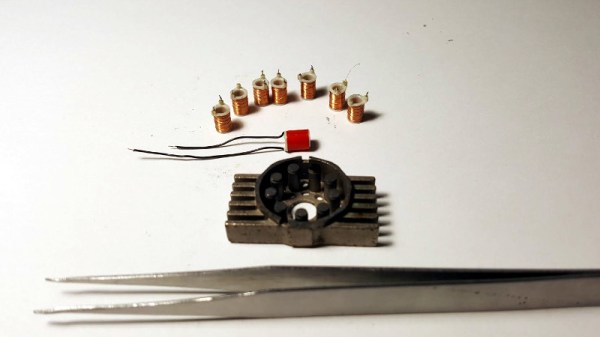
[Wpqrek] bought an old dot-matrix printer, a Commodore MPS 803. Sadly it didn’t live up to the dot-matrix reputation for reliability in that it didn’t work, some of its pins weren’t moving, so he set to on its repair. Behind each of those pins was a solenoid, and after finding a crack in the flexible ribbon to the head he discovered that some of the solenoids were open-circuit. On dismantling the head it became apparent that the wires had detached themselves from the solenoids, so he very carefully reattached new wires and reassembled the unit. Of course, he had no replacement for the flexible ribbon, so he made a replacement with a bundle of long lengths of flexible hook-up wire. This hangs out of the top of the printer as it follows the carriage, but for now it keeps the device working.

Dot-matrix printers are a favourite for our readership. Among others, we’ve seen another Commodore get the Python treatment, as well as an Apple capable of printing in full colour.

Samy Kamkar’s LED Balloon Network

Writing this in the frigid darkness of a Northern Hemisphere January evening, I have to admit to more than a little envy of Samy Kamkar and his friends. One of their summer events is a private party at a secluded campground somewhere that looks quite warm, which from here seems mighty attractive.

Samy wanted to provide a spectacle for his friends. What he came up with is glowing orbs; LED balloons that would float above the campsite and wow his friends with their pretty synchronised illumination. Thus an adventure in wireless communications, lighter-than-air flammable gasses versus electronics weight calculations, and code optimization began, the details of which were shared in Samy Kamkar’s 2018 Hackaday Superconference talk embedded below.

Continue reading “Samy Kamkar’s LED Balloon Network”

Anatomy Of A Cloned Piece Of Hardware

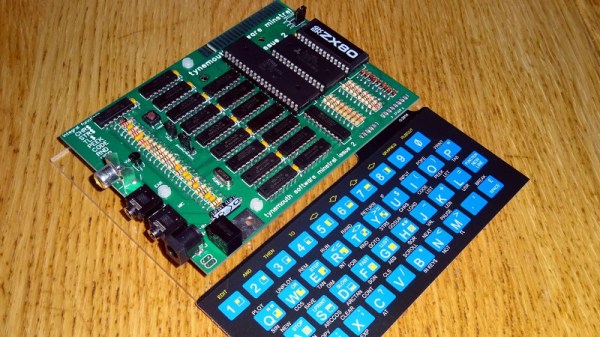
What would you think if you saw a bootleg of a product you design, manufacture, and sell pop up on eBay? For those of us who don’t make our livelihood this way, we might secretly hope our blinkenlight project ends up being so awesome that clones on AliExpress or TaoBao end up selling in the thousands . But of course anyone selling electronics as their business is going to be upset and wonder how this happened? It’s easy to fall into the trap of automatically assigning blame; if the legit boards were made in China would you assume that’s where the design was snagged to produce the bootlegs? There’s a saying about assumptions that applies to this tale.

Dave Curran from Tynemouth Software had one of his products cloned, and since he has been good enough to share all the details with us we’ve been able to take a look at the evidence. Dave’s detective work is top notch. What he found was surprising, his overseas manufacturer was blameless, and the bootleg board came from an entirely different source. Continue reading “Anatomy Of A Cloned Piece Of Hardware”

No Keyboard Needed, This Laptop Is All Screens

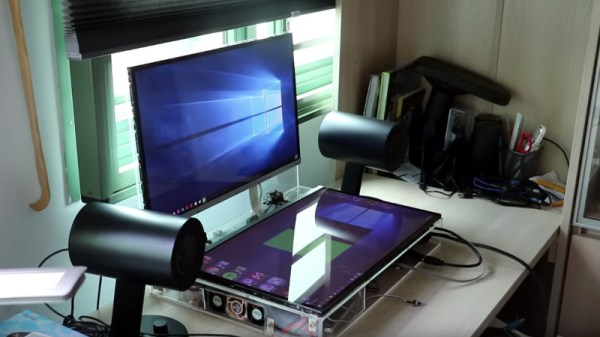
If you have an eye for obscure Microsoft products, you may be aware of the Microsoft PixelSense, a table-sized horizontal touchscreen designed as a collaborative workspace. It’s a multi-user computer with no traditional keyboard or mouse, instead multiple users work with documents and other files as though they were real documents on a table. It’s an impressive piece of technology, and it was the first thing that came to mind when we saw [Anitomicals C]’s dual screen portable computer. It has a form factor similar to a large laptop, in which the touchscreen folds upwards to reveal not a conventional keyboard and trackpad, but another identical touchscreen. The entire surface of the computer is a touch display with a desktop propagated across it, and in a similar way to the Microsoft product the user can work exclusively in the touch environment without some of the limitations of a tablet.

He freely admits that it is a prototype and proof of concept, and that is obvious from its large size and extensive use of desktop components. But he has brought it together in a very tidy Perspex case serving as an interesting class in creating a portable computer with well-chosen desktop components, even though with no battery it does not pretend to fit the same niche as a laptop. We’d be interested to see the same interface produced as a less bulky desktop-only version with solely the two monitors, because the horizontal touch screen is what sets this machine apart from other home-made ones.

Home made laptops are a regular sight on these pages, but some of them are a little more rough-and-ready.

Continue reading “No Keyboard Needed, This Laptop Is All Screens”

Hold That Cam Belt Pulley In Place With This Neat CNC Work

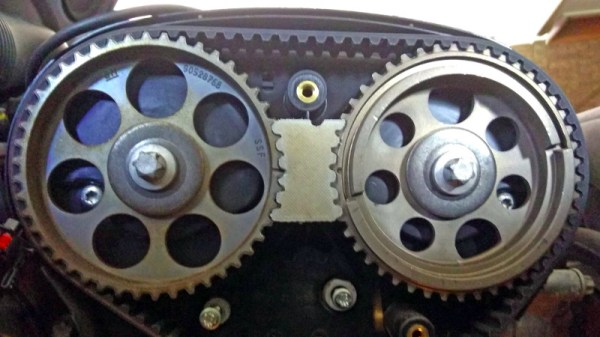
The modern overhead-cam internal combustion engine is a mechanical masterpiece of hundreds of parts in perfect synchronisation. In many cases it depends for that synchronisation upon a flexible toothed belt, and those of you who have replaced one of these belts will know the exacting requirements for keeping the various pulleys in perfect alignment during the process.

[Greolt] had this problem with a dual overhead-cam engine, particularly that the shafts would spring out of alignment on removal of the belt. The solution was one of those beautifully simple hacks that use high-tech methods to make something that is not high-tech in itself but which solves a problem perfectly. He produced a CNC-machined block of HDPE to sit between the two toothed pulleys that was machined exactly to their profiles and which once inserted kept them securely and exactly in alignment.

It’s likely that the same job could easily be done with a 3D printer, and indeed we’ve seen it done with a small piece of soft wood and a hammer. But there is something very elegant indeed about this particular incarnation that we like, it may not be the most complex of the hacks you’ll see here but we’re sure you’ll agree if you’ve ever changed a cambelt, it’s a pretty useful one.

Of course, once you’ve changed that belt, perhaps you’d like to do something with the old one.

Thanks [Brian Moran] for the tip.

UPnP, Vulnerability As A Feature That Just Won’t Die

UPnP — in a perfect world it would have been the answer to many connectivity headaches as we add more devices to our home networks. But in practice it the cause of a lot of headaches when it comes to keeping those networks secure.

It’s likely that many Hackaday readers provide some form of technical support to relatives or friends. We’ll help sort out Mom’s desktop and email gripes, and we’ll set up her new router and lock it down as best we can to minimise the chance of the bad guys causing her problems. Probably one of the first things we’ll have all done is something that’s old news in our community; to ensure that a notorious vulnerability exposed to the outside world is plugged, we disable UPnP on whatever cable modem or ADSL router her provider supplied.

Continue reading “UPnP, Vulnerability As A Feature That Just Won’t Die”

A Fully Automatic Electric Can Crusher

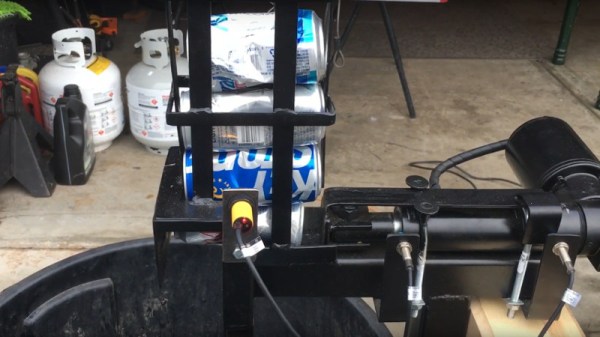
Those of us who recycle our empty drink cans know the annoying storage problem these containers present. For an object with very little metal, a can takes up a huge amount of space, and should you possess a greater than average thirst you can soon end up with a lot of space taken up with stacks of cans. The solution of course is to crush them, and while there are many simple solutions involving hinged blocks of wood or lever systems, this is 2019! We have Machines to that kind of thing for us! [All Things Electro-Mechanical] thinks so anyway, for he has created an automatic can crusher that is a joy to behold.

At its heart is a 120V AC powered linear actuator, which crushes a can held in a welded steel guide. As the can is crushed it drops into a waiting bin, and when the actuator retracts a fresh can drops down from a hopper. Control is handled by a Raspberry Pi, and there are end sensors for the actuator and an optical sensor for the can hopper. As it stands, once the last can is in place the machine stops due to the optical sensor registering no can in the hopper, but no doubt a software change could cause it to execute a single crush cycle after the last can it detects.

This machine would be an ideal candidate for a simple industrial automation system, but however it is controlled it would save its owner from an embarrassing test of strength. Take a look, we’ve posted the two videos showing it in action below the break.

Thanks [Baldpower] for the tip.

Continue reading “A Fully Automatic Electric Can Crusher”