Living in a condo with inadequate opportunity for fresh light wiring presented a problem for [Raphael Luckom], which he solved by taking a few off-the-shelf ESP8266-based IoT mains switches. That in itself is nothing particularly new these days, but what makes his switches special is that when faced with fiddly soldering to reprogram them, instead he fabricated a pogo pin jig to make the required contacts.
He took inspiration for his work from a Hackaday.io project hacking some Chinese switched outlets. They contain a standard ESP-12 module, so identifying the correct pins to program them was easy enough. He simply had to create a jig for his pogo pins, which he did with his 3D printer. Of course, “simply” is not an appropriate word, because along the way he had to pass through many iterations of the print, but eventually he had his jig secured to the boards with a clamp.
The result: a successful relay, and without the tricky soldering. We know many of our readers will have no problems with a bit of solder, but for those of you that don’t there might be a bit of interest here.
There is no question, that Santa Claus exists. He’s real, with the sleigh, the beard, and the reindeer and everything. He distributes gifts to billions of children in an evening, squeezes down a billion chimneys without getting that stylish red outfit dirty, and gets back home to the North Pole before sunrise. What more proof do you need, after all the missile defence folks track his progress over the icy wastes every Christmas Eve!
Well, the previous paragraph is the story you’ll get from the average youngster in countries where St. Nick is a cultural fixture, and who are we to disabuse them of this notion. Certainly not [Dave Barrett], who has the task of coming up with some ideas for a Santa Proof Of Existence for a kids’ Christmas party. In a previous year he’s thrilled them with a view of the sleigh taking off (in reality a remote-controlled model rocket launch complete with fake air traffic control clearance for Santa via CB radio), but this year the party isn’t somewhere with the space to do that trick. Instead he has the task of maintaining the illusion in those young minds for another year, with only a modest suburban plot in which to do it.
How would you prove Santa’s existence for the credulous young party-goers, using the finest technological marvels available to the Hackaday community? Perhaps you might create the illusion of boots crunching in the snow outside, or maybe the not-so-distant sound of reindeer. We suggest a Santa-Pede won’t cut it, and neither will hiring the beardy member of your hackspace as a stand-in. Kids aren’t that stupid!
Feeding the cat should be a moment of magic, in which you bond with your adorable pet as she rubs seductively against your ankles. As you place the saucer of tender and moist meaty chunks on the floor, she bounds the length of your kitchen, excited expression on her little kitty face, and tail in the air.
If Hackaday made television adverts for cat food, we’d have it nailed. But our everyday reality involves the cute-as-heck Hackaday moggy turning into a persistent little pest when she decides it’s feeding time. [ThinkSilicon]’s friends had exactly this problem, with their furry friend’s preferred timing coming early in the morning. His solution? An automated cat feeder (translated) that dispenses kibbles from a hopper into the lucky mouser’s feeding dish.
The mechanical part of this endeavour is pretty straightforward, a servo moves a sliding piece of plywood with a hole cut in it across the bottom of a hopper full of cat food. Move the slide, dispense food down a chute to the waiting happy cat. Behind the scenes is an ESP8266 and a NodeMCU web service, through which feeding time can be either scheduled, or dispensed at will.
A happy cat means a happy owner, especially in the very early morning. Until that is the newly-sated creature decides to spread the love, jumping onto the owner’s bed in thanks and breathing cat-food-breath into their face. You really do have to love ’em!
Winter in the parts of the Northern Hemisphere for which observing Christmas includes bringing half a forest into the house should really be divided into two seasons. No-spruce-needles-in-the-carpet season, and spruce-needles-doggedly-clinging-to-the-carpet season. Evergreen trees were not designed for indoor use, and for a hapless householder to stand any chance of keeping those needles on the branches there has to be a significant amount of attention paid to the level of the water keeping the tree hydrated.
[Evan] has paid that attention to the problem of Christmas tree hydration, and to address the shortcomings of earlier designs has come up with a low water warning using an ultrasonic rangefinder. Where previous sensor attempts based on conductive probes succumbed to corrosion or dirt build-up, this one has no contact between sensor and water.
Behind the rangefinder is a CHIP board, whose software sends a text message to his phone when the water level gets a bit low. All the software is available in the linked GitHub page, so should you wish to make your tree safe from thirst, you too can give it a try.
When we mention vacuum technology, it’s not impossible that many of you will instantly turn your minds to vacuum tubes, and think about triodes, or pentodes. But while there is a lot to interest the curious in the electronics of yesteryear, they are not the only facet of vacuum technology that should capture your attention.
When [Alan Yates] gave his talk at the 2017 Hackaday Superconference entitled “Introduction To Vacuum Technology”, he was speaking in a much more literal sense. Instead of a technology that happens to use a vacuum, his subject was the technologies surrounding working with vacuums; examining the equipment and terminology surrounding them while remaining within the bounds of what is possible for the experimenter. You can watch it yourself below the break, or read on for our precis.
In the first instance, he introduces us to the concept of a vacuum, starting with the work of [Evangelista Torricelli] on mercury barometers in the 17th century Italy, and continuing to explain how pressure, and thus vacuum, is quantified. Along the way, he informs us that a Pascal can be explained in layman’s terms as roughly the pressure exerted by an American dollar bill on the hand of someone holding it, and introduces us to a few legacy units of vacuum measurement.
In classifying the different types of vacuum he starts with weak vacuum sources such as a domestic vacuum cleaner and goes on to say that the vacuum he’s dealing with is classified as medium, between 3kPa and 100mPa. Higher vacuum is beyond the capabilities of the equipment available outside high-end laboratories.
Introduction over, he starts on the subject of equipment with a quick word about safety, before giving an overview of the components a typical small-scale vacuum experimenter’s set-up. We see the different types of vacuum gauges, we’re introduced to two different types of service pumps for air conditioning engineers, and we learn about vacuum manifolds. Tips such as smelling the oil in a vacuum pump to assess its quality are mentioned, and how to make a simple mist trap for a cheaper pump. There is a fascinating description of the more exotic pumps for higher vacuums, even though these will be out of reach of the experimenter it is still of great interest to have some exposure to them. He takes us through vacuum chambers, with a warning against cheap bell jars not intended for vacuum use, but suggests that some preserving jars can make an adequate chamber.
We are then introduced to home-made gas discharge tubes, showing us a home-made one that lights up simply by proximity to a high voltage source. Something as simple as one of the cheap Tesla coil kits to be found online can be enough to excite these tubes, giving a simple project for the vacuum experimenter that delivers quick results.
Finally, we’re taken through some of the tools and sundries of the vacuum experimenter, the different types of gas torches for glass work, and consumables such as vacuum grease. Some of them aren’t cheap, but notwithstanding those, he shows us that vacuum experiments can be made within a reasonable budget.
It was a tweet from an online friend in the world of amateur radio, featuring a transmitter design published in Sprat, the journal of the G-QRP club for British enthusiasts of low-power radio. The transmitter was very simple, but seriously flawed: keying the power supply line would cause it to exhibit key clicks and frequency instability. It would probably have been far better leaving the oscillator connected full-time and keying the supply to the amplifier, with of course a suitable key click filter.
[M0CVO]’s Tweet that started it allWe’ve all probably made projects that get the job done at the expense of a bit of performance and economy, and from one angle this circuit is a fantastic example of that art. But it’s not the shortcomings of direct PSU keying a small transmitter that has brought it here, but observation instead of what it represents. Perhaps my social group of radio amateurs differs from the masses, but among them the universal lament is that there is nothing new in a simple transistor transmitter that could just as well have been published in 1977 as 2017.
To explain why this represents a problem, it’s worth giving some background. Any radio amateur will tell you that amateur radio is a wonderful and diverse pastime, in fact a multitude of pastimes rolled into one. Working DX? Got you covered. Contesting? UR 599 OM QRZ? Digital modes pushing the envelope of atmospheric propagation? Satellites? SDRs? GHz radio engineering? All these and many more can be yours for a modest fee and an examination pass. There was a time when radio was electronics, to all intents and purposes, and radio amateurs were at the vanguard of technology. And though electronics has moved on from those days of purely analogue communications and now stretches far beyond anything you’d need a licence and a callsign to investigate for yourself, there are still plenty of places in which an amateur can place themselves at the cutting edge. Software defined radio, for instance, or digital data transmission modes. With an inexpensive single board computer and a few components it is now possible to create a software-defined digital radio station with an extremely low power output, that can be copied on the other side of the world. That’s progress, it’s not so long ago that you would have required a lot of dollars and a lot of watts to do that. Continue reading “Radio Amateuring Like It’s 1975”→
If you have a car parked outside as you are reading this, the overwhelming probability is that it has a reciprocating piston engine powered by either petrol(gasoline), or diesel fuel. A few of the more forward-looking among you may own a hybrid or even an electric car, and fewer still may have a piston engine car powered by LPG or methane, but that is likely to be the sum of the Hackaday reader motoring experience.
We have become used to understanding that perhaps the era of the petroleum-fueled piston engine will draw to a close and that in future decades we’ll be driving electric, or maybe hydrogen. But visions of the future do not always materialize as we expect them. For proof of that, we only need to cast our minds back to the 1950s. Motorists in the decade following the Second World War would have confidently predicted a future of driving cars powered by jet engines. For a while, as manufacturers produced a series of prototypes, it looked like a safe bet.
The Chrysler gas turbine car from [Bryan]’s article. CZmarlin [Public domain].Back in August, my colleague [Bryan] wrote a feature: “The Last Interesting Chrysler Had A Gas Turbine Engine“, in which he detailed the story of one of the more famous gas turbine cars. But the beautifully styled Chrysler was not the only gas turbine car making waves at the time, because meanwhile on the other side of the Atlantic a series of prototypes were taking the gas turbine in a slightly different direction.
Rover was a British carmaker that was known for making sensible and respectable saloon cars. They passed through a series of incarnations into the nationalized British Leyland empire, eventually passing into the hands of British Aerospace, then BMW, and finally a consortium of businessmen under whose ownership they met an ignominious end. If you have ever wondered why the BMW 1-series has such ungainly styling cues, you are looking at the vestiges of a Rover that never made it to the forecourt. The very successful Land Rover marque was originally a Rover product, but beyond that sector, they are not remembered as particularly exciting or technically advanced.
The Rover JET1 prototype. Allen Watkin [CC BY-SA 2.0].At the close of the Second World War though, Rover found themselves in an interesting position. One of their contributions to war production had been the gas turbine engines found in the first generation of British jet aircraft, and as part of their transition to peacetime production they began to investigate civilian applications for the technology. Thus the first ever gas turbine car was a Rover, the 1950 JET1. Bearing the staid and respectable styling of a 1950s bank manager’s transport rather than the space-age look you might expect of the first ever gas turbine car, it nonetheless became the first holder of the world speed record for a gas turbine powered car when in 1952 it achieved a speed of 152.691 MPH.
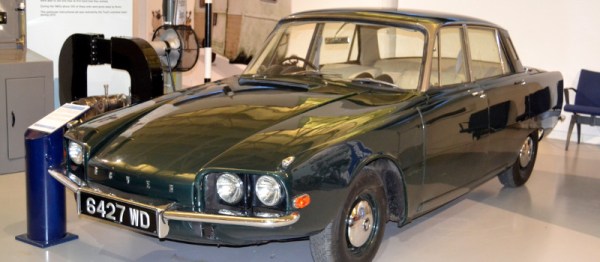
The JET1 was soon followed by a series of further jet-powered prototypes culminating in 1956’s T3 and 1961’s T4. Both of these were practical everyday cars, the T3, a sports coupé, and the T4, an executive saloon car whose styling would appear in the 1963 petrol-engined P6 model. There was also an experimental BMC truck fitted with the engine. The P6 executive car was produced until 1977, and all models were designed to have space for a future gas turbine option by having a very unusual front suspension layout with a pivot allowing the spring and damper to be placed longitudinally in the front wing.
The Rover-BRM racing car at Gaydon. David Merrett [CC BY 2.0].It was not only prototypes for production cars with gas turbines that came from Rover in the 1960s though, for in 1963 they put their gas turbine into a BRM racing chassis and entered it into the Le Mans 24 hour endurance race. It returned in the 1964 season fitted with a novel rotating ceramic honeycomb heat exchanger to improve its efficiency, racing for a final season in 1965.
The fate of the gas-turbine Rovers would follow that of their equivalent cars from other manufacturers including the Chrysler covered by [Bryan]. Technical difficulties were never fully overcome, the increasing cost of fuel made gas turbine cars uneconomic to run, and meanwhile by the 1960s the piston engine had improved immeasurably over what had been available when the JET1 had been produced. The Rover P6 never received its gas turbine, and the entire programme was abandoned. Today all the surviving cars are in museums, the JET1 prototype in the Science Museum in London, and the T3, T4, and Rover-BRM racing car at the Heritage Motor Centre at Gaydon. The truck survives in private hands, having been restored, and is a regular sight at summer time shows.
As a footnote to the Rover story, in response to the development of JET1 at the start of the 1950s, their rival and later British Leyland stablemate Austin developed their own gas turbine car. If international readers find Jet1’s styling a bit quaint compared to the American jet cars, it is positively space-age when compared to the stately home styling of the Sheerline limousine to which Austin fitted their gas turbine.







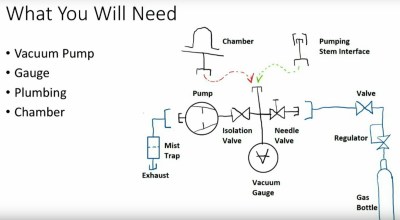 Introduction over, he starts on the subject of equipment with a quick word about safety, before giving an overview of the components a typical small-scale vacuum experimenter’s set-up. We see the different types of vacuum gauges, we’re introduced to two different types of service pumps for air conditioning engineers, and we learn about vacuum manifolds. Tips such as smelling the oil in a vacuum pump to assess its quality are mentioned, and how to make a simple mist trap for a cheaper pump. There is a fascinating description of the more exotic pumps for higher vacuums, even though these will be out of reach of the experimenter it is still of great interest to have some exposure to them. He takes us through vacuum chambers, with a warning against cheap bell jars not intended for vacuum use, but suggests that some preserving jars can make an adequate chamber.
![[M0CVO]'s Tweet that started it all](https://hackaday.com/wp-content/uploads/2017/10/screenshot-2017-10-31-nigel-booth-on-twitter.png)
![The Chrysler gas turbine car from [Brian]'s article. CZmarlin [Public domain].](https://hackaday.com/wp-content/uploads/2017/08/turbine.jpg)
![The Rover Jet1 prototype. Allen Watkin [CC BY-SA 2.0].](https://hackaday.com/wp-content/uploads/2017/11/rover_sort_of-_2398190117.jpg)
![The Rover-BRM racing car at Gaydon. David Merrett [CC BY 2.0].](https://hackaday.com/wp-content/uploads/2017/11/1024px-rover_brm_-_gas_turbine_heritage_motor_centre_gaydon_1.jpg)