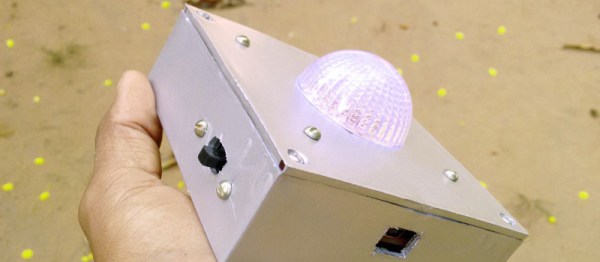
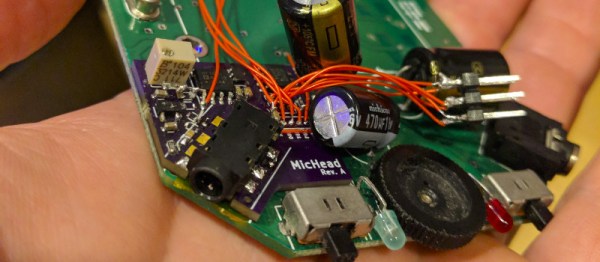
At its heart is a modified Arduino Nano clone that draws a measured 608 nA from a CR2450N. From the specification of the cell he has calculated the 50 year maximum figure, as well as a possible 29 years for a CR2032 and 64 years for a CR2477. He does however note that this does not take self-discharge into account, but you can probably afford a new battery in a decade or so.
The Arduino clone carefully selected for its “P” version low-power processor has had its serial bridge IC removed to achieve this power consumption, as well as a voltage regulator and some discrete components. Interestingly he notes that the ATMega168P is even more frugal than its 328 cousin, so he’s used the former chip. A selection of internal flags are set for minimal power consumption, and the internal oscillator is selected to use as low a clock speed as possible. There is an Intersil ISL1208 low power RTC chip mounted on a piece of stripboard to provide the timing, and of course an LED to provide the essential birthday alert.
When the LED lights for the big day there’s always the hope you’ll receive another coin cell, this time powering an edge-lit musical birthday card.
Coin Cell Challenge
Build something cool powered by a coin cell, win prizes!
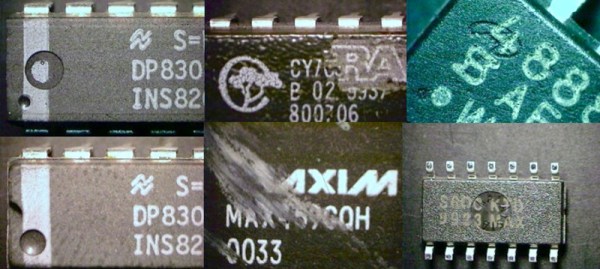
If you order an electronic component, how do you know what it is you are receiving? It has the right package and markings, but have you got the real thing from the original manufacturer or have you got an inferior counterfeit? We hear so much about counterfeit parts, and sometimes the level of effort put in by the fraudsters is so high that from either a visual or electrical standpoint they can be hard to spot.
The first feature of a package to be examined are the indents. Relabeled chips often have their old markings sanded off and a coating applied to simulate the surface of an unmolested chip, and this coating can either obliterate or partially fill any indentations. Using comparison photos we are shown discernable hidden indents, and partially filled indents.
We’re shown textures and paints, and how markings can sometimes be shown as counterfeit by washing with solvent. A Cypress-marked part is found to be a cheaper Altera one under the paint, and other parts are shown with misaligned markings and markings placed over indents. Wildly varying countries of origin are claimed while seemingly retaining the same batch codes, an impossibility confirmed by manufacturers.
If you order your parts from legitimate distributors then it’s likely that what you receive will be the genuine article. However with the popularity of online auction sites and online bazaars the possibility has become ever more likely of being left with a counterfeit. Knowing some of these tips might just make the difference between the success or failure of your work, so it’s an interesting read.
In the years since the Raspberry Pi and other similar inexpensive Linux-capable single board computers came to the market, we have shown you a huge variety of projects using them at the heart of portable computers. These normally take the form of a laptop or tablet project, but today we have one that starts from a completely different perspective.
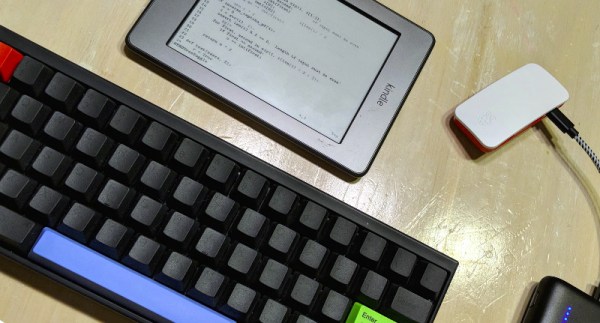
The “Kindleberry Pi Zero W” from [Ben Yarmis] does not attempt to create an enclosure or form factor for a portable computing solution. Instead it’s fair to say that it is more of a software hack than a hardware one, as he’s created something of an ad-hoc portable Raspberry Pi from other off-the-shelf pieces of consumer hardware.
The Zero W is a particularly useful computer for this application because of its tiny size, lowish power consumption, on-board Bluetooth, and wireless networking. He has taken a W and put it in the official Pi case, with a portable battery pack. No other connections, that’s his computer. As an input device he has a Bluetooth keyboard, and his display is a jailbroken Kindle Touch tied to the Pi using his Android phone as a WiFi router. We suspect with a little bit of configuration the Pi could easily serve that function on its own, but the phone also provides an Internet connection.
The result is a minimalist mobile computing platform which probably has a much longer battery life and higher reliability than portable Pi solutions using LCD displays, and certainly takes up less space than many others. Some might complain that there’s no hack in wirelessly connecting such devices, but we’d argue that spotting the possibility when so many others embark on complex builds has an elegance all of its own. It has the disadvantage for some users of providing only a terminal based interface to Raspbian, but of course we’re all seasoned shell veterans for whom that should present no problems, right?
When the ESP32 microcontroller first appeared on the market it’s a fair certainty that somewhere in a long-forgotten corner of the Internet a person said: “Imagine a Beowulf cluster of those things!”.
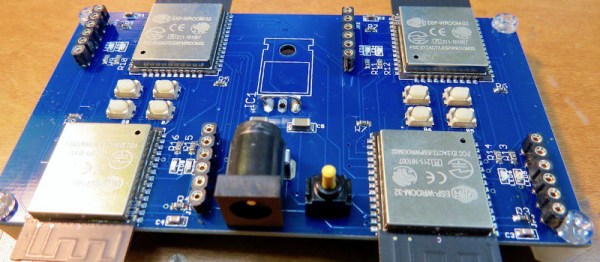
Someone had to do it, and it seems that the someone in question was [Kodera2t], who has made a mini-cluster of 4 ESP32 modules on a custom PCB. They might not be the boxed computers that would come to mind from a traditional cluster, but an ESP32 module is a little standalone computer with processing power that wouldn’t have looked too bad on your desktop only in the last decade. The WiFi on an ESP32 would impose an unacceptable overhead for communication between processors, and ESP32s are not blessed with wired Ethernet, so instead the board has a parallel bus formed by linking together a group of GPIO lines. There is also a shared SPI SRAM chip with a bus switchable between the four units by one of the ESp32s acting as the controller.
You might ask what the point is of such an exercise, and indeed as it is made clear, there is no point beyond interest and edification. It’s unclear what software will run upon this mini-cluster as it has so far only just reached the point of a first hardware implementation, but since ESP32 clusters aren’t exactly mainstream it will have to be something written especially for the platform.
Keeping animals from tropical regions of the world in a cold climate is an expensive business, they need a warm environment in their pens and sleeping areas. Marwell Zoo was spending a small fortune keeping its herd of nyalas (an antelope, not as the title suggests a deer, native to Southern Africa) warm with electric heating, so they went looking for a technology that could reduce their costs by only heating while an animal was in its pen.
One might expect that a passive IR sensor would solve the problem, but a sleeping nyala too soon becomes part of the background heat for these devices, and as a result, the heaters would not operate for long enough to keep the animals warm. The solution came from an unlikely source, a coffee queue monitoring project at the IBM Watson headquarters in Munich, that used an array of infra-red sensors to monitor the changing heat patterns and thus gauge the likelihood of a lengthy wait for a beverage.
In the zoo application, an array of thermal sensors hooked up to ESP8266 boards talk back to a Raspberry Pi that aggregates the readings and sends them to the IBM Watson cloud where they are analyzed by a neural net. The decision is then made whether or not a nyala is in the field of view, and the animal is toasted accordingly.
Hands up if you’ve had the misfortune to work in an office with a fondness for following the latest fads. Paperless office, how long did that last? Or moving from physical telephones to a flaky VOIP application on your Windows computer, that’s sure to be a resounding success! We’ve all been there at some point, haven’t we?
[Joshua Wise] found himself in that unenviable situation of the VOIP app move, and since he is a habitual headphone music listener the prospect of wearing his company-supplied headset was not appealing. His solution was to take his HeadRoom BitHead amplifier and plumb into it a microphone channel, and though he went through quite some work to reach that point the quality of his final work is very high.
He was in luck with the headphone amplifier, because the USB audio codec turns out to have an unused audio-in function as well as some HID input lines. His headset has a set of buttons as well as the microphone, which switch in and out a set of resistors to indicate which of them is pressed. Some work with a microcontroller to detect this resulted in a working interface, which he put along with the microphone circuitry on a beautifully done piece of protoboard.
Most constructors would have been happy at this point, but not [Joshua]. He proceeded to design a PCB to fit into the space around the headset socket, to contain the circuitry and better fit within the case. The result is an exceptionally high quality piece of work which he admits consumed a huge amount of resources but for which we applaud him.
So [Joshua] has a cool headset. But is it solar powered?
Our better-traveled colleagues having provided ample coverage of the 34C3 event in Leipzig just after Christmas, it is left to the rest of us to pick over the carcass as though it was the last remnant of a once-magnificent Christmas turkey. There are plenty of talks to sit and watch online, and of course the odd gem that passed the others by.
It probably doesn’t get much worse than nuclear conflagration, when it comes to risks facing the planet. Countries nervously peering at each other, each jealously guarding their stocks of warheads. It seems an unlikely place to find a 34C3 talk about 6502 microprocessors, but that’s what [Moritz Kütt] and [Alex Glaser] managed to deliver.
Policing any peace treaty is a tricky business, and one involving nuclear disarmament is especially so. There is a problem of trust, with so much at stake no party is anxious to reveal all but the most basic information about their arsenals and neither do they trust verification instruments manufactured by a state agency from another player. Thus the instruments used by the inspectors are unable to harvest too much information on what they are inspecting and can only store something analogous to a hash of the data they do acquire, and they must be of a design open enough to be verified. This last point becomes especially difficult when the hardware in question is a modern high-performance microprocessor board, an object of such complexity could easily have been compromised by a nuclear player attempting to game the system.
We are taken through the design of a nuclear weapon verification instrument in detail, with some examples and the design problems they highlight. Something as innocuous as an ATtiny microcontroller seeing to the timing of an analogue board takes on a sinister possibility, as it becomes evident that with compromised code it could store unauthorised information or try to fool the inspectors. They show us their first model of detector using a Red Pitaya FPGA board, but make the point that this has a level of complexity that makes it unverifiable.
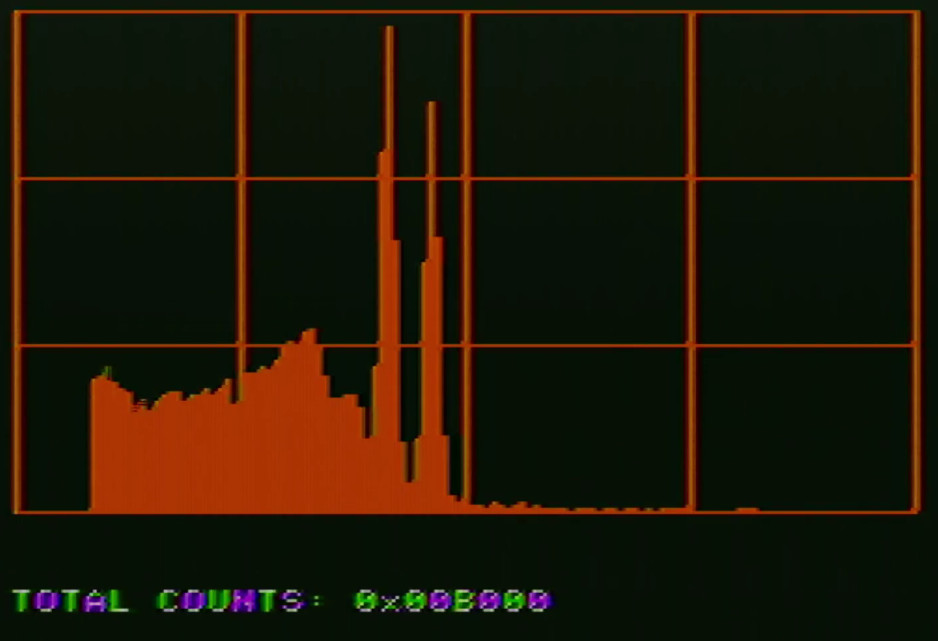
The gamma ray energy spectrum of a cobalt-60 source as seen from an Apple II.
Then comes the radical idea, if the technology used in this field is too complex for its integrity to be verified, what technology exists at a level that can be verified? Their answer brings us to the 6502, a processor in continuous production for over 40 years and whose internal structures are so well understood as to be de facto in the public domain. In particular they settle upon the Apple II home computer as a 6502 platform, because of its ready availability and the expandability of [Steve Wozniak]’s original design. All parties can both source and inspect the instruments involved.
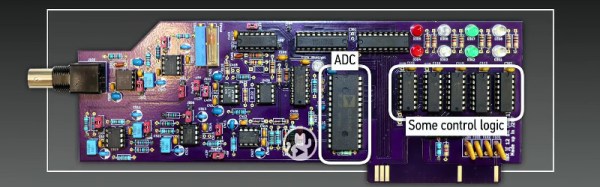
If you’ve never examined a nuclear warhead verification device, the details of the system are fascinating. We’re shown the scintillation detector for measuring the energies present in the incident radiation, and the custom Apple II ADC board which uses only op-amps, an Analog Devices flash ADC chip, and easily verifiable 74-series logic. It’s not intentional but pleasing from a retro computing perspective that everything except perhaps the blue LED indicator could well have been bought for an Apple II peripheral back in the 1980s. They then wrap up the talk with an examination of ways a genuine 6502 system could be made verifiable through non-destructive means.
It is not likely that nuclear inspectors will turn up to the silos with an Apple II in hand, but this does show a solution to some of the problems facing them in their work and might provide pointers towards future instruments. You can read more about their work on their web site.