Modern Wooden Houses With No Glue Or Nails

Depending where you are in the world, the techniques used to build houses can sometimes seem to be stuck in another century. Bricks and mortar, for instance, we build with them because we are used to them and have a large workforce of people trained to work with them and not much else. But in the 21st century with more advanced building technologies sitting relatively unused and looming housing crises at every turn, does it make sense to still build houses the slow and expensive way our great-grandparents did? Probably not.

Wooden houses are a promising solution to some of the problems outlined in the previous paragraph, and indeed in large parts of the world wood is the housing material of choice. It’s eco-friendly, not too expensive, and can be applied easily to multiple different types of structure. If you think of a wooden house, does the image of a log cabin come to mind, or perhaps a weatherboard house? Both construction methods that would be familiar again to your great-grandparents, so perhaps you might not call it an advanced building technology.

It’s interesting then to see an innovation from France, a system of interlocking wood sections that can be built into walls that look very similar to brick (Here’s the French language original). These are short sections of board cleverly designed with dovetailing to engage with vertical sections that interlock between different courses and leave a gap between wooden inner and outer faces of the wall that can be filled with insulation material. The effect is to create a wooden building system that can produce a vast range of structures that can be assembled in a very short time indeed. This isn’t prefabricated housing, but it delivers the speed you’d expect from it.

They have a video shoving construction of a typical house in rather idyllic French countryside, which we’ve put below the break. It has French language annotations, however for non Français speakers the context is pretty obvious.

Continue reading “Modern Wooden Houses With No Glue Or Nails”

Broken Plastic? No Problem!

When a computer case has survived several decades from being a new toy through being an unloved relic to being rediscovered and finding its way into the hands of an enthusiast, it is inevitable that it will have picked up some damage along the way. It will be scuffed, maybe cracked, and often broken. If it has faced the ordeal of an international courier after an eBay sale then the likelihood of a break increases significantly.

If you receive a vintage computer in the post and find it cracked or broken, never fear. [Drygol] has a solution, a guide to plastic welding with a soldering iron.

After a thorough cleaning, the technique is to hold the sides of the break together, run the iron along it to melt the plastic together, and scrape the overflowed plastic back into the resulting trench before it solidifies. With careful sanding, a spot of polyester putty, and some spray paint, the broken case can be returned to new condition.

There is a video showing the process, in this case repairing a crack on a Commodore 64 case.

Continue reading “Broken Plastic? No Problem!”

Surfing Like It’s 1998, The Dreamcast’s Still Got It!

If you were a keen console gamer at the end of the 1990s, the chances are you lusted after a Sega Dreamcast. Here was a console that promised to be like no other, a compact machine with built-in PowerVR 3D acceleration (heavy stuff back then!), the ability to run Windows CE in some form, and for the first time, built-in Internet connectivity. Games would no longer be plastic cartridges as they had been on previous Sega consoles, instead they would come on a proprietary DVD-like Sega disc format.

It was a shame then that the Dreamcast never really succeeded in capitalizing on its promise. Everyone was talking about the upcoming Sony Playstation 2, and disappointing Dreamcast sales led Sega to withdraw both the console, and themselves from the hardware market entirely.

There remains a hard core of Dreamcast enthusiasts though, and they continue to push the platform forward.The folks at the Dreamcast Junkyard decided to go backwards a little when they resurrected the console’s dial-up modem to see whether a platform from nearly twenty years ago could still cut it in 2017. This isn’t as easy a task as you’d imagine, because, well, who uses dial-up these days? Certainly in the UK where they’re based it’s almost unheard of. They were able to find a pay-as-you go dial-up provider though, and arming themselves with the most recent Dreamkey V3.0 browser disc were able to get online.

As you might expect, the results are hilariously awful for the most part. Modern web sites that rely on CSS fail to render or even indeed to load, but retro sites like those in the Dreamcast community appear as they should. There is a video we’ve put below the break showing the rather tortuous process, though sadly they didn’t think to load the Hackaday Retro Edition. It does however feature the rarely-seen keyboard and mouse accessories.

Continue reading “Surfing Like It’s 1998, The Dreamcast’s Still Got It!”

How An Oscilloscope Probe Works, And Other Stories

The oscilloscope is probably the most versatile piece of test equipment you can have on your electronics bench, offering a multitude of possibilities for measuring timing, frequency and voltage as well as subtleties in your circuits revealed by the shape of the waveforms they produce.

On the front of a modern ‘scope is a BNC socket, into which you can feed your signal to be investigated. If however you simply hook up a co-axial BNC lead between source and ‘scope, you’ll immediately notice some problems. Your waveforms will be distorted. In the simplest terms your square waves will no longer be square.

Why is this? Crucial to the operation of an oscilloscope is a very high input impedance, to minimise current draw on the circuit it is investigating. Thus the first thing that you will find behind that BNC socket is a 1 megohm resistor to ground, or at least if not a physical resistor then other circuitry that presents its equivalent. This high resistance does its job of presenting a high impedance to the outside world, but comes with a penalty. Because of its high value, the effects of even a small external capacitance can be enough to create a surprisingly effective low or high pass filter, which in turn can distort the waveform you expect on the screen.

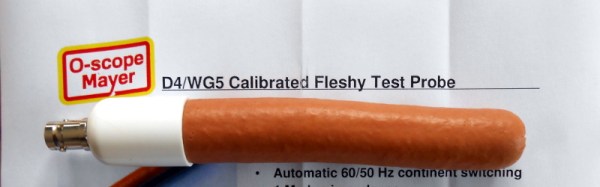
The answer to this problem is to be found in your oscilloscope probe. It might seem that the probe is simply a plug with a bit of wire to a rigid point with an earth clip, but in reality it contains a simple yet clever mitigation of the capacitance problem.

Continue reading “How An Oscilloscope Probe Works, And Other Stories”

This WAV File Can Confuse Your Fitbit

As the devices with which we surround ourselves become ever more connected to the rest of the world, a lot more thought is being given to their security with respect to the internet. It’s important to remember though that this is not the only possible attack vector through which they could be compromised. All devices that incorporate sensors or indicators have the potential to be exploited in some way, whether that is as simple as sniffing the data stream expressed through a flashing LED, or a more complex attack.

Researchers at the University of Michigan and the University of South Carolina have demonstrated a successful attack against MEMS accelerometers such as you might find in a smartphone. They are using carefully crafted sound waves, and can replicate at will any output the device should be capable of returning.

MEMS accelerometers have a microscopic sprung weight with protruding plates that form part of a set of capacitors. The displacement of the weight due to acceleration is measured by looking at the difference between the capacitance on either side of the plates.

The team describe their work in the video we’ve put below the break, though frustratingly they don’t go into quite enough detail other than mentioning anti-aliasing. We suspect that they vibrate the weight such that it matches the sampling frequency of the sensor, and constantly registers a reading at a point on its travel they can dial in through the phase of their applied sound. They demonstrate interference with a model car controlled by a smartphone, and spurious steps added to a Fitbit. The whole thing is enough for the New York Times to worry about hacking a phone with sound waves, which is rather a predictable overreaction that is not shared by the researchers themselves.

Continue reading “This WAV File Can Confuse Your Fitbit”

The Inventions Of Arthur Paul Pedrick

We hear a lot about patent portfolios when we scan our morning dose of tech news stories. Rarely a day passes without news of yet another legal clash between shady lawyers or Silicon Valley behemoths, either settling spats between multinationals or the questionable activities of patent trolls.

These huge and well-heeled organisations hold many patents, which they gather either through their staff putting in the hard work to make the inventions, or by acquisition of patents from other inventors. It is not often that a large quantity of patents are amassed by any other means, for example by an individual.

There is one prolific individual inventor and holder of many patents though. He achieved notoriety not through his inventions being successful, but through their seeming impracticability while conforming to the rules of the patent system. His name was [Arthur Paul Pedrick], and he was a retired British patent examiner who filed a vast number of eccentric patents from the early 1960s until his death in the mid 1970s, all of which stretched the boundaries of practicality.

His subject matter was varied, but included a significant number of transport inventions as well as innovations in the field of energy and nuclear physics. We wish there was room to feature them all on these pages, but sadly they are so numerous that it is difficult even to pick the selection we can show you. So sit down, and enjoy the weird and wonderful world of [Pedrick] innovations.

Continue reading “The Inventions Of Arthur Paul Pedrick”

[Ashhar Farhan]’s Done It Again!

If you are a regular follower of these pages as well as a radio amateur, you may well have heard of [Ashhar Farhan, VU2ESE]. He is the designer of the BitX, a simple single-sideband transceiver that could be built for a very small outlay taking many of its components from a well-stocked junk box.

In the years since the BitX’s debut there have been many enhancements and refinements to the original, and it has become something of a standard. But it’s always been a single-band rig, never competing with expensive commercial boxes that cover the whole of the available allocations.

With his latest design, he’s changed all that. The uBITX (Micro-BITX when spoken aloud), is an SSB and CW transceiver that covers all of the HF amateur bands, and like the original is designed for the home constructor on a budget. It shows its heritage in the use of bi-directional amplifiers, but diverges from the original with a 45 MHz first IF and an Arduino/SI5351 clock generator in the place of a VFO. It looks to be an excellent design in the spirit of the original, and we can’t wait to see them in the wild.

He’s put up a YouTube video which we’ve placed below the break. His write-up is extensive and fascinating, but it is his closing remarks which sum up the project and the reason why you should build one. We don’t often reproduce entire blocks of text, but this one says it so well:

As a fresh radio amateur in the 80s, one looked at the complex multiband radios of the day with awe. I remember seeing the Atlas 210x, the Icom 720 and Signal One radios in various friends’ shacks. It was entirely out of one’s realm to imagine building such a general coverage transceiver in the home lab.

Devices are now available readily across the globe through online stores, manufacturers are more forthcoming with their data. Most importantly, online communities like the EMRFD’s Yahoo group, the BITX20’s groups.io community etc have placed the tribal knowledge within the grasp of far flung builders like I am.

One knows that it was just a matter of breaking down everything into amplifiers, filters, mixers and oscillators, but that is just theory. The practice of bringing a radio to life is a perpetual ambition. The first signal that the sputters through ether, past your mess of wires into your ears and the first signal that leaps out into the space from your hand is stuff of subliminal beauty that is the rare preserve of the homebrewer alone.

At a recent eyeball meet, our friend [Dev(VU2DEV)] the famous homebrewer said “Now is the best time to be a homebrewer”. I couldn’t disagree.

If you build a uBITX, please share it with us!

Continue reading “[Ashhar Farhan]’s Done It Again!”