Hackaday Prize Entry: Neopixel Pocket Watch

A timepiece is rather a rite of passage in the world of hardware hacking, and we never cease to be enthralled by the creativity of our community in coming up with new ones.

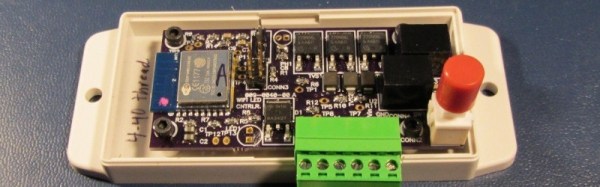
Today’s example comes from [Joshua Snyder], who has made a pocket watch. Not just any pocket watch, he’s taken the shell of a clockwork watch and inserted a ring of Neopixels, which he drives  from an ESP8266 module. Power comes from a small LiPo battery, and he’s cleverly engineered a small push-button switch so that it can be actuated by the knob from the original watch. Different colour LEDs traverse the ring to simulate the hands of a traditional timepiece, and the whole nestles behind the perforated cover of the watch shell for something of a steampunk feel.

He admits the battery life is not very good at the moment, probably because for now the WiFi is always enabled so he can reach its web interface for debugging. Sadly he appears to have not yet posted the software, but he does tell us it uses NTP to update its time, and that it supports over-the-air updating for new versions. He suggests a future version might dispense with the ESP and use an ATtiny or similar with a real-time clock giving better battery life.

We’ve covered a lot of LED timepieces over the years, including quite a few watches. Only a small selection are this PIC LED ring in a pocket watch case, another LED ring this time powered by an ATMega645, and this very stylish OLED wristwatch.

The Surprising Story Of The First Microprocessors

If you maintain an interest in vintage computers, you may well know something of the early history of the microprocessor, how Intel’s 4-bit 4004, intended for a desktop calculator, was the first to be developed, and the follow-up 8008 was the first 8-bit device. We tend to like simple stories when it comes to history, and inventions like this are always conveniently packaged for posterity as one-off events.

In fact the story of the development of the first microprocessors is a much more convoluted one than it might appear, with several different companies concurrently at the forefront of developments. A fascinating recent IEEE Spectrum piece from [Ken Shirriff] investigates this period in microprocessor design, and presents the surprising conclusion that Texas Instruments may deserve the crown of having created the first 8-bit device, dislodging the 8008 from its pedestal. Continue reading “The Surprising Story Of The First Microprocessors”

Review: The National Museum Of Computing

Here’s a question for you all: how will you know when you are no longer young? When you fall out of love with contemporary popular music perhaps, or start to find the idea of a cruise holiday attractive? The surefire sign for many people is having to ask a teenager how a piece of technology works — this is probably not that applicable to most Hackaday readers.

How about when you’re shocked to encounter a significant part of your youth in a museum? These are supposed to be places of The Olden Days, full of rustic agricultural tools or Neolithic pottery, yet here you are in front of your teenage years presented for all to see. You have two choices: you can surrender to the inevitable and henceforth only wear beige clothing, take up golf or maybe book that old person’s cruise holiday, or you can dive in misty-eyed and reacquaint yourself with everything in front of you.

The above is probably an experience many regulars of these pages would share on a visit to Britain’s National Museum Of Computing in a corner of the famous Bletchley Park site, home of Britain’s wartime codebreaking efforts. They describe what they do on their web site as follows:

We conserve, restore, reconstruct, and give hands-on access to historic computers and related artefacts – with a particular focus on those which were the result of pioneering British ingenuity.

For the visitor this means that their galleries contain a huge array of computing and associated equipment, many of which are presented as working exhibits without too much of the dumbing-down that pervades so many other museums, and that the staff are extremely knowledgable about them.

The museum is housed in one of the groups of wartime codebreakers’ huts, laid out roughly in the shape of a capital H with the top of one vertical lopped off. If you are a connoisseur of British wartime sites you’ll recognise these buildings, they were built to a fairly standard design all over the country. Internally this means that the galleries are structured around the long corridors that are a staple of that era, giving in particular the earlier exhibits a feel of their time.

Continue reading “Review: The National Museum Of Computing”

The USB Killer Now Has Commercial Competition

With a proliferation of USB Flash disk drives has come a very straightforward attack vector for a miscreant intent on spreading malware onto an organisation’s computer network. Simply drop a few infected drives in the parking lot, and wait for an unsuspecting staff member to pick one up and plug it into their computer. The drives are so familiar that to a non-tech-savvy user they appear harmless, there is no conscious decision over whether to trust them or not.

A diabolical variant on the exploit was [Dark Purple]’s USB Killer. Outwardly similar to a USB Flash drive, it contains an inverter that generates several hundred volts from the USB’s 5 volts, and repeatedly discharges it into the data lines of whatever it is plugged into. Computers whose designers have not incorporated some form of protection do not last long when subjected to its shocking ministrations.

Now the original has a commercial competitor, in the form of Hong Kong-based usbkill.com. It’s a bit cheaper than the original, but that it has appeared at all suggests that there is an expanding market for this type of device and that you may be more likely to encounter one in the future. They are also selling a test shield, an isolated USB port add-on that allows the device to be powered up without damaging its host.

From the hardware engineer’s point of view these devices present a special challenge. We are used to protecting USB ports from high voltage electrostatic discharges with TVS diode arrays, but those events have an extremely high impedance and the components are not designed to continuously handle low-impedance high voltages. It’s likely that these USB killers will result in greater sales of protection thermistors and more substantially specified Zener diodes in the world of USB interface designers.

We covered the original USB Killer prototype when it appeared, then its second version, and finally its crowdfunding campaign. This will probably not be the last we’ve heard of these devices and they will inevitably become cheaper, so take care what you pick up in that parking lot.

[via Extremetech]

A Motorcycle Lift From A Trailer Jack

If you have ever worked on a motorcycle on a regular basis with a limited workshop, you’ll know the challenge of taking off one or other of the wheels. You’ll probably have plenty of tales of bikes balanced precariously on blocks or suspended from the ceiling on a web of cargo straps, and if you are really unlucky you’ll have the Dented Tank Of Shame from the whole edifice tumbling down.

Continue reading “A Motorcycle Lift From A Trailer Jack”

Very Simple PC Frequency Counter Works Up To 100MHz

We all use 74 logic in our projects as general purpose logic interfacing glue. These chips have become as ubiquitous as a general-purpose op-amp, or even as passive components. In most cases we’re not demanding much of them, and power requirements aside an original 74 chip from the dawn of the series could probably do the same job that we’re putting a more modern variant to work on.

It is easy therefore to forget that 74 logic is a field that has seen continuous improvement and innovation reflecting the developments elsewhere in electronics, and the most modern 74 versions hide some impressively high specifications.

A good example comes via a project from [Scott, AJ4VD], a very simple frequency counter that uses a single 74 series chip at its business end, and counts to over 100MHz. The chip in question is a 74LV8154 dual 16-bit counter which he is using as a prescaler to deliver a rate more acceptable to an ATMega328 microcontroller that does the counting. As he points out, the accuracy of a frequency counter is only as good as its gate timing, and he ensures as accurate a seconds-worth of pulses as he can with a 1PPS signal derived from an inexpensive GPS receiver. The 328 makes its counting available to a host computer via a serial port, and can be easily read through a terminal. He’s built it dead-bug style on a piece of unetched PCB, on which the simplicity of the circuit is evident.

There was a time when a project like this one would have required multiple integrated circuits including a probably quite expensive purpose-built prescaler. Cheap glue logic has now advanced to a stage at which it can be done instead at commodity prices, and we like that.

We’ve featured a few 74-series counters before, including this old-school one and this one also using a 74LV8154.

31415926 (That’s Roughly Π Times 10 Million Raspberries)

The Raspberry Pi Foundation founder Eben Upton has announced that their ten millionth eponymous single-board computer has been sold since their launch back in February 2012. It’s an impressive achievement, especially so since their original sales expectations were for a modest ten thousand. For those of us who watched the RS and Farnell websites crumble under the strain of so many would-be purchasers on that leap day morning four and a half years ago their rapidly exceeding that forecast came as no surprise, but still, it’s worth a moment’s consideration. They passed the Sinclair ZX Spectrum’s British record of 5m computers sold back in February 2015, leaving behind the Pi’s BBC Micro spiritual ancestor on 1.5m sold long before that.

Critics of the Pi will point out that its various versions have rarely been the most powerful small single board computer on the market, or even at times the cheapest. They will also point to the closed-source nature of the Broadcom binary blob that underpins Pi operating systems, and even the sometimes unpredictable nature of the Pi Foundation with respect to its community, product availability and launches. But given that the Pi Foundation’s focus is not on our side of the community but on using the boards as a tool to introduce young people to computing, it’s fair to say that they’ve done a pretty good job of ensuring that a youngster can now get their hands on a useful and easily programmable computer much more easily than at any time in the past.

Would we be in the same position of being able to buy a capable Linux computer for near-pocket-money prices had the Raspberry Pi not been released? Probably so, in fact certainly so. The hardware required to deliver these products has inevitably fallen into a more affordable price bracket, and we would certainly have plenty of boards at our fingertips. They would probably have Allwinner or maybe Mediatek processors rather than the Pi’s Broadcom part, but they would be very likely to deliver equivalent performance at a similar cost. Where the Raspberry Pi’s continued success has come from then has not necessarily been from its hardware but from its community and software. The reliability and ease of use delivered by the Raspbian Linux distribution that Just Works for the parent putting a Pi in front of their child, and the wealth of expert information on the Raspberry Pi forums to get them through any Pi-related troubles are what has given the Pi these sales figures. The boards themselves are almost incidental, almost any hardware paired with that level of background information would likely have met with similar success. Comparing the Pi software experience with for example one of their most capable competitors, it’s obvious that the software is what makes the difference.

It’s likely that Raspberry Pi sales will continue to climb, and in years to come we’ll no doubt be reporting on fresh milestones on ever more powerful revisions of their product. But it’s also likely that their competition will up their software game and their position in the hearts and minds of single board computer users might be usurped by a better offering. If this increased competition in the single board computer market delivers better boards with more for the hardware developer community, then we’re all for it.