Playing The Interview Game

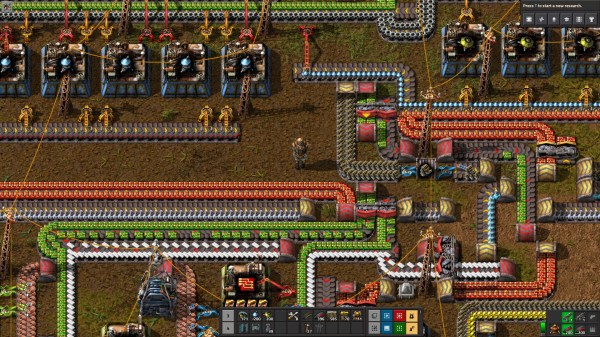
Technical interviews are generally dreaded, just like every other interview. However, technical interviews include many elements that non-technical folks might find mystifying or even pointless, such as whiteboard problem solving, take-home assignments, design sessions, or even just straight brain teasers. [Erik McClure] went a bit off the beaten path and started using the factory builder game Factorio as a technical interview.

Many point to the intent behind the problems and tricky questions inherent in whiteboard coding exercises and assert that the focus is not to complete the problem, but rather to expose how a candidate thinks and problem solves. Factorio is all problem-solving as you work as a team to slowly scale up a humble production line to a massive factory, which makes it a good candidate for assessing these sorts of skills. We doubt that the fine developers who wrote the game ever imagined it being used as an interview.

In all likelihood, you probably won’t have a Factorio interview anytime soon as [Erik] estimated each interview would take between eight and twenty hours. But we love the idea of reimagining the interview from a tedious set of problems to solve to an evolving cooperative game. Of course, you can also read more about getting the experience necessary for a job and what companies are looking for in an interview.

A trailer for Factorio is after the break.
Continue reading “Playing The Interview Game”

A Fresh E-Ink Newspaper Delivered Every Morning

[Greg Raiz] recently set out to make it easy to read multiple newspapers in the morning over breakfast. Inspired by a similar project, he built an e-ink newspaper that hangs on his wall, delivering fresh news every ten minutes.

The project started with a 32″ Visionect e-ink display configured as a thin client. With a battery life measured in months thanks to the low power electronics, most of the work here was focused on the backend. A docker container running on a local NAS server collects newspapers via freedomforum.org, formats them to fit the aspect ratio of the display, and serves them up. [Greg] is really trying to preserve the design and thought that goes into the front page of each of these publications as traditional newspaper layouts are often designed by hand.

We love the simplicity and the “it-just-works” feel of this project as there are no buttons, wires, or anything that you need to fiddle with. [Greg] points out that it could also be used for other purposes, and we’d love to see a large calendar such as this e-ink calendar or perhaps even a 32″ version of this e-ink laptop. The code for this is on his GitHub with a video after the break.

Continue reading “A Fresh E-Ink Newspaper Delivered Every Morning”

Serene Snowdecahedrons

It’s no secret that many parts of the United States saw quite a bit of snow that past few weeks. Even snowed in, hackers and engineers continue to do what they do and invent crazy wonderful things. Spurred on by a grand vision of complex polyhedron snowballs, [Jacob] created a clever 3D printed mold that can create Rhombic Dodecahedrons. It has some rather unusual properties as it can be stacked perfectly (no gaps in between the snowdechedrons) and all opposing sides are parallel so it can be held easily in a mitten or glove. Additionally, since the faces are parallel, it unmolds easily and without marring the beautiful snow you just crafted.

Premade STL’s of three different sizes are provided under creative commons with some helpful instructions on how best to print them. Perhaps next time your area gets some good snow, you can be prepared to show off with your high-performance ski-sled as your fly by throwing molded snowballs. That is until you get roped into a friendly debate about whether your snowdechedrons are in fact snow “balls”.

Thanks [Jacob] for sending this one in!

A Sympathetic Nail Violin

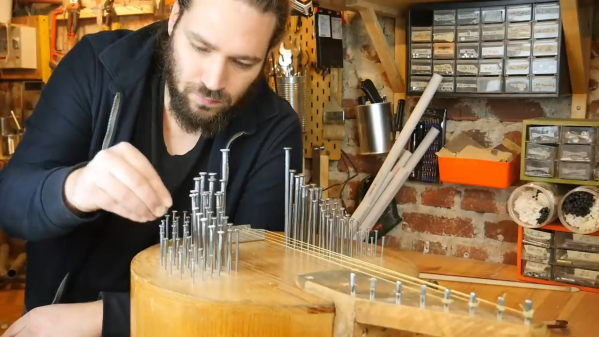
As a hacker community, we are no strangers to beautiful and unique musical instruments. A sympathetic nail violin built by [Nicolas Bras] is a welcome addition to the eclectic family. Working up from the simple idea of a nail in a piece of wood and adjusting the pitch by hammering the nail farther into the wood, [Nicolas] expanded the idea. With careful planning and tuning, the nails can have sympathetic properties. These properties mean that when one nail is played via a bow, it causes other nails to sound, creating harmonies and sustains.

With a bit of careful woodworking and a scant touch of metalwork, an instrument was crafted. It offers vast flexibility as it can be played by bow, by plucking with your finger, or by strumming. There are several levels of nails, each level having a paired sympathetic nail. This allows for a diverse and versatile instrument.

Here at Hackaday, we seem to have a thing for tiny violins, whether physical or virtual. While the nail violin may not look like your traditional violin, we can certainly appreciate the wonderful music it creates.

Continue reading “A Sympathetic Nail Violin”

Increasing The Resolution Of The Electrical Grid

As a society in the USA and other parts of the world, we don’t give much thought to the twisting vines of civilization that entangle our skies and snake beneath our streets. The humming electrical lines on long poles that string our nations together are simply just there. Ever-present and immutable. We expect to flick the switch and power to come on. We only notice the electrical grid when something goes wrong and there is a seemingly myriad number of ways for things to go wrong. Lighting strikes, trees falling on lines, fires, or even too many people trying to crank on the A/C can all cause rolling blackouts. Or as we found out this month, cold weather can take down generation systems that have not been weatherized.

We often hear the electrical grid described as aging and strained. As we look to the future and at the ever-growing pressure on the infrastructure we take for granted, what does the future of the electrical grid look like? Can we move past blackouts and high voltage lines that criss-cross the country?

Continue reading “Increasing The Resolution Of The Electrical Grid”

Stochastic Markov Beats

[Attoparsec] has been building intriguing musical projects on his YouTube channel for a while and his latest is no exception. Dubbed simply as “Node Module”, it is a rack-mounted hardware-based Markov chain beat sequencer. Traditionally Markov chains are software state machines that transition between states with given probabilities, often learned from a training corpus. That same principle has been applied to hardware beat sequencing.

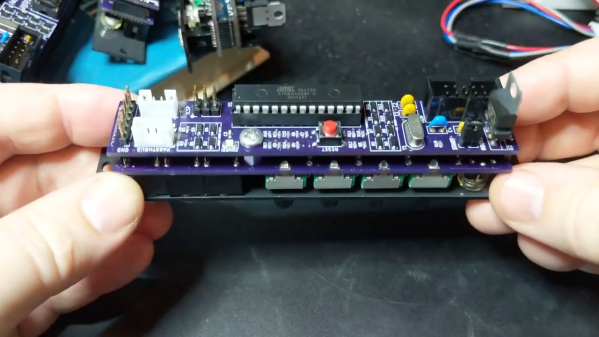
Each Node Module has a trigger input, four outputs each with a potentiometer, and a trigger out. [Attoparsec] has a wonderful explanation of all the different parts and theories that make up the module at the start of his video, but the basic operation is that a trigger input comes in and the potentiometers are read to determine the probabilities of each output. One is randomly selected and fired. As you can imagine, there are loops and even dead-end nodes and for some musical pieces there is a certain number of beats expected, so a clever reset signal can be sent to pull the chain back to the initial starting state at a regular interval. The results are interesting to listen to and even better to imagine all the possibilities.

The module itself is an Arduino-based custom PCB that is laid out quite cleanly. The BOM, code, and KiCad files are available on GitHub if you want to make one yourself. This isn’t the first instrument we’ve seen [Attoparsec] make, and we’re confident it won’t be the last.

Continue reading “Stochastic Markov Beats”

FreeTouchDeck Upgrades Its Hardware And Its Name: ESP32 Touchdown

With many folks continuing to work from home for far longer than they ever thought, it’s no surprise that we’re seeing the rise of small DIY devices to make that video call or virtual presentation a little easier. [Dustin Watts] was interested in the functionality of the Elgato Stream Deck — a macro keyboard where each key is its own screen. But that kind of fancy hardware comes with a formidable price tag. So he built his own, and made it open source!

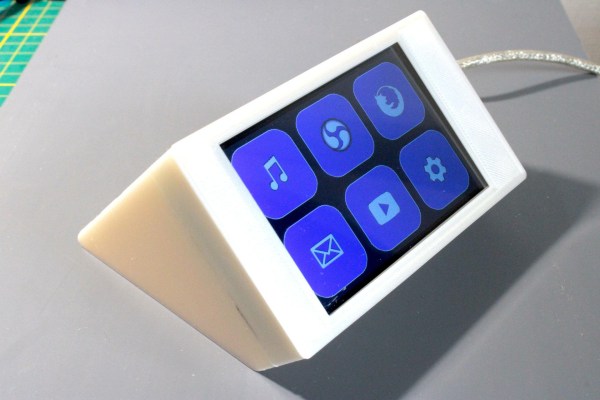
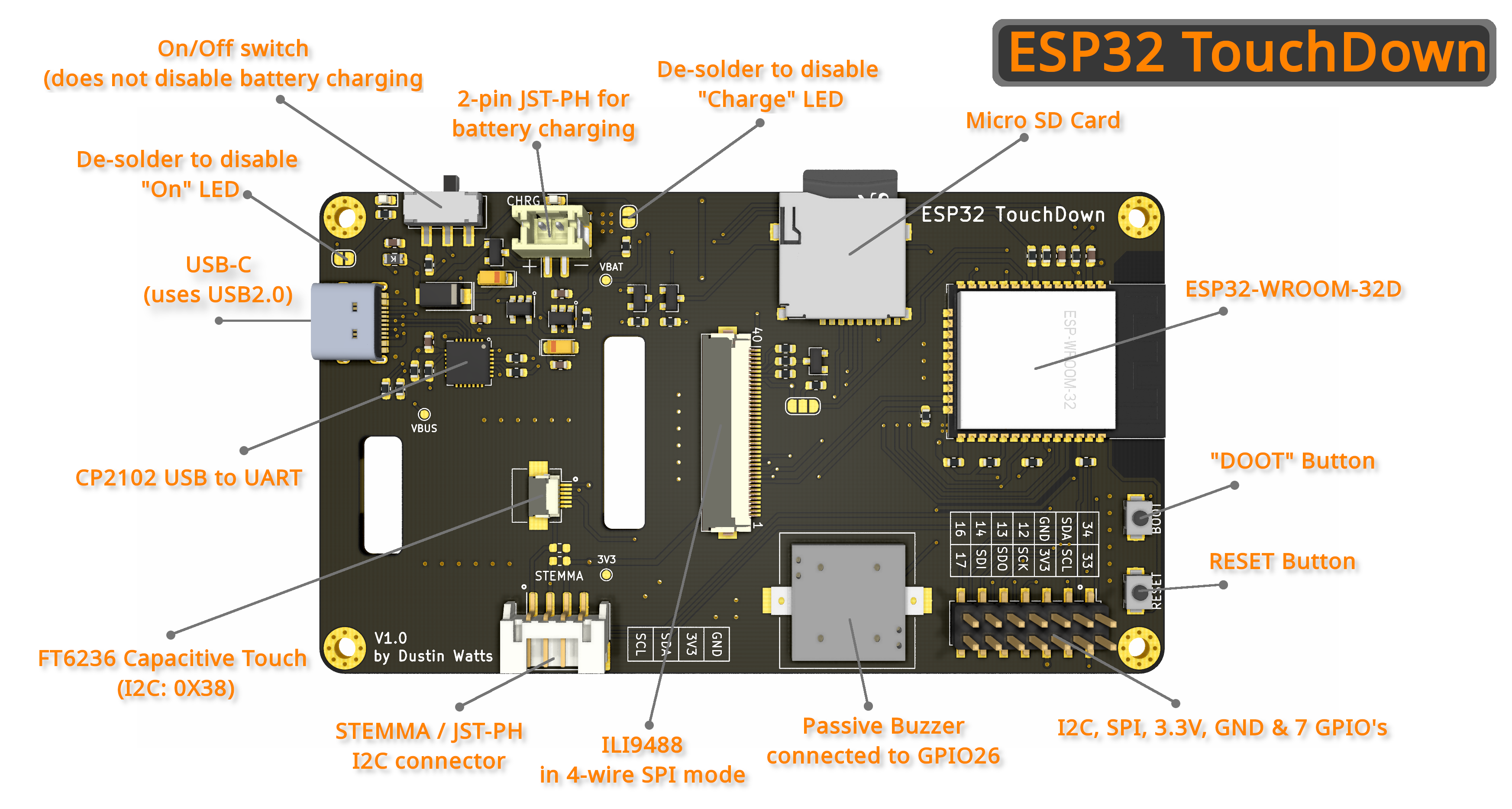
His first iteration — FreeTouchDeck — was built using commonly available modules but has since evolved into the ESP32 Touchdown which does it all with a single PCB. It’s a highly-customizable touchscreen macro keyboard which provide easy access shortcuts and macros for quick actions. Need a quick mute button, want to switch camera views on OBS, or maybe you want smarter shortcut keys for your CAD of choice. This will can get you there.

There a few key differences from the first version (FreeTouchDeck). The ESP32 dev board was ditched for a tidy PCB the directly integrates the module. This one has a capacitive touch controller (FT6236) rather than a resistive one as the capacitive screens deliver a far nicer user experience. A built-in battery and charger circuit (which the FreeTouchDesk didn’t have) allows for the extra bit of flexibility to stream from anywhere (within wireless range of course). Multiple case designs are available in STL form that allows it to be placed on a wall or desk with ease.

Datasheets, gerbers, kicad files, BOMs, and example firmware is provided on GitHub. The software is easily configurable so it can be set up to do any sort of macro, key combination, or action. This isn’t just limited to emulating a Bluetooth keyboard as there are examples showing how to connect to Home Assistant. All in all, this is a wonderful example of continued iteration on a project.

Thanks [Timothy Gregory] for sending this one in!