A Detailed Breakdown Of The 2021 Texas Power Crisis

Although the Texas grid operator managed to prevent a full-blown collapse of the electrical grid in February 2021, they only managed to do so after exhausting every measure at their disposal, while the emergency kept happily zipping through the neatly lined up holes in the stack of cheese slices. These events, what led up to them and the conclusions of the official investigative report are covered in a detailed breakdown by [Jordan], also known as [The Electric Brit].

The most obvious problem was the lack of cold weather proofing, which during Winter Storm Uri set in motion something that would end up costing the lives of hundreds of people. The sudden extreme freezing weather conditions affected all generators on the grid, with wind turbines suffering from iced-up blades that led to loss of capacity and protection mechanisms kicking in due to e.g. excess vibrations caused by unbalanced blades.

For gas-powered plants the issues were many, with them relying on a constant supply of pressurized gas and thus having many weak points at processing and extraction sites. Even one nuclear power unit tripped due to an external feedwater sensor malfunctioning, highlighting the importance of weatherproofing auxiliary systems, with this also taking out some solar capacity.

Although often called a blackout, the grid operator managed to disconnect enough load to limp by on the remaining generators to keep part of the grid functional. Yet with 20 GW disconnected, the impact on the Texan population was severe, trying to survive in houses not built to withstand temperatures down to -20°C.

Perhaps most inexcusable of this event was that previous events in 1989 and again in 2011 showed the need to better prepare, yet with the short memory of the politicians and populace at large those lessons were repeatedly forgotten, including the benefits of having more interconnects with the wider US grids.

Keeping a large grid stable is a delicate balance between voltage, frequency and reactive power. Usually this goes well, but as the 2003 Northeast Blackout showed, sometimes the holes line up perfectly and all you can do is hold on for dear life. If you’re lucky the crisis happens during pleasant weather as in 2003 or with the 2025 Iberian peninsula blackout, rather than during an extreme winter storm.

Although the idea of using electric cars as grid-level backup is rather daft, they can be very useful to power one’s home during an outage, providing a lot of power without the risks of e.g. gas-powered generators.

Continue reading “A Detailed Breakdown Of The 2021 Texas Power Crisis” →
How To Make A Nixie Tube

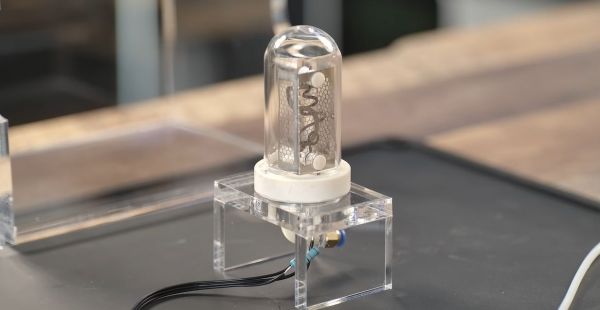
Recently [polymatt] had a poke at one of the all-time favorites in the retro community, by making his own Nixie tube. Over the course of two weeks he tried to create one from scratch, following in the footsteps of other people who are trying to revive this obsolete type of indicator.

Before VFDs and LED technology made them firmly obsolete, Nixie tubes were one of the few ways that devices could provide something like an alphanumeric indicator to a user. Each digit or other symbol is formed by its own cathode, which glows when powered. They’re a type of neon lamp, though with multiple cathodes and a mesh anode for a distinctive look. Simple neon lamps served effectively the purpose of LED indicators alongside their Nixie siblings.

While the design of a Nixie tube fundamentally isn’t much more complex than making a simple neon indicator lamp, the internal structure has many more elements, all of which have be carefully designed, created and assembled, before evacuating the air from the glass envelope and filling it with the usual neon-argon Penning gas mixture.

For his design, [polymatt] used borosilicate test tubes for the glass envelope, leaving just designing the base, the internals and sealing the whole construction. Even with a range of laser cutting heads at his disposal this took a while, especially for finer features like the mesh anode. Rather than going for the typical Penning mixture pure argon would be used, which requires a higher voltage.

Unfortunately the first major test after the two-week deadline showed that his vacuum setup was leaking just about everywhere, so the big glow-up gets pushed to a follow-up video. Unfortunately it’s not mentioned why a pure argon gas mixture would be used, though it’s probably just for ease of filling with just one tank required.

Continue reading “How To Make A Nixie Tube” →

When Decoupling Capacitors Go Wrong

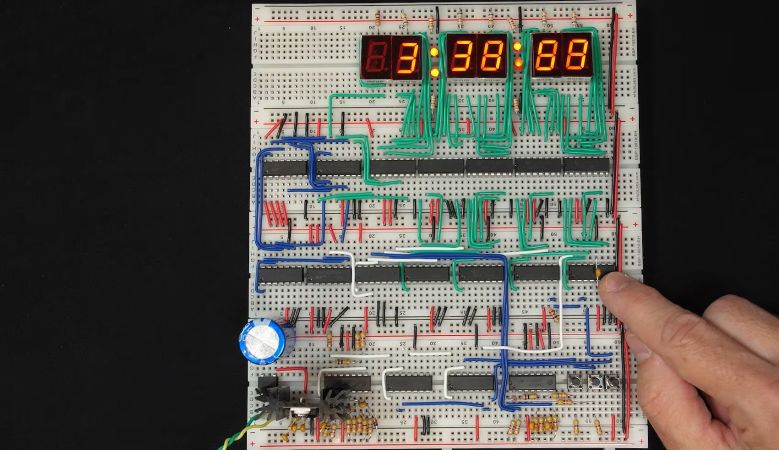
Popular wisdom holds that decoupling capacitors are good, and thus more decoupling capacitors is better. Unfortunately physics disagrees on that notion, as [Ben Eater] discusses in a recent video, following feedback from a viewer who found that upon adding said capacitors, their supply rail got unstable and began oscillating.

After reproducing the issue, [Ben] set to work trying to understand what was going on and why the oscillation was happening. Ultimately it was deduced that the large electrolytic capacitor on the output of the 7805 5V regulator was missing a straight ground path to said regulator. By having the ground thus take a circuitous loop through a large section of wiring and segments of the breadboard a lot of induction was introduced.

The effort is similar to a tank circuit, where an inductor-capacitor combination creates a resonance that can be really useful if it’s intentional. In this case it merely served to introduce a lot of noise on the supply lines which got amplified by the decoupling capacitors placed near the ICs.

In short, this is why you must always put  input and output capacitors as close as possible to your voltage regulators, with in this particular case one ground wire between the regulator and the electrolytic capacitor’s ground fixing the decoupling issue.

Continue reading “When Decoupling Capacitors Go Wrong” →

Diagnosing A Failed LG Fridge Ice Maker

Although a useful feature for people who use ice cubes a lot, an automatic ice cube maker feature in a refrigerator can be a bit of a pain if they stop working properly. In the case of [Adrian]’s LG fridge its ice maker began to overfill the internal tray, causing cubes to freeze together and ultimately the entire mechanism to stop producing cubes. In his diagnostics video he goes over the way the mechanism works, how it interacts with the control board in the fridge and a lot of puzzlement over a new tray fixing the issue with no clear cause.

Bottom of the tray with the temperature sensor and feeler arm.

The most bemusing aspect of this mechanism is probably that the water filling mechanism is an open loop system that only has a timer, a temperature sensor and a feeler arm for the ice bucket. The timer’s duration is settable  using dip switches depending on the water pressure at the installation site. After swapping out the control board [Adrian] found that this made no difference to the problem of it working fine for a few cycles until it started overfilling the tray again.

In the comment section [Jeffrey Hullekes] seems to be on point with his theory that one or more ice cubes simply do not dislodge from the tray, which is not detected by the fill mechanism that thus happily keeps filling for the same number of seconds. After that the excess water then helps to worsen the problem until it’s all one frozen block of water.

With the mechanism having no way to detect fill level, stuck cubes or other issues, it would seem that the smoothness of the tray’s plastic is a load-bearing part of the whole system. Perhaps that spraying on some kind of release film will provide a fix here, as also suggested in the comments, but overall it’s an interesting cost-optimized mechanism that works well for a ‘just buy a replacement unit’ mindset.

Continue reading “Diagnosing A Failed LG Fridge Ice Maker” →

NASA’s Perseverance And Odyssey Teams Investigate Technical Issues

Teams over at NASA are currently dealing with two major issues affecting the Perseverance rover and the 2001 Mars Odyssey orbiter, with the former losing one of its two UHF radios and the latter limping along on two reaction wheels that impede its ability to orient itself without burning through the hydrazine for its thrusters.

The Perseverance rover is basically a copy of the Curiosity rover which landed on Mars in 2012, with its sibling  — featuring updated instruments and the Ingenuity helicopter — following in its proverbial wheel tracks in 2021. Both missions were going swimmingly until on October 30th, when Perseverance‘s primary downlink radio did not send its usual heartbeats to the rover’s computer.

Following this the system switched to its backup radio, but this led to a second issue being discovered. The backup’s radio’s transmit link was only at half of its rated power. Although the rover has a backup X-band communications system that works directly with the Deep Space Network (DSN), this is only capable of 800 bps versus the 2 Mbps of the UHF link, putting the rover out of commission until the issue can be diagnosed and repaired or worked around.

Perhaps more troublesome is that the 2001 Mars Odyssey orbiter suddenly got a deadline of 1 to 2 months before it runs out of hydrazine and can no longer orient itself. Since reaching Mars orbit in 2001, its total of four reaction wheels which control the spacecraft’s orientation have gradually begun to fail. The first wheel failed in 2013, with now a second reaction wheel having ceased to function. With three required, the thrusters are thus the last option and attempts are underway to coax at least one wheel back to life.

Although a successful outcome to these diagnostics-and-repair sessions will be great, it’ll only postpone the dire need to have more in-orbit data relays. All Mars rovers rely on these satellites to transmit high-bandwidth links to the DSN, which has become problematic since NASA lost the MAVEN spacecraft, apparently due to a system glitch.

Although plans for updates to the Mars Relay Network (MRN) have been ongoing for many years, currently there’s no alternative to keeping satellites like the 2001 Mars Odyssey patched up and orbiting to not leave at least two Mars rovers stuck talking on an X-band link with speeds that make one long for a 56k dial-up connection.

Self-Sensing Artificial Muscles From Liquid Crystal Elastomer With Graphene

Although we tend to be more aware of the large muscles in our bodies that enable our legs and arms to move, the real stars are the many small muscles found in our face, hands and so on. Everything from focusing our eyeballs to typing on a keyboard requires the precise cooperation of many small muscles, which is not a feat easily emulated by technology.

Here the liquid crystal elastomer LCE) and graphene composite fibers demonstrated by [Ziyun Zhang] et al. provide an interesting example of how artificial muscles could approach such versatility. Although LCEs are not new technology – having been invented in the 1970s – it’s not enough to simply have an actuator for delicate tasks.

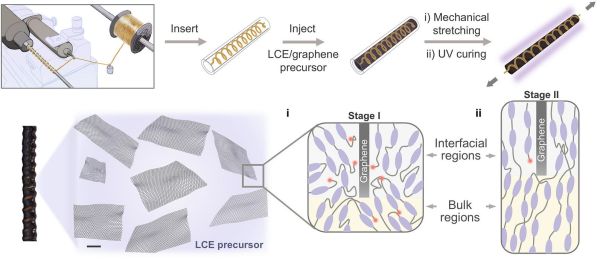
In the paper their CoilLCE is demonstrated. This involves a closed loop system with multistage actuation by creating an LCE-graphene composite with a thin copper heating coil that is embedded into the artificial muscle. The addition of graphene was mostly to increase toughness and to increase thermal conductivity.

To self-sense the state of the muscle the copper coil’s resistance measurement as it relates to temperature was used, which turned out to be accurate to within about 2%. The performance of these muscles was demonstrated both with a robotic hand on a toy piano and with a human eye model. Although not exactly a speed demon or incredibly convenient unless you have a way to also efficiently cool the muscle after heating, it does show promise for the use of LCEs for this kind of fine-grained control.

Voyager 1 Stops Sending Data, Reaches One Light-Day From Earth

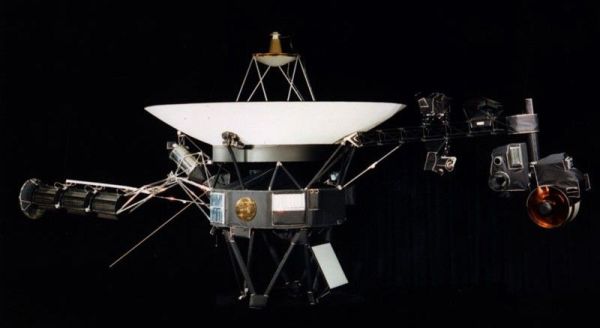
Recently NASA confirmed that the Voyager 1 spacecraft is now one light-day from Earth, taking more than 49 years to reach this point since its launch in 1977. Marring this memorable occasion is the disconcerting discovery that although the spacecraft is still sending a carrier wave back to Earth via the Deep Space Network (DSN), it’s no longer sending science- and engineering data, with the cause still to be determined.

This is reminiscent of the 2023 incident in which Voyager 1 went completely silent aside from the carrier signal, before being coaxed back to life. Following this, a defective flight data system (FDS) RAM chip was remotely diagnosed and bypassed. More recently Voyager 1 went quiet for about two days for an unknown reason, which may be related to this current issue.

With the spacecraft’s radioisotope thermoelectric generators (RTGs) slowly running out of juice, failing RAM chips, and various instances of clogged fuel lines hampering basic orientation controls it’s hard to tell how many more kilometers we’ll get out of Voyager 1 or its sibling, or whether it’ll make it to the 2030s.

Until we invent faster-than-light space travel, both Voyagers will remain the most distant human-made objects from Earth, as well as our furthest glimpse at what lies beyond this solar system should we ever venture outside it. Or as the ancient Roman poet Virgil once wrote: Sic itur ad astra.