Dead Simple Jamming Gripper Design

dead-simple-jamming-gripper

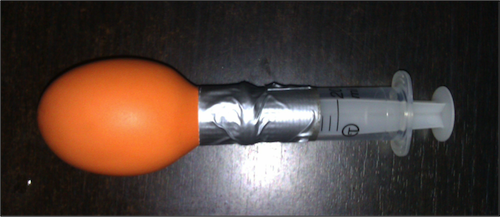
This jamming gripper design is the simplest we’ve seen so far. It uses a syringe to generate the suction necessary for the orange appendage to grip an object.

As with previous offerings this uses coffee grounds inside of a balloon. When pressed against an object the grounds flow around it. When a vacuum is applied to the balloon those grounds are locked in place, jamming themselves around the item for a firm grip. About a year ago we saw a hardware-store grade design which used a vacuum pump for suction and a shower head as the gripper body. This time around the plastic syringe serves as both.

The plastic tip was cut away and the resulting hole covered with a cloth to keep the coffee in place. After installing the coffee-filled balloon the grip can be operated by pulling the plunger to lock the grounds in place. It’s not going to be as easy to automate as a pump-based rig. But if you just want to toy with the concept this is the way to go.

Continue reading “Dead Simple Jamming Gripper Design”

Keurig Hack Now Automatically Fills The Water Reservoir

keurig-automatic-water-fill

This hack makes your Keurig experience fully automatic. For those that aren’t familiar with the hardware: this type of coffee maker includes a water reservoir. Coffee is brewed One cup at a time by drawing from that water, quickly heating it, then forcing it through disposable pods containing coffee grounds and a filter. This takes the user-friendly design one step further by automatically keeping the water full.

This goes beyond the last water reservoir hack we saw. That one routed a water line to the machine, but included a manually operated valve. [Eod_punk] added a solenoid valve and level sensor in this project. The level sensor is submerged in the tank and is monitored by a Basic Stamp microcontroller. When the level is low the BS1 drives the solenoid via a transistor, letting the water flow. This is all shown in the video below.

Continue reading “Keurig Hack Now Automatically Fills The Water Reservoir”

Quick And Dirty Touch-sensitive Keyboard Project

quick-dirty-touch-sensitive-keyboard

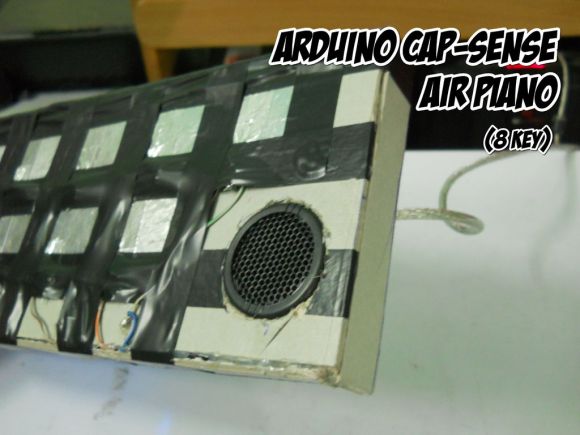
You don’t have to have high-quality parts to play around with electronics and here’s a great example. [Vishal] used junk to play around with CapSense, the touch sensitive Arduino library. What he ended up with is this touch-based piano keyboard.

We’ve featured the CapSense library in the past, but even that example uses a very meticulously crafted test rig of foil tape, protoboard, and some resistors. If you still haven’t given it a try follow this example of using aluminum foil, electrical tape, and a cardboard box.

[Vishal] just sandwiched the end of jumper wire between two pieces of foil to make each ‘key’. We believe the other end of the wire is soldered to the bias resistors where they connect to a couple of pin headers. The headers were hot-glued in place through holes in the bottom of the box, making the entire rig simple to plug into the Arduino board driving it. After adding in a small speaker and flashing the code he’s finished. It certainly makes for a short afternoon project which you won’t feel bad about taking apart later since you didn’t sink a ton of time or resources into the build.

Hardware Store Robot Hand

hardware-store-robot-hand

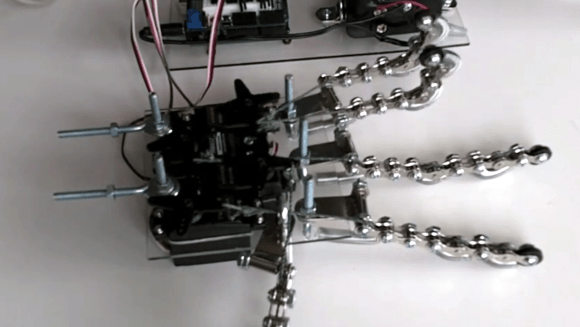
Here’s a robot hand which can be built using mostly hardware store items. It doesn’t have the strongest of grips, but it does have lifelike movement. The demonstration video shows it picking up small objects like a metal nut.

The image above shows the ring and pinky fingers of the hand beginning to flex. These are controlled by the servo motors mounted in the palm area. The skeletal structure of each digit begins with the links of a bicycle chain. The links are first separated by removing the friction fit rods. Each rod is replaced with a screw and a nut, which also allows the springs (which open the digits) to be anchored at each ‘knuckle’.

[Aaron Thomen] didn’t stop the design process once the hand was finished. He went on to build a controller which lets you pull some rings with your fingers to affect movement. This movement is measured by a set of potentiometers and translated into electrical signals to position the hand’s servo motors. The demo, as well as two how-to videos are embedded below.

Continue reading “Hardware Store Robot Hand”

Hackaday Links: Sunday, June 2nd, 2013

hackaday-links-chain

Who knew you could build your own digital computer out of paperclips? EMSL did a great feature on the guide which was published in 1968.

Trying to keep your Raspberry Pi from overheating? Make it log its core temperature on the web.

[Lennart] must be some kind of Eagle CAD guru. Check out these PCBs that incorporate his logo in a very artsy way.

No need for a tripod when you can just strap the video camera to your safety glasses for some POV project videos.

Turn your Pogoplug E-02 into a Shairport (Airplay clone) music hub. Just follow this guide which installs Arch Linux and all the supporting packages you need.

We don’t have the background to judge the quality of this build. But you have to admit it’s pretty neat to see a radio telescope built using a tin can and an umbrella.

Dead rodent email: get a notification every time your mouse trap springs.

USB Fume Extractor Takes Stink Out Of Soldering Sessions

usb-powered-fume-extractor

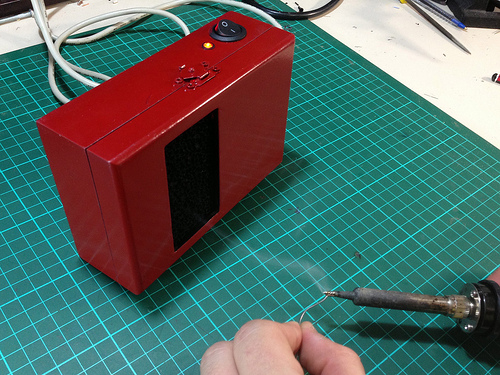
Our homemade shop tools rarely reach this level of finished quality. We probably would have stopped with assembly of this USB powered fume extractor. But [X2jiggy] went for style points by adding a coat of paint.

There are several nice features included in his build. He wanted it to be very easy to power the device so he settled on the 5V USB standard. But a PC fan running at 5V won’t pull much air. He used a boost converter board to ramp that up to 12V. The enclosure is a wooden hobby box. He drilled mounting holes and an airflow opening in the bottom of the box for the fan. The lid of the box has a rectangular opening which accepts a carbon filter meant for aquariums. The rocker switch and LED seen above are also nice touches, but not strictly necessary if you build this for yourself.

We’re still in the habit of gently blowing the fumes away from us as we solder. So the question is, will this device save us from a gruesome disease down the road, or is it mostly to capture the odor of the solder fumes?

Looking for a more permanent setup? You should build a solder hood for your workbench.

Continue reading “USB Fume Extractor Takes Stink Out Of Soldering Sessions”

Delta-type 3D Printer Built Using Extruded Rails

delta-3d-printer-extruded-rail

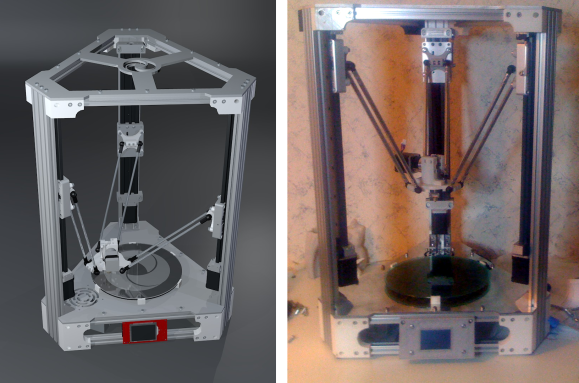
From concept to completion this delta-style 3D printer (translated) is a sweet build. The quality of the work comes as no surprise. We’re familiar with [Arkadiusz Spiewak’s] craftsmanship from that H-bot type 3D printer we saw from him back in April.

Planning started off with a render of the design using Blender 3D. Not only did this give him a 3D model to use as his building reference, but the animation framework allowed him to test the kinematics of the design. After ordering an extruded rail system and assembling the frame he found the pillars had too much flex to them due to the rails used on the top and bottom. The fix was to mill a top and bottom plate to stiffen things up. After testing out the motors and the extruder head mount he made one final design change. He exported his Blender design as dxf files to cut and weld an aluminum replacement for the extruder mounting platform. As you can see in this video, the preliminary results are looking good!

Continue reading “Delta-type 3D Printer Built Using Extruded Rails”