Hackaday Podcast 079: Wobble Sphere, Pixelflut, Skeeter Traps, And Tracing Apps

Hackaday editors Mike Szczys and Elliot Williams gaze upon the most eye-popping projects from the past week. Who would have known that springy doorstops could be so artistic? Speaking of art, what happens if you give everyone on the network the chance to collectively paint using pixels? There as better way to catch a rat, and a dubious way to lure mosquitoes. We scratch our heads at sending code to the arctic, and Elliot takes a deep look at the contact tracing apps developed and in use throughout Europe.

Take a look at the links below if you want to follow along, and as always, tell us what you think about this episode in the comments!

Take a look at the links below if you want to follow along, and as always, tell us what you think about this episode in the comments!

Direct download (60 MB or so.)

Continue reading “Hackaday Podcast 079: Wobble Sphere, Pixelflut, Skeeter Traps, And Tracing Apps”

Hackaday Remoticon: Our 2020 Conference Is Packed With Workshops And We’re Calling For Proposals

We’re proud to announce the Hackaday Remoticon, taking place everywhere November 6th – 8th, 2020. It’s a weekend packed with workshops about hardware creation, held virtually for all to enjoy.

Update: Tickets are now available for 2020 Remoticon!

But we can’t do it without you. We need you to host a workshop on that skill, technique, or special know-how that you acquired through hard work over too many hours to count. Send in your workshop proposal now!

What is a Remoticon?

The Hackaday Remoticon achieves something that we just couldn’t do at the Hackaday Superconference: host more workshops that involve more people. Anyone who’s been to Supercon over the past six years can tell you it’s space-limited and, although we do our best to host a handful of workshops each day, those available seats are always in high demand.

We’re sad that we can’t get together in person for Supercon this year, but now we have an opportunity to host more workshops, engaging more live instructors and participants because they will be held virtually. This also means that we can make recordings of them available so that more people can learn from the experience. This is something that we tried way back during the first Supercon with Mike Ossmann’s RF Circuit Design workshop and 140,000 people have watched that video. (By the way, that link is worth clicking just to see Joe Kim’s excellent art.) Continue reading “Hackaday Remoticon: Our 2020 Conference Is Packed With Workshops And We’re Calling For Proposals”

Hackaday Podcast 078: Happy B-Day MP3, Eavesdropping On A Mars Probe, Shadowcasting 7-Segments, And A Spicy Commodore 64

Hackaday editors Elliot Williams and Mike Szczys go down the rabbit hole of hacky hacks. A talented group of radio amateurs have been recording and decoding the messages from Tianwen-1, the Mars probe launched by the Chinese National Space Administration on July 23rd. We don’t know exactly how magnets work, but know they do a great job of protecting your plasma cutter. You can’t beat the retro-chic look of a Commodore 64’s menu system, even if it’s tasked with something mundane like running a meat smoker. And take a walk with us down MP3’s memory lane.

Take a look at the links below if you want to follow along, and as always, tell us what you think about this episode in the comments!

Take a look at the links below if you want to follow along, and as always, tell us what you think about this episode in the comments!

Direct download (60 MB or so.)

Continue reading “Hackaday Podcast 078: Happy B-Day MP3, Eavesdropping On A Mars Probe, Shadowcasting 7-Segments, And A Spicy Commodore 64”

Learn Software Reverse Engineering: Ghidra Class Videos From HackadayU Now Available!

The HackadayU video series on learning to use Ghidra is now available!

Ghidra is a tool for reverse engineering software binaries — you may remember that it was released as Open Source by the NSA last year. It does an amazing job of turning compiled binaries that tell the computer how to operate into human-readable C code. The catch is that there’s a learning curve to making the most out of what Ghidra gives you. Enter the Introduction to Reverse Engineering with Ghidra class led by Matthew Alt as part of the HackadayU series. This set of four one-hour virtual classroom videos were just made available so that you can take the course at your own pace.

Matthew has actually been schooling us for a while. He’s also known as [wrongbaud] and we’ve been spending a lot of time covering his reverse engineering projects, including the teardowns of NES-on-a-chip hardware and his excellent hacker’s guide to JTAG. His HackadayU class continues that legacy by pulling together course materials for a high-quality hands-on walk through Ghidra. You’ll get a dose of computer architecture, the compilation process, ELF file structure, and x86_64 instructions sets along the way. He’s done a superb job of making example code for the coursework available.

While this was the first HackadayU course, there are more on the way. Anool Mahidharia just finished teaching KiCAD & FreeCAD 101 and videos will be published a soon as the editing process is complete. The fall lineup of classes is shaping up nicely and will be announced soon. As a sneak peak, we have instructors working on classes covering tiny machine learning, a second set of classes on Ghidra reverse engineering, a protocol deep dive (I2C, SPI, one-wire, JTAG etc.), Linux on Raspberry Pi, building interactive art, and all about LEDs, and an intro to design with Rhino. Keep your eye on Hackaday for more info as classes are added to the schedule.

Continue reading “Learn Software Reverse Engineering: Ghidra Class Videos From HackadayU Now Available!”

Saturday: Vintage Computer Festival West

The Vintage Computer Festival West is an annual gathering to celebrate the awesome hardware that ushered in the Information Age. Normally held at the Computer History Museum in Mountain View, California, this year VCF West is happening virtually and it all starts on Saturday!

The lineup of talks looks great, covering everything from operating an Apollo DSKY display panel and how to recover magnetic tape to ENIAC technical manual bugs and the genesis of the 6502. That last one is presented by Bill Mensch who was on the team that created the 6502 in the first place. He’ll be joined by Hackaday’s own Bil Herd (himself a celebrated Commodore and MOS alum) and Eric Schlaepfer (you may remember his Monster 6502 project). You may not be able to wander the exhibits and play with the vintage hardware this year, but you can hear from a lot of people who have spent years learning the hacks and quirks that made these systems tick.

Hacakaday is proud to once again sponsor VCF West. You don’t need a ticket, the conference will live stream on their YouTube channel for all who are interested. We’ve embedded the live stream below, as well as the awesome poster at that Joe Kim produced for display at the festival.

Continue reading “Saturday: Vintage Computer Festival West”

Denim Sunglasses Frames Use A Wicked Set Of Jigs

An obligatory “Future’s so bright I gotta wear… denim” joke is the only way to kick off this article. Sorry!

Now that that’s out of the way, how would you turn your own blue jeans into sunglasses? Well you wouldn’t, unless you’ve built an intricate jig for assembling sunglasses frames like [Mosevic] has done. Boiled down, this is like making parts out of carbon fiber, except you swap in denim for the carbon fiber. Several layers of blue jean material are layered in a mold and impregnated with resin. Once hardened, parts can be milled or laser cut from this stock and then assembled into the frames all of the hipsters are after.
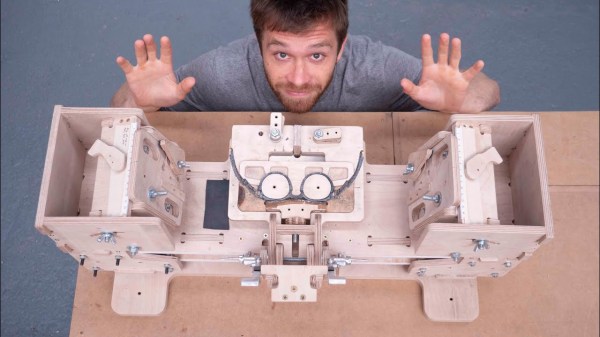
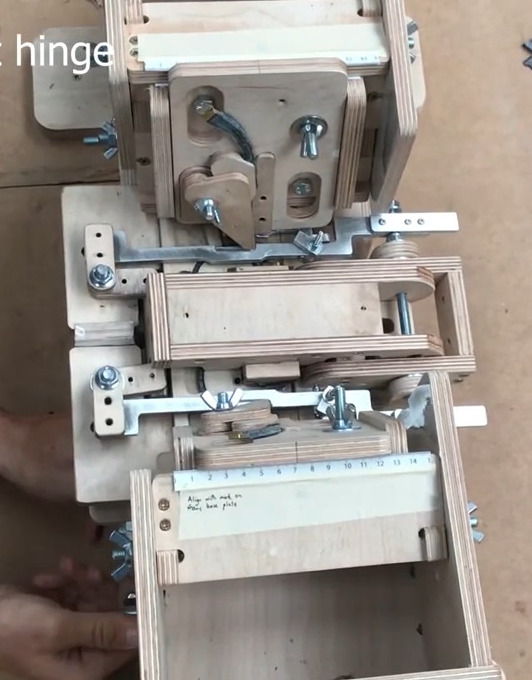
For us its the assembly jig that’s so interesting to see. [Mosevic] shared it in an unlisted video of an update to the Kickstarter campaign which ran at the end of 2019. The jig is used to align machined parts into stack ups that include brass reinforcement and pins to align layers, as well as the joining for the three parts of the frame via the metal hinges. Most of the jig is made from machined plywood. The plates that hold the three parts of the frame, the “frame front” and the two “temples” in eyeglass parlance, are interchangeable so that the same jig can be used to assemble several variants of the frame design. The most notable non-plywood part of the jig are two metal clamps that hold the hinge into the frame front as the glue dries, holding a couple of tiny chunks of denim/resin block in place.

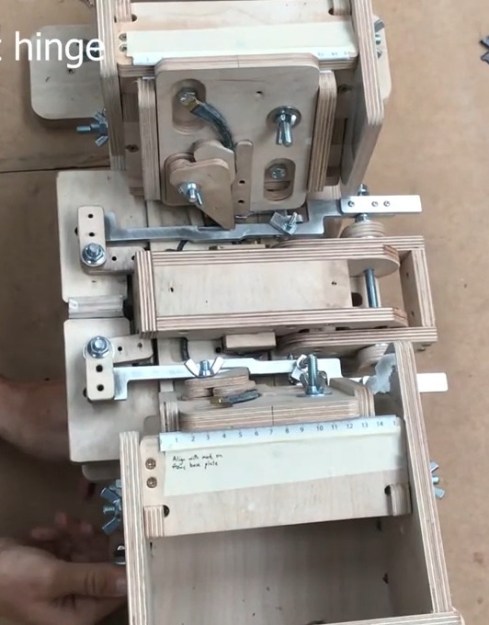
Here you can see the jig with all clamps fully closed. There is not an insignificant amount of time just getting the parts into this jig. But parts still need quite a bit of cleanup after this process to sand, shape, and polish all edges and surfaces of the frames. And of course you have to figure in the time it took to make the parts that went into the jig in the first place. The finished frames are gorgeous, but we have a lot more respect having seen what it takes to pull it off.

Now if you like your glasses like George Washington liked his false teeth, here’s how you can pull a set of shades out of your woodshop.

Continue reading “Denim Sunglasses Frames Use A Wicked Set Of Jigs”

Busting GPS Exercise Data Out Of Its Garmin-controlled IoT Prison

If you take to the outdoors for your exercise, rather than walking the Sisyphusian stair machine, it’s nice to grab some GPS-packed electronics to quantify your workout. [Bunnie Huang] enjoys paddling the outrigger canoe through the Singapore Strait and recently figured out how to unpack and visualize GPS data from his own Garmin watch.

By now you’ve likely heard that Garmin’s systems were down due to a ransomware attack last Thursday, July 23rd. On the one hand, it’s a minor inconvenience to not be able to see your workout visualized because of the system outage. On the other hand, the services have a lot of your personal data: dates, locations, and biometrics like heart rate. [Bunnie] looked around to see if he could unpack the data stored on his Garmin watch without pledging his privacy to computers in the sky.

Obviously this isn’t [Bunnie’s] first rodeo, but in the end you don’t need to be a 1337 haxor to pull this one off. An Open Source program called GPSBabel lets you convert proprietary data formats from a hundred or so different GPS receivers into .GPX files that are then easy to work with. From there he whipped up less than 200 lines of Python to plot the GPS data on a map and display it as a webpage. The key libraries at work here are Folium which provides the pretty browsable map data, and Matplotlib to plot the data.

These IoT devices are by all accounts amazing, listening for satellite pings to show us how far and how fast we’ve gone on web-based interfaces that are sharable, searchable, and any number of other good things ending in “able”. But the flip side is that you may not be the only person seeing the data. Two years ago Strava exposed military locations because of an opt-out policy for public data sharing of exercise trackers. Now Garmin says they don’t have any indications that data was stolen in the ransomware attack, but it’s not a stretch to think there was a potential there for such a data breach. It’s nice to see there are Open Source options for those who want access to exercise analytics and visualizations without being required to first hand over the data.