Using An HD44780 Character LCD With The Raspberry Pi

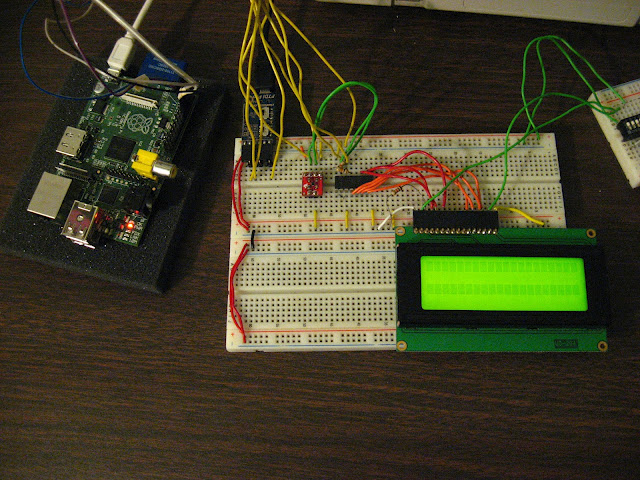
[Tech2077] is one of the lucky ones who already got his hands on a Raspberry Pi. He’s been looking into different interface options with the GPIO header and just posted a guide to using an HD44780 character display with the RPi. We like this approach because instead of doing some hard-core LCD work he’s using prototyping equipment you probably already have on hand.

Getting a character LCD running should be really simple. The gotcha is the logic level gap between the devices. If you’ve been working with Arduino, your add-ons are probably meant for a 5V power rail  and logic levels. The RPi outputs 3.3V logic. You could use a level converter (you’d need at least 7 pins to be converted in this case) or you can be a bit more clever. [Tech2077] grabbed an I2C port expander that uses just 2 of the RPi lines to address even lines of the display (four data bits plus three control bits). This is a bit of a hack, as the 3.3V logic is 0.2V below the recommended minimum for a digital 1 on the port expander. But it seems to work just fine! If it didn’t, a couple of NPN transistors would do the trick as well.

Addressing the new peripheral is just a matter of loading the i2c module and writing some Python.
VGA Message Board Displays SMS Without A Computer

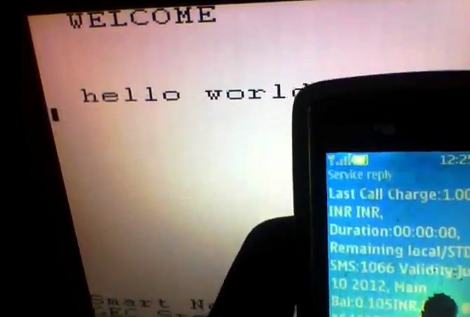
[Achu Wilson’s] latest creation is a VGA message board which is written to via SMS text messages. This doesn’t sound too interesting at first, until you find out he’s doing this with a microcontroller rather than a PC. All of the complexity is in the code that drives the VGA. He managed to do it without any jitter while using an 8-bit microcontroller.

But first, the cellular side of things. A GSM modem takes care of connectivity. To communicate with the modem [Achu] used an ATmega8. He mentions the he could have used a much smaller uC, like an ATtiny, but this is what he had lying around. When a message is received the ATmega8 feeds the characters to an ATmega16 which is driving the VGA monitor. Rather than deal with the analog voltages necessary to run a color display he simply ganged the three color lines together and drives them from one of the microcontroller pins. This results in white and black which correspond to voltage or no voltage.

You can see him showing off the system in the clip after the break.

Continue reading “VGA Message Board Displays SMS Without A Computer”

DIY ROV Explores The Watery Depths

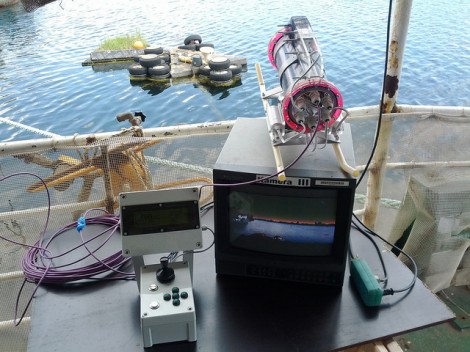
This rig looks so good it’s hard to believe this is the first ROV that [DZL] has ever built. It houses an HD camera which feeds the display at the operator’s station. You can see the controller to the left of that screen which uses a joystick and buttons to pilot the underwater vessel.

In order to simplify construction, [DZL] decided not to use propellers. The problem with that technique is that you need to have bearings that will allow the propeller shafts to turn without letting water in. Propulsion is instead provided by a group of small water pumps whose intake is on one end and outflow is on the other. These are mounted at various places on the body and each have one power cable that connects to the control circuitry in the main housing. The passage of cables through the enclosure is another possible leak point, but [DZL] found some off the shelf bushings that ended up making it pretty easy.

The link at the top is a round-up of all the different project posts. For us, the most interesting Flickr set is the one showing how the enclosure is put together. There is also a pretty neat dive video after the break that shows the craft being tested underwater.

Continue reading “DIY ROV Explores The Watery Depths”

Penetration Testing With The Raspberry Pi

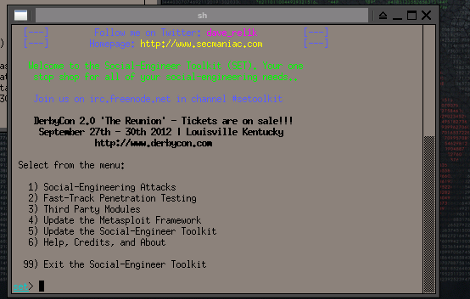
PwnPi is a penetration testing distribution rolled up for the Raspberry Pi platform. This should come as no surprise to anyone. The RPi board has a beefy processor, it’s relatively low power, has the option of the on-board NIC or a USB WiFi dongle, and it already has Linux kernel and desktop sources available to start from.

Now we will admit we’re a bit disappointed from this tip. Don’t get us wrong, the distro looks like it’s well done, and we’re sure there are a lot of folks out there who will be happy to have these tools to help test their network security. But this is a software only hack and we were expecting to see a nice little covert package that could be plugged into an outlet (SheevaPlug style), or a battery-powered module that can be plugged into an Ethernet port and hidden away.

Now you know what we want, don’t forget to send in a link once you pull it off.

[Thanks Scott]

Roll Your Own Battery Backup System

[Chris] and [Dom] wanted to build their own battery backup system on the cheap. They were very creative in sourcing the parts, and ended up putting together a battery-backed CCTV system for about eighty bucks.

Since short power outages are fairly common in the area this battery backup makes sense. We’ve seen some pretty gnarly whole-house systems but this is more of a novelty. That’s a good thing, because the hacking duo decided to reuse batteries which were headed for the scrap yard. They’re connected to a trickle charger which makes sure that they’re continually topped off when mains power is energized. But when there’s a blackout a relay switches an outlet box over to the inverter (also a used part).

The system is outlined in the entertaining video after the break. You’ll see they guys show off the completed build, followed by a walk through of the circuit they designed and how it functions.

Continue reading “Roll Your Own Battery Backup System”

Cheat Your Way Through The Original Prince Of Persia

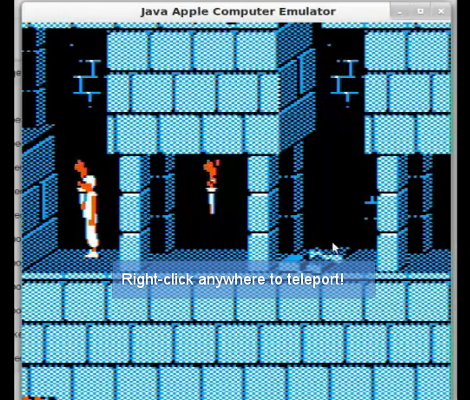
If you don’t have the patience to play through the original Prince of Persia perhaps you should just cheat? [BLuRry] has made this easy for us, by building Prince of Persia cheats into JACE, the Java Apple Computer Emulator.

He shows off the emulator and the cheats he added in the video after the break. We saw the ability to teleport anywhere, kill enemies immediately, and open gates and exits. All of this happens with the click of a mouse. But there’s also a configuration screen used to enable the cheats that offers a handful of other cheat options that weren’t original to the game. [BLuRry] managed to roll these cheats into the emulator after some thoughtful study of the original source code which [Jordan Mechner] recently released after the once-lost floppy discs storing the ancient digital gem were discovered.

You know, we always see people running doom on various types of hardware. Maybe we should start using PoP as our go-to novelty game?

Continue reading “Cheat Your Way Through The Original Prince Of Persia”

LiPo Battery Tester For Solar Vehicle Battery Array

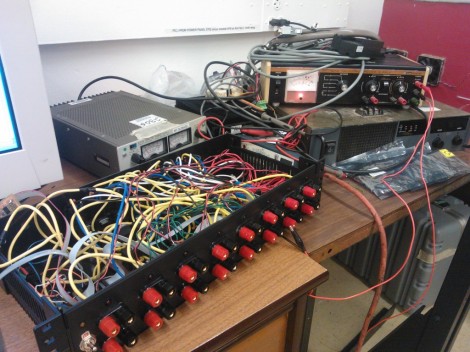
If you’re building solar vehicles at a competitive level you’ve got to know exactly how the storage batteries will perform. To that end [Matthew] built a Lithium Polymer battery tester for use by the McMaster University Solar Car Project. It worked well, but could only test one battery at a time. He just finished up a second version, which can test battery specifications on up to eight units at once. It saves a lot of time, but still takes fifteen hours to test just one set of the units used by the vehicle.

The most important aspect being measured is the discharge curve. Sure, there’s a datasheet that includes this information, but how can be sure that what you received will perform at spec? Each of the eight channels can be disconnected from the system using a relay. This is just one of the safety features which watch for things like over-voltage and over-current conditions. Remember, Lithium batteries can heat up fast if there’s a problem. Data is sampled on a 12-bit ADC and can be pushed to a computer via USB for graphing.