Easy Rotary Encoding For Your Projects

Want to monitor how much a wheel has turned in your project? Then you need a rotary encoder! Here’s a way to add rotary encoding without changing the mounting method of your wheels (translated). [Jorge] added it as a way to improve the functionality of this line-following robot. It uses a paper encoder wheel which is monitored by an optical sensor.

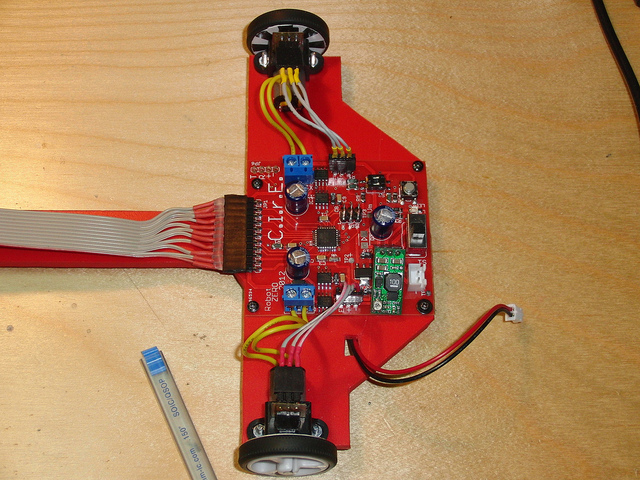
The paper wheel consists of alternating white and black pie pieces. You can make this with a felt-tipped marker, or use a tool like the one we featured a couple of years ago to print out a disc rendered to your own specifications. This is glued to the inside of the wheel and monitored by a CNY70 reflective sensor (the same one used in that electric keyboard retrofit).

The homemade board which holds the sensor can be seen mounted on top of each wheel’s motor. It requires three wires, voltage, ground, and data. The data line is connected to the output of the phototransistor in the CNY70 package so it can be used with a microcontroller interrupt for easy integration with the firmware driving the robot.

[Jorge] goes into some detail about how the added data helps to improve the speed performance seen in the clip after the break.
Continue reading “Easy Rotary Encoding For Your Projects”

Pep Up Your House Cat’s Boring Wintertime Life

With winter upon us, and all the windows shut, [Garfield] and [Socks] can get a little restless. But [Dino] is determined to keep his furry friends entertained through the cold dark months. He hit the junk box, and used some interesting fabrication techniques to build the Chase-a-Mouse motorized cat toy.

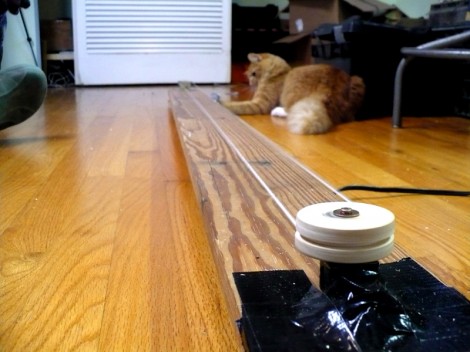
The toy is popular with the cats because it incorporates two traditionally satisfying features; something to chase, and an obstacle to chase it around. The base of the unit is a long plank which is held up from the floor by a couple of inches. The loop of rope which spans the board’s length has a mouse attached to it with about six inches of string. When the motor is flipped on it bounces and jerks its way around the circuit, darting in and out of the space below the base.

As you can see in the video after the break the motor is a bit loud. [Dino] used the sweeper motor from a Roomba for this. It might freak the kitties out at first, but curiosity will get the better of them eventually. It’s a quick build, and we love the drill-turned-lathe that is used make the wooden pulley for the system.

Continue reading “Pep Up Your House Cat’s Boring Wintertime Life”

Using Mains Wiring As An Antenna

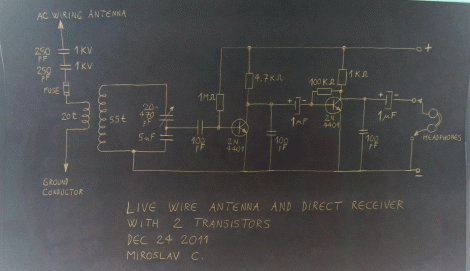
Make sure to brush up on your safety protocol if you undertake this project. The penalty for messing up when using live wiring as a radio receiver antenna is rather severe. But after reading about it in some old books [Miroslav] decided to give this technique a try.

We love the old-school chalk board he used to map out his test circuit. With safety in mind, he uses two high voltage capacitors in series. If these should somehow fail, there is also a fuse which would blow, disconnecting the apparatus from mains. But just to be sure, he isolated the circuit using a two coils. These step down the voltage, but would also burn out if hit with a voltage spike.

You can see the results he gets using the setup as an AM radio receiver in the video after the break. He tested against a meter long antenna and found that his setup far outperforms it. Actually, he found that a six foot extension cord which is not plugged into the wall will also outperform the 1m antenna. Something to keep in mind the next time the ball game isn’t coming in as clear as you would like.

Continue reading “Using Mains Wiring As An Antenna”

Zombie [Jackson] Bot Dances To Thriller

[Marc Cryan] built this little bugger which he calls Wendell the Robot. But what good is an animatronic piece like this unless you do something fun with it? That’s why you can catch the movements matching [Michael Jackson’s] choreography from the music video Thriller in the clip after the break.

This is a ground-up build for [Marc]. He started by designing templates for each of the wood parts using Inkscape. After printing them out, he glued each to a piece of 1/4″ plywood and cut along the lines using a band saw. We don’t have a lot of adhesive spray experience, but he mentions that the can should have directions for temporary adhesion so that the template can be removed after cutting.

During assembly he makes sure to add servo horns for easy connection when adding the motors. All together he’s using five; two for the wheels, two for the arms, and one for the neck. A protoboard shield makes it easy to connect them to the Arduino which is used as a controller.

Continue reading “Zombie [Jackson] Bot Dances To Thriller”

Programming An Arduino Using An Audio File

This proof-of-concept is just waiting for you to put it to good use. [Mike Tsao] wrote an Arduino sketch that lets him decode incoming audio data which could be used to program the device. He’s calling the project TribeDuino because it decodes an audio file which is actually the firmware update for a Korg Monotribe.

Earlier in the month [Mike] read our feature on a project that reverse engineered the audio-based firmware update for the Korg hardware. He wanted to see if he could write some code to read that file on his own hardware. All it took was an audio jack and two jumper wires to get the Arduino ready to receive the audio file. His firmware reads the Binary Frequency-Shift Keying encoded data as the audio is played, then echos a checksum to prove that it works.

This would be a fantastic addition to your own projects. Since the audio connection only needs to be mono, it only takes just one Arduino pin to add this jack (the other is a ground connection). Having just played around with alternative ways to push data to a microcontroller ourselves, we might give this a try when we have some free time.

Focus Fix For Non-reflex 35mm Camera

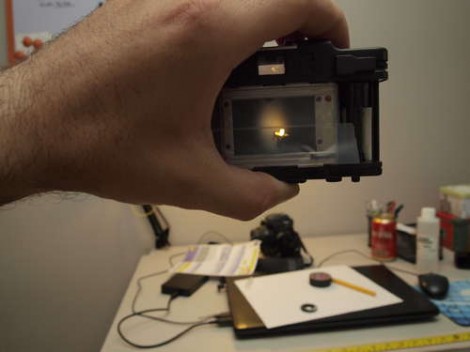
For camera fanatics the acquisition of an old camera is a thrilling event. But if you’re going to collect them, you’d better have some repair skills so that you can also use them. [Fernando’s] latest find was this Minox 35mm camera. The aperture needed cleaning, and after reassembling the unit he realized the he had not marked the focus ring when taking it apart. This is not a reflex camera, so you can’t look in the view finder to adjust focus. He came up with his own method to get the focus ring calibrated.

The focal point needs to focus on the film. He simulated this plane using some magic tape, which removes easily without leaving a residue. When the shutter is open, you can see the image projected on this translucent surface. He then set up the camera with the lens 90 cm from a bright light bulb. By adjusting the focus to create a sharp image on the temporary screen, he knows the focus is calibrated, and can reset the focus ring to the 0.9m mark.

Need some help developing that exposed film? You could always give the coffee and vitamin C hack a try.

Spring Clamp Tripod Mount Has Potential

Admittedly this post is flirting with flamebait, but we think the concept of using a spring clamp as an iPhone tripod mount has a lot of hacking potential. Hear us out, and if we havn’t made our case you can rant about it in the comments.

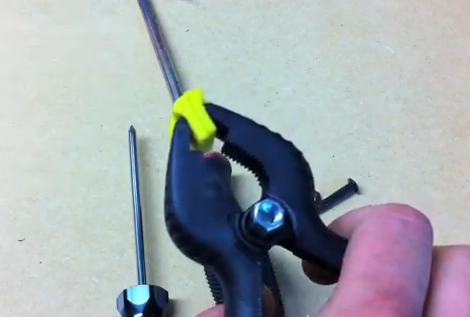
[Joe] wanted an easy way to mount his iPhone on a standard tripod. We’ve seen some creative solutions for this, like using Sugru to make a removable bracket. But he went a different route, using a cheap spring clamp to grip the phone body. These plastic clamps are like over-powered clothespins, and use a screw as the pivot point. [Joe] replaced the stock screw with a longer one, then used a coupling nut which will attach to the tripod. A bit of foam on the pads of the clamp protect your device from the plastic teeth.

It’s a fine solution (if you don’t mind putting that pressure on your smart phone). But we think this would be a great way to build your own heavy-duty third hand. It would be right at home with this modular solder platform. See [Joe’s] how-to video embedded after the break.

Continue reading “Spring Clamp Tripod Mount Has Potential”