Multivibrator In Theory And Practice

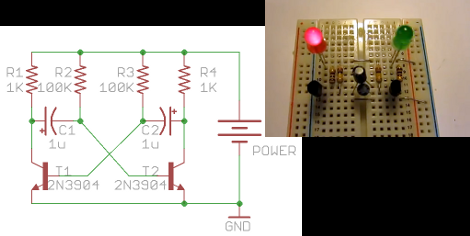
We must admit that we’ve been guilty of using a microcontroller to make two LEDs blink alternately in the past. It’s not the worst transgression, but it stems from our discomfort with analog circuits. Luckily, [Ray] published an illustrated guide on building multivibrator circuits. This is a simple method of assembling a two-output oscillator. All it takes is a pair of NPN transistors, which are then switched by on and off based on a resistor-capacitor (RC) timer.

[Ray] does a good job of walking us through how the circuit works at each stage of one complete cycle. You’ll need to read carefully, but the supplementary schematics he uses to water down snap shots of the various electrical states really helped us understand.

Of course, blinking LEDs isn’t the sole purpose of a multivibrator. It is a method of producing a clean square wave which can be used as a clock signal for TTL logic chips. Oh, who are we kidding, see the blinky goodness for yourself in the video after the break.

Continue reading “Multivibrator In Theory And Practice”

Milling Interlocking Wooden Rings

[Johan von Konow] wanted to make something special as a wedding gift to his wife. He decided a pair of interlocking miniature rings would be the perfect keepsake. He started his search for a way to mill the wooden rings from a solid piece of wood, and documented his journey for our enjoyment.

This project poses an interesting challenge. Most CNC mills offer three axes of freedom, but he only had a 2D mill meant for routing PCBs. This means the cuts can only be made from the top down at one depth. In order to fabricate the rings he needed to cut from more than one side. With more study, [Johan] discovered that it would be necessary to cut the wood stock from eight different angles before the rings would be complete.

The solution to the problem was to first mill a jig to hold the wood stock. It has positions to hold the stock at each different angle. The final step before starting the cut was to mill the stock itself to perfectly fit his custom jig. We think it turned out great, thanks in part to hand filing, sanding, and polishing to smooth the marks left from milling.

Make Your Own Spray Paint Cans

[Mikeasaurus] found a way to build his own refillable spraypaint canister. The donor vessel used here is a plastic soda bottle. It’s a great choice since it is engineered to house a pressurized liquid and you can find them for free by intercepting a satisfied soda consumer before they reach the recycling bin.

He repurposed the spray nozzle from a commercial spray paint can. By first releasing all of the pressure from the empty paint he could then use a hack saw to remove the top disk. He used Sugru to attach it to the bottle cap which has a hole drilled in the center to accept the feed straw. We wonder if there wouldn’t be a better way to attach this from the inside of the cap for better resistance to bottle pressure?

The final piece of hardware is a Shrader valve from a bicycle inner tube. This lets you pump up the pressure in the bottle. You’ll need to dilute the paint you use to make it sprayer-friendly. [Mikeasaurus] diluted his six to one which might have been a bit too much judging from the drips seen in the video after the break.

Continue reading “Make Your Own Spray Paint Cans”

Binary Division When Your Processor Lacks Hardware Division

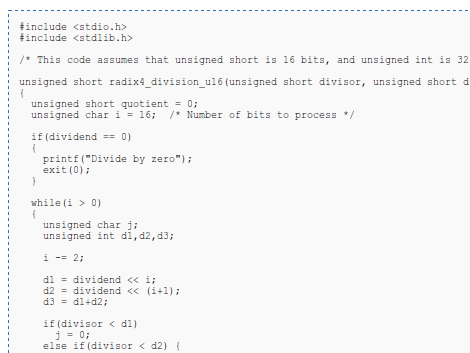
[Hamster] wanted to take a look at division operations when the chip you’re using doesn’t have a divide instruction. He makes the point that the divide instruction takes a lot of space on the die, and that’s why it’s sometimes excluded from a chip’s instruction set. For instance, he tells us the ARM processor used on the Raspberry Pi doesn’t have a divide instruction.

Without hardware division you’re left to implement a binary division algorithm. Eventually [Hamster] plans to do this in an FPGA, but started researching the project by comparing division algorithms in C on an AMD processor.

His test uses all 16-bit possibilities for dividend and divisor. He was shocked to find that binary division doesn’t take much longer than using the hardware instruction for the same tests. A bit of poking around in his code and he manages to beat the AMD hardware divide instruciton by 175%. When testing with an Intel chip the hardware beats his code by about 62%.

He’s got some theories on why he’s seeing these performance differences which we’ll let you check out on your own.

From The Readers: Low Battery Cutoff Solutions

We got a lot of really great feedback about low battery cutoff options in the comments section of Monday’s replacement battery post. To refresh your memory, some power tool batteries were replaced by Lithium Polymer units which can be damaged if drained too low before recharging. We had thought that many Lithium cells had cutoff circuitry these days. The consensus is that these batteries didn’t because they’re for RC applications where weight is an issue. But we did get a ton of people sending in commercially available drop-in solutions, mostly from RC hobby outlets, so search around for those if you’re interested.

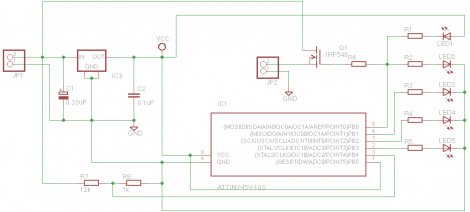
[Christopher] sent us a link to the cutoff circuit he built for his bike light. You can see the schematic for it above (direct link). He sourced an ATtiny45 to drive a MOSFET which disconnects the battery when it gets too low. This would be easy to adapt to other uses, but note that there’s a voltage regulator involved as well as a few other passives… not a difficult solution but also not all that simple.

This same concept can be adapted. A few commentors mentioned using a transistor (or MOSFET) with the base driven by a voltage divider including a zener diode. This way the voltage rating of the diode would effectively shut off the gate when that threshold was reached.

We also enjoyed reading about [Bill’s] human-controlled cutoff circuit. It also uses a zener diode, but this time in series with a resistor and and LED patched into the trigger of the tool. The LED will shine brightly when the battery is in good shape. It will dim near the end, and fail to light when the critical limit has been reached. Just make sure you’re paying attention and you’re in good shape.

Building A Computer Around A 6502 Processor

When it came time to try out some old-school computing [Quinn Dunki] grabbed a 6502 processor and got to work. For those that are unfamiliar, this is the first chip that was both powerful, affordable, and available to the hobby computing market back in the 1970’s. They were used in Apple computers, Commodore 64, and a slew of other hardware.

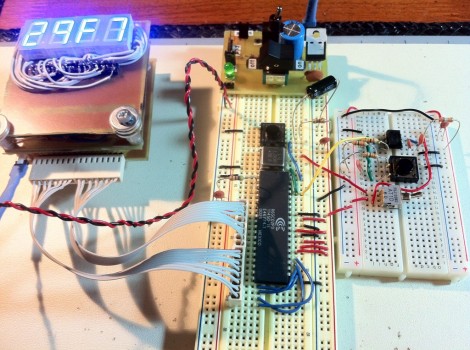
The first order of business in making something with the chip is to establish a clock signal. She sourced a crystal oscillator which runs at 1 MHz, but also wanted the option to single step through code. Her solution was to build two clock signals in one. A toggle switch allows her to choose the crystal, or a 555 timer circuit which uses a push button to fire each clock pulse.

Check out the video after the break to see some single stepping action. There’s no memory on board just yet. But the input pins have been hard-wired to voltage or ground to simulate data input. We wondered what she was up to with that HEX Out project which stiffs the logic on the data bus. Looks like it’s extremely useful in this project!

Continue reading “Building A Computer Around A 6502 Processor”

Siri As A Lippy And Sometimes Profane Television Remote

If the addition of Siri to your iPhone has given you a somewhat-real life companion (and hope that you might not be forever alone) this hack is right up your alley. [Todd Treece] built a hardware fixiture for the living room which bridges the gap between Apple’s new digital assitant and your television.

The box itself is an Arduino with a WiFly shield and the hardware necessary to make it a universal infrared remote control. He mounted it on the underside of his end table, with the IR LED in line-of-sight for the television. Using SiriProxy he’s added functionality that lets you request a channel change either by the name of the network, or the channel number.

As you can see in the video after the break, Siri has some strong opinions on the quality of programming for certain channels. That and contempt for your inability to just change the channel yourself. But this setup does augment your remote control experience by giving you a synopsis of what’s playing right now for the channel you’ve requested.

Continue reading “Siri As A Lippy And Sometimes Profane Television Remote”