Nixie Clock Exhibits Well Fabricated Metal Bezel

[Matt Evans] achieves a total win with his Nixie clock. Not only does he have the benefit of the retro display hardware, but he really catches our eye with the enclosure he built for it.

The project had its genesis when he came across a set of the Nixie Tubes in a surplus store. This was back in 2007, and with parts in hand he built the high-voltage driver circuit and a control board. The thing kept time, but was housed in a temporary case that was a bit rough looking. There it sat, waiting to become the focus of his attention once again.

When it did finally come time to build a proper case [Matt] started with a small sheet of recycled copper. He made the cutouts and bends by hand. He mentions that it’s a little uneven; maybe, but we don’t think it detracts from the design. Some black screen (like would be used on a porch door) covers the openings, giving texture and contrast to the facade.

We love the look, and the ATmega48 with a clock crystal for the RTC functions should make this a reliable time source.
FT-2232 Bridges Python And I2C/SPI

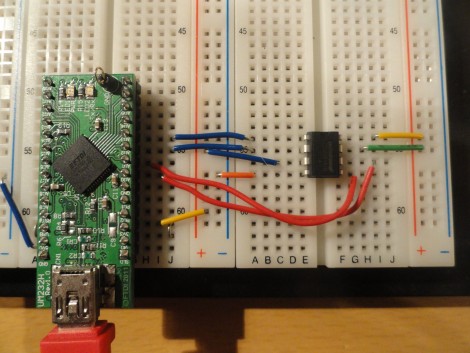
You might already have the hardware on hand to easily interface I2C and SPI devices with Python scripts on your computer. The board seen above is an FT-2232 breakout board. These chips are often used to facilitate JTAG programming via USB, but they have other features that might be useful to you as well. The chip has a Multi-Protocol Synchronous Serial Engine (MPSSE) which can speak the I2C and SPI protocols, you just need to know how to active them in your code.

[Craig] makes this easy with his MPSSE Python wrapper. Simply install his module, and you’ll be able to import all the commands you need. He demonstrates reading the data out of a 1 MB SPI flash memory chip. This could be used for a lot more, including debugging peripherals à la the Bus Pirate, or reprogramming chips to add to your projects (we’re thinking font arrays and sprites for displays, or look-up tables).

If you’re not aware, these FTDI chips were the go-to for USB support for a long time. We’ve got a guide for bit-banging using this hardware. Lately more chips have become available with USB hardware built-in. They’re quite useful and cost-effective, especially with the availability of open-source stacks like the LUFA project.

There’s A Lot Packed Into This BeagleBoard Controlled Rover

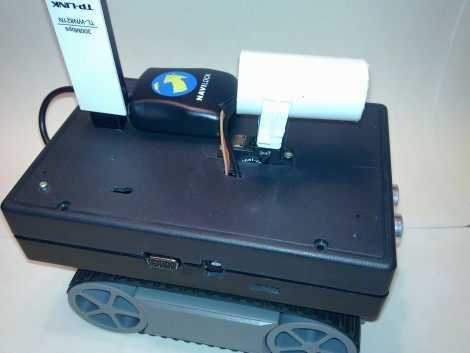
That black box is hiding all kinds of goodies that make this rover a hacking playground. [Andrey] built the device around a BeagleBoard, which offers the processing power and modules that he needed to make the rest of it work.

The control unit shrinks the pilot down to the rover’s size, using a cockpit that has a steering wheel and other controls, and a monitor playing the stream from the camera on the front of the bot. It has a WiFi adapter which allows control via the Internet. The camera, which can be rotated thanks to its servo mounting, feeds the video to the BeagleBoard where it is compressed using the h264 codec (more about that and the cockpit here) to lighten the streaming load. You’ll also find an ultrasonic rangefinder on the front for obstacle avoidance, and a magnetic compass for orientation information. Finally, a GPS bolsters that data, allowing you to plot your adventures on the map.

It’s great, but it will cost you. Material estimates are North of five hundred Euros!

Half-tone CNC With Man-powered Z Axis

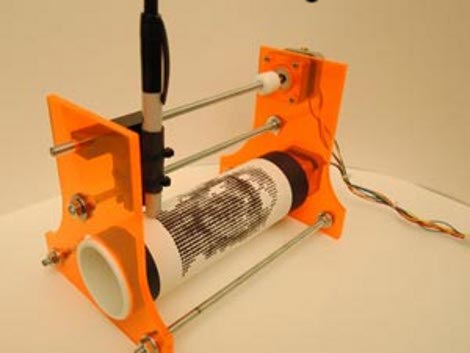
We think this is an intriguing take on half-tone art. It’s a CNC machine that uses an Arduino and two stepper motors to draw on a paper-covered drum. But you’re not just going to set it and forget it. To simplify the device, the Z-axis is not mechanized, but requires the dexterous opposing digit of a person to actuate.

The first prototype used a frame cut from plywood, but the developers moved to some attractive laser-cut Lexan for the final version. The rotating drum was inspired by observing the off-set printing process. It greatly simplifies the build when compared to a flat CNC bed. But including a Z-axis solution that could account for differently sized dots really opens a can of worms. Because of this, the choice was made not to automate that task, but to leave it up to the user. A clickable Sharpie does the marking. When the pen is in place, you click the plunger to hold the felt tip against the paper until a dot of the appropriate size has leeched onto the paper.

It’s not a bad solution to the problem. Especially if you don’t have the high-end milling equipment necessary to do this on a piece of plywood.

[Thanks Dron]

Spaduino Heats Up A Used Hot-tub

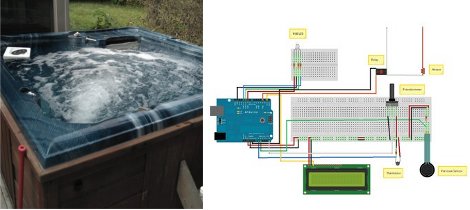
[Ryan] and the roomies decided that a hot tub was just what they needed to spice up the place. They hit Craig’s List and found one for the right price. After acquisition and setup they were pleased to find that the jets and pump worked great. But you’re not going to want to stick as much as your big toe into this ice-cold cryogenics experiment. Some poking around in the control system exposed the dead relays which are responsible for switching the heater. Instead of swapping the parts, [Ryan] began building a control system that will replace the twenty-year-old original.

The heating element still works, but it’s rated at 5.5 kW and here’s no way to automatically switch it on and off. [Ryan] found a 60 Amp solid state relay which can handle the load, and plays nicely with his Arduino. Initial tests got the tub up and running again. Obviously you want the tub to maintain temperature and so a thermistor was added to take readings from the heater core. There’s also a potentiometer to adjust the temperature, and an LCD screen to show the current settings. But [Ryan] hopes to add more features over time, like incorporating jet control, and adding wireless communications via an Xbee module.

Kitchen Hacks: [Dino’s] Egg Tricks

[Dino’s] latest weekly hack plays right into our Kitchen Hacks theme. He’s sharing some obscure tips and tricks involving eggs.

It should come as no surprise that he knows a thing or two about using eggs. After all, he keeps chickens and you’ve can’t just let good eggs go to waste. Which is where his first tip comes in. Eggs will keep for weeks, but if you don’t know if they’re still good you can put them in a bowl of water before cracking them. Eggs that float are on the way out!

Need some scrambled eggs but don’t have a pan to cook them in? His next feat is to cook up a breakfast of steamed eggs using the steamer nozzle on his espresso machine. It’s messy (egg seems to be flying everywhere) but the final product does look appetizing.

The rest of the video (embedded after the break) shows his methods of making Hollandaise sauce for Eggs Benedict, and how to blow the innards out of an egg-shell.

Now we have a picture in our minds that [Dino’s] daily routine is surrounded by eggs… like the egg farmers in Napoleon Dynamite.

Continue reading “Kitchen Hacks: [Dino’s] Egg Tricks”

Chicken Light Keeps Up Egg Production

It turns out that as the days get shorter, chickens lay fewer eggs. But you can trick them into keep up production using artificial light. [Jpitz31] decided to build his own timed coop light to bridge the gap until the days of plentiful sunlight return.

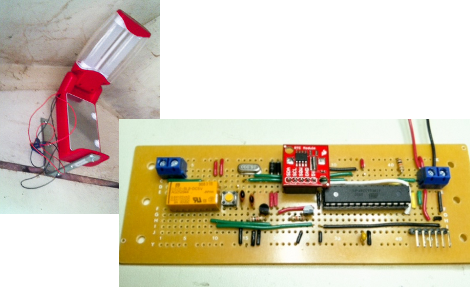
He already had an LED camping light to use, but needed to find a way to power it and to switch it on and off on a schedule. He chose an ATmega328 for the latter, as he had a bunch of extras sitting around. As for power, there isn’t AC available where the coop is, so he opted for a 12V lead-acid battery with hopes of adding solar charging features in the future.

Switching is handled by a relay, with accurate time kept by a DS1307 real-time clock (it’s the red PCB seen above). Everything fits nicely on the board, and we have a couple of feature suggestions for future improvements. The linear regulators will eat up some extra power so moving to a switching regulator will help save juice. Also, it would be very easy to add a light sensor so that the light will only be on when the ambient light drops to a preset level. This way he won’t need to mess with the schedule as the length of the days change.