Remote Uses No Batteries

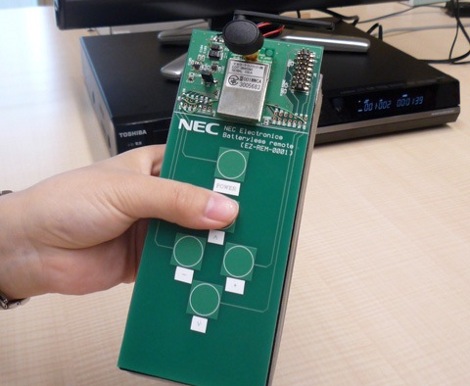
How often do you change the batteries in your television remote control?  Yeah, basically never. But that’s a tribute to how efficient the device is and not a reason to overlook this development. NEC is showing off a remote control that uses no batteries. Power is generated using the piezo effect that occurs when a button is pushed. That is to say, when a crystal is compressed it emits a tiny bit of electricity which is harnessed and used to power this device. This is the same principle that is used in the electricity producing sidewalks tested in Japan.

It’s pretty phenomenal that they can run the device using this method. Right now there’s only a handful of buttons but we’re sure there’ll be advances in the technology. There’s a ton of use for this if it can be miniaturized. It is using radio frequency instead of infrared, making it a useful development in wireless doorbells, garage door openers, key-less entry fobs for your car, and many more applications.

[Thanks das_coach]

Another Stationary Bike VR Rig

[Shingo] shared his implementation of a stationary bike as a virtual reality interface. This is similar to the Google Street View setup we covered a week ago but goes a few steps further. They patched into the bike computer to pick up rotation of the bicycle wheel and added an accelerometer for directional control. This setup can navigate through Street View but the video after the break also details an interface with Google Earth and even the ability to navigate through Second Life, following your avatar as it bikes along with you. The use of a wearable display is far superior to something like the SurfShelf and really gives you a goal other than just some cold-weather exercise. So take this idea, patch it into a wearable computer and you’ve got the exercise setup worthy of the future world we’ve been promised.

Continue reading “Another Stationary Bike VR Rig”

AVR8 Virtual Processor On FPGA

[Jack] wrote in to let us know about a project that creates a virtual microprocessor core based on the ATmega103 by using a Field-Programmable Gate Array. Great, we thought. Here’s another rather esoteric project like the NES on a FPGA, but what’s the motivation behind it? We asked [Jack] and he provided several scenarios where this is quite useful.

Implementing the AVR core allows code already written for the chips to be easily ported to an FPGA without a code rewrite. This way, if your needs outpaced the capabilities of the microcontroller long after the project has started, you can keep the code and move forward from that point with the added capabilities of the gate array. Having the core already implemented, you then only need to work with HDL for the parts of the project the AVR was unable to handle. He also makes the point that having an open source AVR core implementation provides a great tool for people already familiar with AVR to study when learning VHDL.

With products like the Butterfly that this project is based around, or the Maple we’ve seen in the past, programmable logic for the recreational hacker is starting to get a little easier.

When An Axe Isn’t Enough

[Chris] wanted a guitar with a keyboard but didn’t want a keytar. Like any good hacker he took a cheap guitar and a small keyboard and introduced them to each other. He moved the control knobs to make room for the keyboard and added the control circuitry from the keyboard to the top of the guitar’s body. A 9v battery is used to power the keys and something called “Chris Collins’ transformer trick” is used to amplify its sound. If you know details on this transformer, leave a comment and we’ll update the post. Take a look at the video after the break to see [Chris] perform the Final Countdown on keys and guitar.

The guitar is a Chinese made Telecaster clone and we think he’s the first one to find a realistic use for keyboards that don’t use full-sized keys. [Chris] apologizes for the lack of build photos but we give him a pass; he lost his phone while crowd-surfing and that’s as good an excuse as any for losing some pictures. We can’t wait to see another performance with this gnarly axe once he’s had enough practice to pull everything together!

Continue reading “When An Axe Isn’t Enough”

Look Ma, No Wires

[Robotkid249] details how to build a wireless power transmission system. This is similar to the commercial applications we have seen in a TED talk as well is in a Sony prototype. Power is fed to a ring made of magnet wire. A smaller loop is attached to the system that you want to power and picked up from the base unit. In this case, he is powering some LEDs but the concept can be tailored for your purposes such as an inductive charging pad. We’d like to see a hack that incorporates the base into a mouse pad (or the desk itself) and the receiver into the body of a wireless mouse. We’ve seen a commercial solution along these lines but we want one that doesn’t require a physical connection for power transfer.

[Thanks Juan]

PIC Powered AVR Programmer

[Texane] wrote in to let us know he has implemented AVR ISP programming using a PIC microcontroller. He wrote some code for an 18F4550 that uses the STK500 standard for In System Programming. This means that his hardware is compatible with AVRdude, the open source AVR programming software. There has long been an argument over the virtues of PIC versus AVR but we say why not both? If you have already honed your programming chops with PIC, you can build your own programmer and give the Atmel family a try.

The current implementation uses a serial port to connect the programmer to a computer. Keep your eye on this one as [texane] plans to add USB connectivity and has told us he will post schematics for the device as soon as that is complete.

Argh, Thar Be A Big Wheel

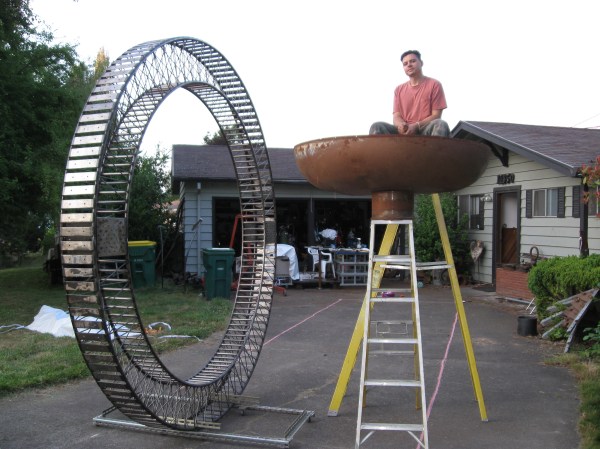
If you’re marooned on a desert island, you want to have a Professor who can build useful items out of coconuts. [LostMachine] is one of those guys, and he’s currently building a land-loving pirate ship. The wacky vehicle will use the giant wheel above to propel the vessel while the captain sits comfortably in the lofty crow’s nest. A crack-pot concept? Not really, he plans to take this to Burning Man where it will be a fairly useful build compared to the folks who have really gone off the deep end.

The story here is the build quality. Take some time to watch his videos which we’ve embedded after the break. In the first, he details his method for creating a precisely level building surface on top of his uneven driveway. This is accomplished by welding supports in a circle that are level compared to the center point. He goes on to share his liquid-cooling system for cutting the pipe supports with a custom-built jig and an old windshield washer water system pump from an RV (second video). The final video shows the construction of the wheel which came in with 2000 welds and about 250-300 hours of construction time.

If you hadn’t guessed, [LostMachine] is a structural engineer. Unfortunately he was laid-off this spring which has put a damper in his building schedule. We hope that with a quality project like this in his portfolio a new job is just around the corner for him.

Continue reading “Argh, Thar Be A Big Wheel”