Teaching Children To Walk Using Video Games

team_equiliberator

Medical conditions that prevent individuals from being able to walk are difficult to handle, even more so if the patient happens to be a child. Shriner’s hospitals treat a good number of children suffering from cerebral palsy, spina bifida, or amputations. They are always looking for creative treatment methods, so their Motion Analysis Laboratory looked to some Rice University undergrads for help. They asked the group of engineers to design a system that would make physical therapy a bit more fun, while helping encourage the children along.

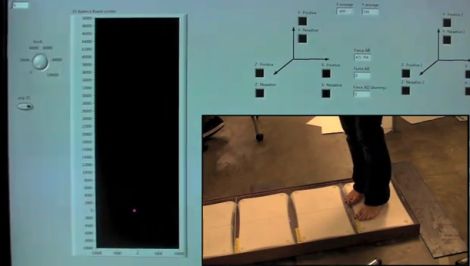
The team recently unveiled their project, called the Equiliberator. The game system incorporates a series of five Wii balance boards situated between a pair of pressure-sensitive handrails. The platform communicates with a computer via Bluetooth, registering the patient’s movements as he or she moves along the path. The software portion of the system consists of a monster-slaying game which requires the child to step on a particular section of the pathway to dispose of the oncoming enemies.

The game is designed to get more difficult as the child’s balance and coordination improve, encouraging them with an ever growing bank of points as they progress. The final goal of the project is to enable the pressure sensitive handrails to determine how much the child is relying on them for balance, offering in-game incentives to walk with as little support as possible.

We love seeing hacks like this which not only entertain, but truly help people in the process. Kudos to the team at Rice University – they have done a fantastic job here.

Continue reading to see a quick video describing the Equiliberator in the designers’ own words.

[via MedGadget]

Continue reading “Teaching Children To Walk Using Video Games”

Guitar Teaches You To Play Using LEDs

guitarduino

[Andrew] is an electrical engineering student at UIC, and decided that he would build a MIDI guitar for his senior design project. After tinkering for awhile, things were not looking good, and the MIDI guitar idea was scrapped. With his deadline creeping up, he came up with a new idea, the Guitarduino. His new project is a guitar that teaches you how to play chords and scales by showing you the proper notes to play via LEDs embedded in the guitar’s neck.

He removed the neck, and carefully drilled the holes that would eventually house his 130+ LEDs. The LEDs were wired to his Arduino via some multiplexing circuitry that resides on the back of the guitar’s body. The Arduino was mounted on the front of the guitar along with a shield used for communicating with his LED array. He built another shield that serves as the LCD display as well as the input board for his guitar.

The final result of all his work is fantastic. The user simply needs to dial in the chord or scale that he wants to learn, and the guitar lights up, showing the proper finger positions on the fretboard. We could see this coming in quite handy for anyone just starting to learn how to play.

Check out the video below to see a demonstration and walkthrough [Andrew] put together highlighting his guitar’s features.

Continue reading “Guitar Teaches You To Play Using LEDs”

Laser Tripwire Alarm System Uses Mirrors To Increase Coverage

laser_tripwire_alarm

Instructables user [EngineeringShock] has been hard at work building a laser trip wire security system, complete with a combination lock. The security system works just like you see in the movies, employing an array of mirrors to bounce the laser across an opening several times in order to secure the space.

A PIC18F1220 micro controller sits at the center of the alarm and handles the majority of its functions. It takes input from the laser detection circuit, triggers the buzzer, as well as arms and disarms the entire alarm system. An LS7222 digital lock handles the passcode verification side of things, taking input from a 16-button matrix keypad, and telling the PIC when the proper code has been entered.

As you can see in the video below, the alarm system works and the buzzer is quite loud. There is one small problem however – the alarm only arms itself after the proper code has been entered and the lights have been turned off. The light sensing circuit he uses is too sensitive and can only operate in darkness, though he discusses the ability to add a more accurate sensing solution.

If you are interested in reading more about laser tripwire security systems, check out this similar passcode-based system, this alarm system built into a toy, and this Arduino-based alarm system.

Continue reading “Laser Tripwire Alarm System Uses Mirrors To Increase Coverage”

Nixie Tube Conference Badge

troopers11_badge

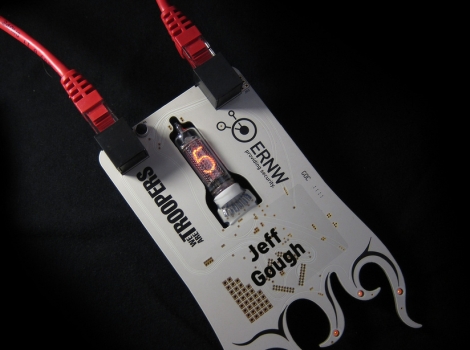
Maker [Jeffrey Gough] was recently asked to construct a set of badges for the TROOPERS11 IT security conference held in Heidelberg last month. The badges were to reflect the overall theme of this year’s conference – personal progression, education, and striving to become better IT security professionals. To do this, he designed a badge that tracked a conference attendee’s participation in various activities.

The badge sports a center-mounted nixie tube that is used to show the attendee’s score. It is worn around the neck using a Cat-5 cable that acts as a LANyard as well serves as a power switch for the badge. The badge can be plugged in to a special programmer used by conference organizers, which updates the attendee’s score after completing each activity.

[Jeffrey] made sure to add all sorts of extra goodies to the badge, including a capacitive touch button that displays a secret message via the nixie, as well as plenty of hole and SMT pads so that hackers could get their game on.

Overall, the reception of the badge was extremely positive. All of the conference attendees had lots of fun exploiting the badges as well as adding components such as LEDs and speakers.

Continue reading to check out a quick demonstration video [Jeffrey] put together, highlighting the badge’s features.

Continue reading “Nixie Tube Conference Badge”

Auxiliary Battery Pack For Field Operations

portable_battery_pack

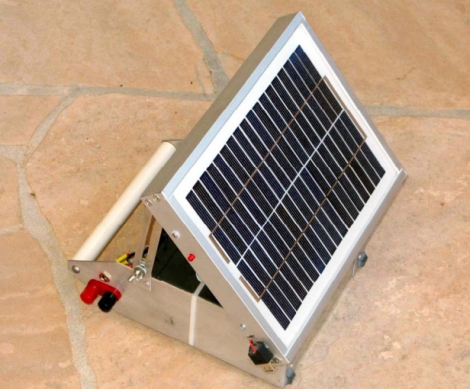
Ham operator [Ken – wa4mnt] wrote us to share a small project that he uses nearly every time he goes out in the field. His portable sealed lead acid battery pack (PDF) always ensures that he has a 12v power source at his fingertips, both for fun as well as in emergency situations.

The battery pack is pretty simple, and includes a 12v, 17ah battery strapped into a light aluminum chassis which he fabricated. The battery is secured with zip ties, so it can easily be swapped out or replaced without much fuss. The frame also sports a tiltable 4w, 17.5v solar panel that keeps the battery topped off and ready to go at all times. He stuck a voltmeter to the top of the battery to keep an eye on things, and he employs a 10A fuse to make sure he doesn’t fry any sensitive radio components should something go wrong.

The battery pack is pretty compact when you think about it, and we imagine it would be great to have on hand for a wide array of outdoor activities. Even if you’re not into Ham field operations, it’s hard to argue with its usefulness during power outages.

[Ken] doesn’t appear to have any published plans for the chassis or the electronic portion of the pack, but we’re pretty sure he would share if asked.

Mechanical Twitter Feed For Offline Reading

mechanical_twitter_feed

Twitter can be a great tool for keeping up to date with your favorite person/company/band/etc. You can find a Twitter client for just about anything that plugs in these days, but sometimes we find that we simply need a break from our computers and smart phones – even if just for a few minutes. What happens when you want to unplug, but still need to know what everyone is up to?

[Patrick Dinnen] asked himself the same thing, and decided that the solution was a mechanical Twitter feed display. The display consists of a static user list strung up against the wall, with a mobile speech bubble mounted next to it. The bubble moves to the user who has most recently updated their status (presumably using a pair of servos), and uses a projector to display their messages. The effect is pretty neat, and it still allows you to get your Twitter fix without staring blankly at your computer screen or smart phone.

We think it would be even cooler if it used a projector on both sides, enabling it to dynamically shuffle through users and status messages at the same time. [Patrick] says that for right now it is merely a proof of concept, so there is no telling how he’ll tweak it going forward.

Continue reading to see his mechanical Twitter feed in action.

[via Adafruit]

Continue reading “Mechanical Twitter Feed For Offline Reading”

Musical Tesla Concert Is Electrifying

musical_tesla_coil

Hackaday reader [Tyler Laseter] wrote in to tell us about an event that he and his fellow Tesla Orchestra team members are hosting next month.

The “Open Spark Project” is a concert event taking place on May 14th, which melds together electricity and music in spectacular fashion. The event features two large Tesla coils which are tuned to play musical notes while shooting bolts of electricity through the air.

Musical Tesla coils are nothing new around here, but we have yet to see someone allow the general public to play music on their coils. That’s what makes this event unique – anyone is encouraged to submit their to the Tesla Orchestra team, which will then be played back via a live video stream next month. Their web site offers up all of the technical details as well as the file format requirements for submitting music for the event, so get started on your entry today!

If a passive approach is more your style, stick around for a quick video demonstrating their coils’ abilities. Sure it’s Lady Gaga, but we won’t tell anyone you watched it. Plus, it’s totally legit when the song is being played using 20,000 volts.

Continue reading “Musical Tesla Concert Is Electrifying”