Hand-cranked Magnet Machine Is Endless Fun

magnet_machine

We can’t think of a single person who doesn’t enjoy playing with a handful of rare earth magnets now and again. We know that [Dave Johnson] certainly does. As a gift to his father in law, he constructed a magnificent machine that does little more than manipulate spherical rare earth magnets with hypnotizing grace.

The machine is constructed almost entirely from wood, save for a few fasteners and rods. Even the gears have been carefully cut from wood, with special attention paid to ensure smooth operation. When cranked, the machine slices off a single magnet from one end of a long chain, passing it along to a lift arm. The lift arm deposits the magnet into a metal tube, and with the help of eddy currents, it drifts slowly down before being redeposited at the end of the magnet chain.

Be sure to check out a video demonstration of the machine after the break, it really is fun to watch.

[via LaughingSquid]

Continue reading “Hand-cranked Magnet Machine Is Endless Fun”
Wireless Rover Has Two Guns…one For Each Of Ya

texas_ranger_airsoft_rover

We never really get bored with remote-controlled rovers around here, especially when they involve reusing some old hardware as well as lasers. [Tycoon] wrote in to share his creation, which he has dubbed “Texas Ranger”.

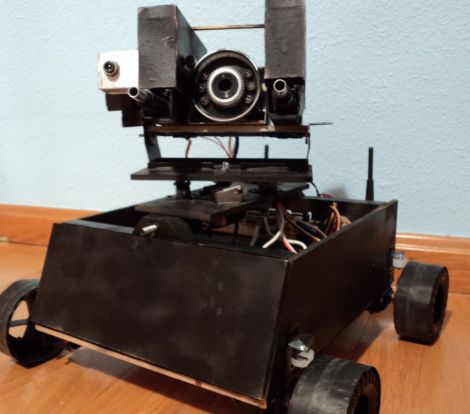
Texas Ranger is built around an old Linksys WRT54GL router, which provides the rover’s WiFi connectivity as well as the serial interface through which everything else is controlled. The rover features a pair of PIC microcontrollers, which handle all of the servo control as well as telemetry calculations.

An onboard camera gives the operator a driver’s seat view of the action, allowing for precise control of the vehicle. Laser triangulation is used to help measure object distance, and a pair of airsoft pellet guns straddle the camera for whenever [Tycoon] feels like making his presence known. One feature we are especially fond of is the pair of Wii nunchucks which the rover uses to monitor its position. Always aware of its operating angle, it auto-adjusts the camera to compensate for uneven surfaces, guaranteeing that [Tycoon] doesn’t have to tilt his head to see straight.

Keep reading to see a quick demo video he shot of Texas Ranger in action.

Continue reading “Wireless Rover Has Two Guns…one For Each Of Ya”

Building A Brushless Motor Controller

brushless_motor_controller

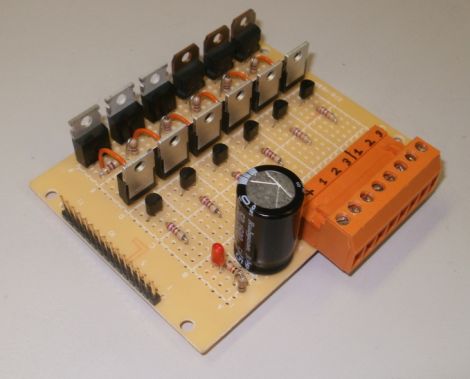
Brushless motors and the way in which they are controlled can be a bit of an enigma to those just starting out in hobby electronics. [Andrew] from spingarage thought it would be helpful to put together a quick tutorial showing how he built a simple brushless motor controller in about a day’s time. He constructs everything on protoboard from components he acquired at RadioShack in order to demonstrate the ease of sourcing parts and building a brushless motor driver.

While he skips most of the theory behind brushless motor control itself, he does touch on the signaling these motors require for movement as well as how motor position is determined. Specifically, he expands on how half-bridges can be used to create the sine wave signaling required by a single motor input, as well as how three of these can be combined to drive a brushless motor.

The post is the first in a series of posts about brushless motors, so we should see some code examples and some practical applications in the near future.

I2C Arduino GPS Shield

i2c_gps_shield

[Wayne] wrote in to share an item he just finished working on, an I2C GPS shield for the Arduino. While other GPS solutions have existed for quite some time, his caught our eye due to its feature list.

The shield removes a good bit of the hassle associated with parsing raw NMEA data from traditional GPS addons. While you have the option to communicate with the GPS module over serial in order to obtain the raw data, the use of the I2C interface makes getting the most commonly used GPS data a breeze. The GPS module itself can be set to update at anywhere from 1 to 10 Hz, and [Wayne] says that the I2C bus blows away the oft-used 9600 baud serial interface. While I2C is primarily used for receiving data, it can also be utilized to configure the GPS via its control registers, allowing for on the fly settings tweaks.

While he does sell the units pre-assembled at a competitive price, [Wayne] also provides a full schematic, making this an easy afternoon project once you have sourced the proper components.

Sound Localization And A Treaded Rover

soundlocalization_and_a_robot

[Jad] recently wrote in to share a pair of projects that have been keeping him busy as of late.

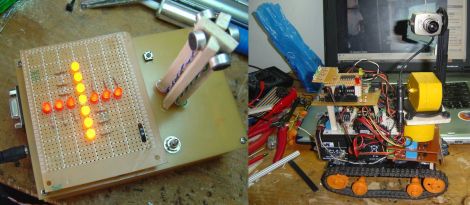
The first is a sound localization system not unlike one we showed you a few weeks ago. The difference is that his system displays the sound source via a set of LEDs rather than by motion, making it far less prone to interference by things like servo noise. His system uses four identical circuits, each of which are wired to a separate analog input on the Arduino. Each channel is adjustable, making it easy to tweak how the system responds to a particular sound.

His second project is a sizable robot built on the Motoruino platform. His contraption features several stacked control boards that handle the bots locomotion as well as camera control. It connects to his computer via a Bluetooth module that boasts a 1 mile range, allowing him to control everything from his PC. [Jad] is using the robot as a prototype for a much larger scale creation, and he says that his current focus is getting the robot to track and follow objects automatically using the on-board camera.

Continue reading to see a small preview of his bot’s progress so far.

Continue reading “Sound Localization And A Treaded Rover”

Wireless Hackerspace Status Notifier

space_probe

Hackerspaces are always looking for novel ways to let their members know that they are open for business, and this notifier [Angus] from Make, Hack, Void recently put together is no exception.

While dumpster diving one day, he came across a fantastic-looking lab power supply from the ‘70s. He gutted it, saving the variable transformer for a future project, and started constructing his notifier. When someone enters the hackerspace, they simply set the dial on the “Space Probe” to the amount of time they expect to be there. The built-in Seeduino sends the data over Bluetooth to an OpenWRT-enabled router, which uses a couple of Lua scripts to notify members via email and Twitter.

Since almost all of the processing is done on the router side, it leaves the Arduino in the probe with little more to do than flash an LED and send ASCII status messages any time the knob is turned. [Angus] is well aware that this would probably make most people’s heads spin, but he hopes that other hackerspace members use that untapped potential to further enhance the notifier.

Stick around to see the Space Probe in action, and if you are interested in seeing what other hackerspaces use to keep their members in the know, check out this status switch from Hack42.

Continue reading “Wireless Hackerspace Status Notifier”

Building Your Own Real Time Clock

diy_rtc

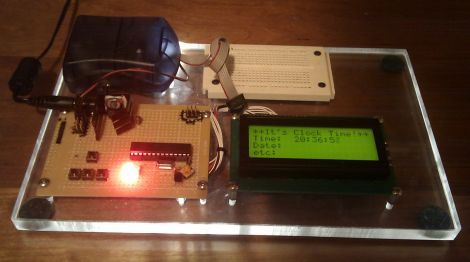
Like many electronics hobbyists, [Pete] found that he had an overwhelming desire to build a clock for himself. He didn’t want to stick a discrete real time clock IC into a box and call it a day, so he opted to construct his own around a microcontroller instead.

After researching the specs on a few RTC ICs, he defined some accuracy requirements for his clock, and got to building. He started out using a 32,768 Hz watch crystal, but found that the accuracy was off by about 46 ppm after only 24 hours of use. That fell well beyond his self-imposed +/- 3 ppm tolerance goal, so he purchased an oscillator with about 500 times the resolution of his previous crystal.

After writing a handful of code to ensure that the clock remains stable, he calculated that his accuracy should be about 0.18 ppm – well within his acceptable tolerance range.

[Pete] says that this is just the first part of his clock construction, and that future revisions should include plenty of additional functionality, so keep an eye out for updates.