A map of the United States showing a series of interconnected lines in white, red, orange, yellow, and green to denote fiber optic and electrical transmission lines. Dots of white, orange, and yellow denote the location of the data centers relative to nearby metropolitan centers.

NREL Maps Out US Data Infrastructure

Spending time as wee hackers perusing the family atlas taught us an appreciation for a good map, and [Billy Roberts], a cartographer at NREL, has served up a doozy with a map of the data center infrastructure in the United States. [via LinkedIn]

Fiber optic lines, electrical transmission capacity, and the data centers themselves are all here. Each data center is a dot with its size indicating how power hungry it is and its approximate location relative to nearby metropolitan areas. Color coding of these dots also helps us understand if the data center is already in operation (yellow), under construction (orange), or proposed (white).

Also of interest to renewable energy nerds would be the presence of some high voltage DC transmission lines on the map which may be the future of electrical transmission. As the exact location of fiber optic lines and other data making up the map are either proprietary, sensitive, or both, the map is only available as a static image.

If you’re itching to learn more about maps, how about exploring why they don’t quite match reality, how to bring OpenStreetMap data into Minecraft, or see how the live map in a 1960s airliner worked.

Hacking T Cells To Treat Celiac Disease

As there is no cure for celiac disease, people must stick to a gluten free diet to remain symptom-free. While this has become easier in recent years, scientists have found some promising results in mice for disabling the disease. [via ScienceAlert]

Since celiac is an auto-immune disorder, finding ways to alter the immune response to gluten is one area of investigation to alleviate the symptoms of the disease. Using a so-called “inverse vaccine,” researchers “engineered regulatory T cells (eTregs) modified to orthotopically express T cell receptors specific to gluten peptides could quiet gluten-reactive effector T cells.”

The reason these are called “inverse vaccines” is that, unlike a traditional vaccine that turns up the immune response to a given stimuli, this does the opposite. When the scientists tried the technique with transgenic mice, the mice exhibited resistance to the typical effects of the target gluten antigen and a related type on the digestive system. As with much research, there is still a lot of work to do, including testing resistance to other types of gluten and whether there are still long-term deleterious effects on true celiac digestive systems as the transgenic mice only had HLA-DQ2.5 reactivity.

If this sounds vaguely familiar, we covered “inverse vaccines” in more detail previously.

A woman in a richly-colored blue head scarf leans over a wooden table looking at the timer between her hands. The timer has a yellow circle on black flip panels on the left and black and white CT scans of a human torso on the right side. The frame is wood, and there is an electric motor on the upper right of the frame and a silver drum on the left of the frame beneath the woman's hand.

A Flip Clock Becomes A Flip Timer

Sometimes it’s nice to have a widget to do a single task and avoid getting distracted by the supposed simplicity of doing it with an app on a smartphone. [Dina Amin] built a timer from an old flip clock to stay focused.

Starting with a disassembly of the flip clocks she found at a flea market with [Simone Giertz], [Amin] decided to change the twenty four hour mechanism to a twenty four minute one which was similar to the amount of time she was already using for several different practices. Since she’s an expert in animation, she planned on turning a set of CT scans into the animation that would play on the section that had previously been the minutes of the clock.

As much of the original clock’s components were damaged, and [Amin] didn’t have a chance to learn clockmaking from scratch in a week, she tried a few different drive mechanisms for the build. The drum from an air fryer timer driven with an electric motor fit the bill, but off enough from proper minutes that [Amin] switched from numerals to a yellow circle that fills in as it approaches the satisfying ding of completion.

If you want to see Simone’s Moon flip clock we’ve covered that project too.

Continue reading “A Flip Clock Becomes A Flip Timer”

A woman in a ball cap and black tank top holds a black and white image of the Moon printed on black acrylic. It can fold and is mounted on a black plastic mechanism with turning knobs affixed to the ends. There are out-of-focus shelves in the background with various items and books on them.

Moon Phase Flip Clock Is Fantastic

We love clocks, but we especially love unusual timepieces that aren’t just about showing the hour of the day. [Simone Giertz] built a flip clock moon phase tracker for a friend.

While in Egypt for Cairo Maker Faire, [Giertz] and [dina Amin] found some old flip clocks at a flea market and had to have them. [Amin] mentioned wanting to make a moon phase tracker with one, and [Giertz] decided to try her hand at making her own version. A side quest in more comfortable flying is included with the price of admission, but the real focus is the process of figuring out how to replicate the flip clocks original mechanism in a different size and shape.

[Giertz] cut out 30 semi-circle flaps from polystyrene and then affixed vinyl cut-outs to the flaps. The instructions for the assembly suggest that this might not be the best way to do it, and that printing stickers to affix to the flaps might work better since the cut vinyl turned out pretty fiddly. We really like the part where she built a grid jig to determine the optimal placement of the beams to keep the flaps in the right position after a disheartening amount of difficulties doing it in a more manual way. Her approach of letting it rest for twenty minutes before coming back to it is something you might find helpful in your own projects.

Best of all, if you want to build your own, the files are available for the flip moon station on the Yetch website. You’ll have to come up with your own method to drive it though as that isn’t in the files from what we saw.

Continue reading “Moon Phase Flip Clock Is Fantastic”

A Portable M4 Mac Mini

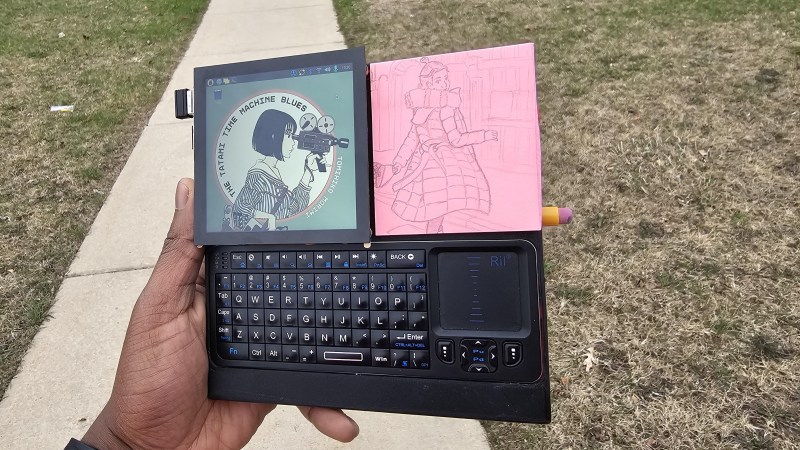
The Mac mini is the closest to an Apple-based SBC you can get, so it lends itself to unusual portable computers. [Scott Yu-Jan] is back to tackle a portable build using the latest and greatest M4 mini.

[Yu-Jan] walks us through his thought process of how to maximize the portability of the system without all that tedious mucking about with setting up a separate keyboard, monitor, and the mini while on the go. With the more complicated electronics, the monitor risked tipping the keyboard over when attached, particularly since [Yu-Jan] isn’t a fan of batteries for his portables.

By affixing the Mac mini to the side of the keyboard, it makes the whole thing easier to slip into a bag without being overly thick. We get a peek into his iterative process as well when he evaluates the build and decides that the closing of the lid wasn’t what he was hoping for. By adding some TPU rests for the monitor to rest on in the closed position, he says it’s really brought the whole project up a notch. We certainly have had our own projects where one little detail really moves it from sketchy to polished, and we appreciate when makers clue us in on where that happened for them.

You may recognize [Yu-Jan] from our previous coverage of his older portable all-in-one Mac mini and this luggable version where he explains why he doesn’t like laptops. If you like your computers more stationary, how about some G4 iMacs with the newer internals from an M-series mini?

Continue reading “A Portable M4 Mac Mini”

A black and white slide with the Supercon 8 logo in the top left, the text, "Nanik Adnani" and "A Hacker's Guide to Analog Design in a Digital World" is in the bottom left. To the right is a circularly cropped image of An image of a college student in glasses and a cap sitting with a black camera in his lap.

Supercon 2024: A Hacker’s Guide To Analog Design In A Digital World

We often think of analog computing as a relic of the past, room-sized monstrosities filled with vacuum tubes doing their best to calculate Monte Carlo simulations or orbital velocities. Analog isn’t as dead as it might seem though, and analog mix signal design engineer [Nanik Adnani] gave us a crash course on analog circuits at Supercon 2024.

Continue reading “Supercon 2024: A Hacker’s Guide To Analog Design In A Digital World”

A picture of a single water droplet on top of what appears to be a page from a chemistry text. An orange particle is attached to the right side of the droplet and blue and black tendrils diffuse through the drop from it. Under the water drop, the caption tells us the reaction we're seeing is "K2Cr2O7+ 3H2O2 + 4H2SO4 = K2SO4+Cr2(SO4)3+7H2O+3O2(gas)"

Water Drops Serve As Canvas For Microchemistry Art

If you’re like us and you’ve been wondering where those viral videos of single water drop chemical reactions are coming from, we may have an answer. [yu3375349136], a scientist from Guangdong, has been producing some high quality microchemistry videos that are worth a watch.

While some polyglots out there won’t be phased, we appreciate the captioning for Western audiences using the elemental symbols we all know and love in addition to the Simplified Chinese. Reactions featured are typically colorful, but simple with a limited number of reagents. Being able to watch diffusion of the chemicals through the water drop and the results in the center when more than one chemical is used are mesmerizing.

We do wish there was a bit more substance to the presentation, and we’re aware not all readers will be thrilled to point their devices to Douyin (known outside of China as TikTok) to view them, but we have to admit some of the reactions are beautiful.

If you’re interested in other science-meets-art projects, how about thermal camera landscapes of Iceland, and given the comments on some of these videos, how do you tell if it’s AI or real anyway?