RC Minecraft Boat Patrols The Pool For Treasure

Looking to recreate those relaxing Minecraft fishing sessions in real life, [electrosync] recently set out to 3D print himself a blocky remote controlled boat, complete with a similarly cubic occupant to ride in it. Each element of the build, from the oars to the bobber on the end of the fishing line, has been designed to look as faithful to the source material as possible. In fact, the whole thing is so accurate to the game that it’s almost surreal to see it rowing around the pool.

That said, some of the resemblance is only skin deep. For example the rowing action, though it appears to be properly synchronized to the boat’s movement through the water, is completely for show. A standard propeller and rudder arrangement under the boat provide propulsion and directional control, and [electrosync] notes its actually powerful enough to push the boat very near to its scale top speed from the game, despite the exceptionally poor hydrodynamics of what’s essentially just a rectangle.
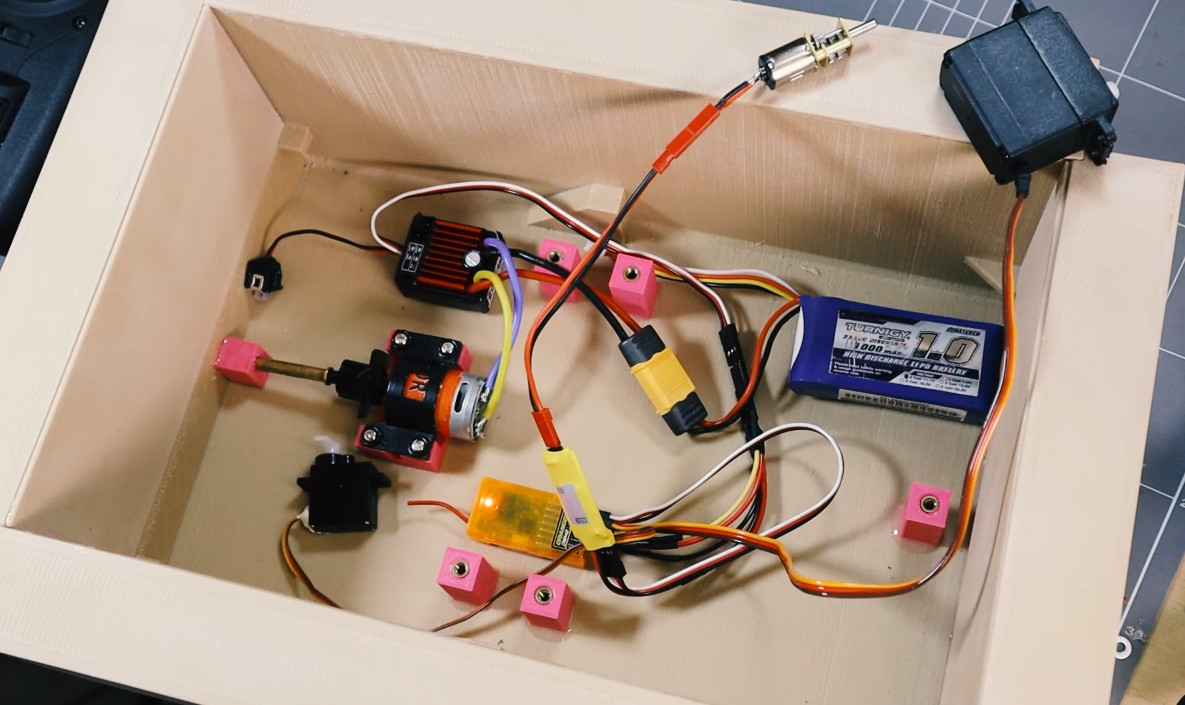
A look under the deck.

Speaking of which, [electrosync] even went through the trouble of printing the hull in wood-fill PLA and coating it in polyester resin to make sure it was watertight. Granted he could have just made the boat out of wood in the first place, saving himself the nearly 60 hours it took to print the hull parts, but that would have been cheating.

Beyond the servos and motors that move the boat and the oars, [electrosync] had to give his 3D printed fisherman a considerable amount of dexterity. Servos embedded into the 3D printed parts allow “Steve” to rotate at the hips and raise and lower his arm. With a fishing pole slipped into a hole printed into the hand, he’s able to cast out his magnetic bobber and see whats biting.

We’ve actually seen quite a number of projects that allow virtual objects inside Minecraft to interact with the real world, but comparatively few efforts to recreate objects from the game’s blocky universe, so the change of pace is nice.

Continue reading “RC Minecraft Boat Patrols The Pool For Treasure”

Four More Talks Added To The 2021 Remoticon Lineup

We’ve already unveiled multiple keynote speakers and a slate of fascinating presenters that will be showing off everything from reverse engineering vintage calculators to taking those first tentative steps on your CAD journey for this year’s Remoticon. You’d be forgiven for thinking that’s everything you’ll see at the conference, but there’s still plenty to announce before the two-day virtual event kicks off on November 19th. Normally we’d be promising to make sure you get your money’s worth, but since tickets are completely free, we’re shooting a bit higher than that.

We were blown away by the number of fantastic talk proposals we received during this year’s extended call. Let’s take a look at the next four presenters who will be joining us for the 2021 Hackaday Remoticon on November 19th through the 20th.

Continue reading “Four More Talks Added To The 2021 Remoticon Lineup”

New Raspberry Pi Zero 2 Upgrades To Quad-Core Processor

Over the years, we’ve seen a steady stream of updates for the Raspberry Pi Foundation’s flagship single-board computer (SBC), with each new release representing a significant boost in processing power and capability. But the slim Raspberry Pi Zero, released all the way back in 2015, hasn’t been quite so fortunate. Beyond the “W” revision that added WiFi and Bluetooth in 2017, the specs of the diminutive board have remained unchanged since its release.

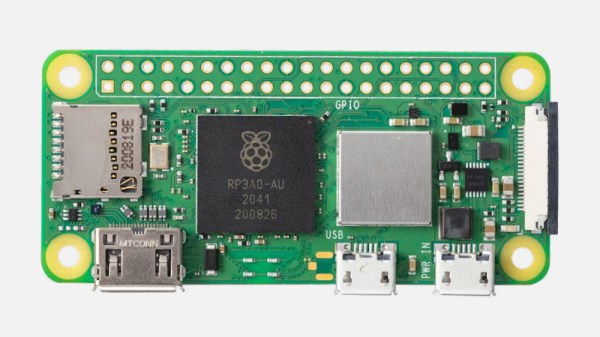
That is, until now. With the introduction of the $15 USD Raspberry Pi Zero 2 W, the ultra-compact Linux board gets a much-needed performance bump thanks to the new RP3A0 system-in-package, which combines a Broadcom BCM2710A1 die with 512 MB of LPDDR2 SDRAM and a quad-core 64-bit ARM Cortex-A53 CPU clocked at 1 GHz. In practical terms, the Raspberry Pi Foundation says the new Zero 2 is five times as fast as its predecessor with multi-threaded workloads, and offers a healthy 40% improvement in single-threaded performance. That puts it about on par with the Raspberry Pi 3, though with only half the RAM.

Otherwise, the new Zero 2 isn’t much different from the original. It’s the same size and shape, meaning existing cases or mounts should work fine. You’ll also find the micro SD slot, CSI camera connector, dual micro USB ports, and mini HDMI port in the same places they were in 2015.

Frankly we’re a little surprised they didn’t switch over to USB-C (at least for the power port) and micro HDMI to bring it in line with the Pi 4, but of course, they presumably didn’t want to break compatibility with existing Zero projects. At least we won’t have to wait for a second edition to add wireless, as the Zero 2 W offers 2.4 GHz 802.11 b/g/n WiFi and Bluetooth 4.2 out of the box.

We’ll have samples of the new Zero 2 W in hand shortly, so keep an eye out for a detailed overview of this highly anticipated new member of the Pi family. In the meantime, let us know what you think about the new hardware in the comments. Is it a worthy successor to the original $5 Pi Zero?

VCF East 2021: Preserving Heathkit’s 8-Bit Computers

To say the Heathkit name is well known among Hackaday readers would be something of an understatement. Their legendary kits launched an untold number of electronics hobbies, and ultimately, plenty of careers. From relatively simple radio receivers to oscilloscopes and televisions, the company offered kits for every skill level from the post-war era all the way up to the 1990s.

So it’s hardly a surprise that in 1977, seeing the success of early home computers like the Altair 8800 and IMSAI 8080, Heathkit decided to join the fray with a computer kit of their own. But by that point the home computing market had started to shift from a hobbyist’s pursuit to something the whole family could enjoy. Compared to the Apple II and TRS-80, both of which also launched in 1977, Heathkit’s machine seemed like the product of a bygone era.

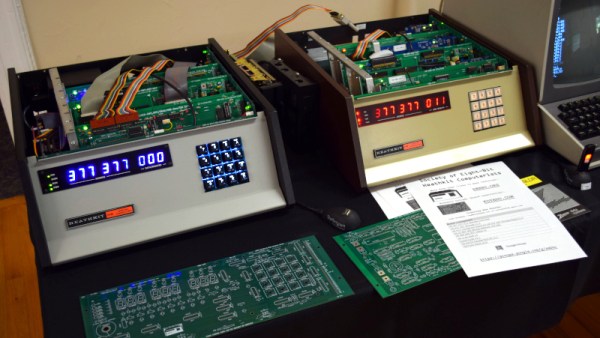
While it might not have gained the notoriety of the microcomputers it was designed to compete with, the Heathkit H8 is certainly not forgotten. Tucked away in a corner at the 2021 Vintage Computer Festival East was an impressive exhibit dedicated to the Society of Eight-Bit Heath Computerists (SEBHC) called Heathkit: Keeping the Legacy Alive. Presented by Glenn Roberts, this collection of original and modern hardware demonstrated the incredible lengths to which this group of passionate Heathkit owners have gone to not just preserve the memory of these often overlooked computers, but to continue to improve upon the kit’s unique design.

Continue reading “VCF East 2021: Preserving Heathkit’s 8-Bit Computers”

Modified Car Alternator Powers Speedy DIY E-Bike

Your garden variety automotive alternator is ripe for repurposing as is, but with a little modification, it can actually be used as a surprisingly powerful brushless motor. Looking to demonstrate the capabilities of one of these rebuilt alternators, [DIY King] bolted one to the back of a old bicycle and got some impressive, and frankly a bit terrifying, results.

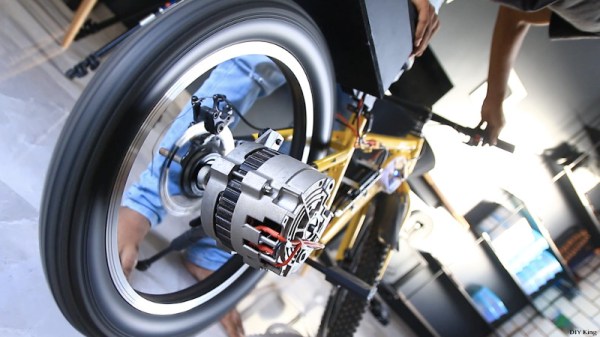
We should say up front that the required modifications to the alternator are quite extensive, so before you get too excited about building your own budget e-bike, you should check out the previous guide [DIY King] put together. The short version is that you’ll need to machine a new rotor and fill it with the neodymium magnets salvaged from hoverboard motors.

A custom built alternator rotor is the key to the project.

Once you’ve got your modified alternator, the rest is relatively easy. The trickiest part of this build looks like it was cutting off the bike’s rear wheel mount and replacing it with a plate that holds the alternator and a pair of reduction gears pulled from a 125cc motorbike. Beyond that, it’s largely electronics.

Naturally, you’ll also need a pretty beefy speed controller. In this case [DIY King] is using a 200 amp water-cooled model intended for large RC boats, though interestingly enough, it doesn’t seem he’s actually running any water through the thing. He’s also put together a custom 1,500 watt-hour battery pack that lives in a MDF box mounted under the seat.

To test out his handiwork, [DIY King] took to the streets and was able to get the bike up to 70 km/h (43 MPH) before his courage ran out. He thinks the motor should be able to push it up to 85 km/h, but he says the bike started wobbling around too much for him to really open it up. In terms of range, he calculated that while cruising around at a more palatable 30 km/h (18 MPH), he should be able to get 100 kilometers (62 miles) off of a single charge.

If you like repurposed motors and suicidal bike speeds, you’ll love this build that uses a washing machine motor to push a rider to a claimed 110 km/h. If you’re not worried about speed or range, then this supercapacitor e-bike is certainly worth a look as well.

Continue reading “Modified Car Alternator Powers Speedy DIY E-Bike”

VCF East 2021: Novasaur TTL Computer Sets The Bar

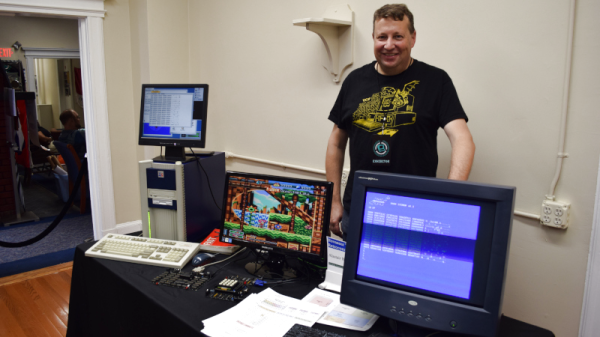
There was certainly no shortage of unique computers on display at the 2021 Vintage Computer Festival East; that’s sort of the point. But even with the InfoAge Science and History Museum packed to the rafters with weird and wonderful computing devices stretching back to the very beginning of the digital age, Alastair Hewitt’s Novasaur was still something of an oddity.

In fact, unless you knew what it was ahead of time, you might not even recognize it as a computer. Certainly not a contemporary one, anyway. There’s nothing inside its Polycase ZN-40 enclosure that looks like a modern CPU, a bank of RAM, or a storage device. Those experienced with vintage machines would likely recognize the tight rows of Advanced Schottky TTL chips as the makings of some sort of computer that predates the 8-bit microprocessor, but its single 200 mm x 125 mm (8 in x 5 in) board seems far too small when compared to the 1970s machines that would have utilized such technology. So what is it?

Inspired by projects such as the Gigatron, Alastair describes the Novasaur as a “full-featured personal computer” built using pre-1980 components. In his design, 22 individual ICs stand in for the computer’s CPU, and another 12 are responsible for a graphics subsystem that can push text and bitmapped images out over VGA at up to 416 x 240. It has 512 K RAM,  256 K ROM, and is able to emulate the Intel 8080 fast enough to run CP/M and even play some early 80s PC games.

Continue reading “VCF East 2021: Novasaur TTL Computer Sets The Bar”

Vizio In Hot Water Over Smart TV GPL Violations

As most anyone in this community knows, there’s an excellent chance that any consumer product on the market that’s advertised as “smart” these days probably has some form of Linux running under the hood. We’re also keenly aware that getting companies to hold up their end of the bargain when it comes to using Linux and other GPL licensed software in their products, namely releasing their modified source, isn’t always as cut and dried as it should be.

Occasionally these non-compliant companies will get somebody so aggravated that they actually try to do something about it, which is where smart TV manufacturer Vizio currently finds itself. The Software Freedom Conservancy (SFC) recently announced they’re taking the Irvine, California based company to court over their repeated failures to meet the requirements of the GPL while developing their Linux-powered SmartCast TV firmware. In addition to the Linux kernel, the SFC also claims Vizio is using modified versions of various other GPL and LGPL protected works, such as U-Boot, bash, gawk, tar, glibc, and ffmpeg.

According to the SFC press release, the group isn’t looking for any monetary damages. They simply want Vizio to do what’s required of them as per the GPL and release the SmartCast source code, which they hope will allow for the development of an OpenWrt-like replacement firmware for older Vizio smart TVs. This is particularly important as older models will often stop receiving updates, and in many cases, will no longer be able to access all of the services they were advertised as being able to support. Clearly the SFC wants this case to be looked at as part of the larger Right to Repair debate, and given the terrible firmware we’ve seen some of these smart TVs ship with, we’re inclined to agree.

Now of course, we’ve seen cases like this pop up in the past. But what makes this one unique is that the SFC isn’t representing one of the developers who’s software has been found to be part of Vizio’s SmartCast, they’re actually the plaintiff. By taking the position of a consumer who has purchased a Vizio product that included GPL software, the SFC is considered a third-party beneficiary, and they are merely asking the court to be given what’s due to them under the terms of the license.

As firm believers in the open source movement, we have zero tolerance for license violators. Vizio isn’t some wide-eyed teen, randomly copying code they found from GitHub without understanding the implications. This is a multi-billion dollar company that absolutely should know better, and we’ll be happy to see them twist in the wind a bit before they’re ultimately forced to play by the rules.