Raspberry Pi Pico Makes For Expeditious Input Device

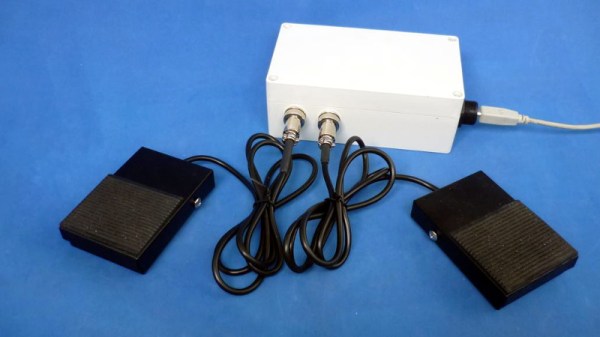
With its copious number of GPIO pins and native USB, the Raspberry Pi Pico is arguably the ideal microcontroller for developing your own platform agnostic USB Human Input Devices. But you don’t have to take our word for it. Check out how quickly the $4 USD board allowed [Alberto Nunez] to put together a pair of foot pedals for his computer.
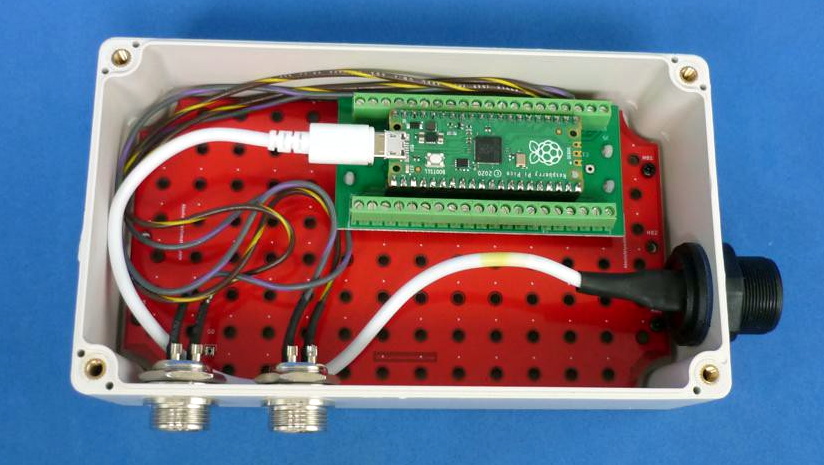
Wiring doesn’t get much easier than this.

A peek inside the enclosure reveals…well, not a whole lot. All that’s hiding inside that heavy-duty plastic box is the Pi Pico and some screw down terminals that let [Alberto] easily wire up the female bulkhead connectors for the pedals themselves. Incidentally, while you could certainly make your own pedals, the ones used for this project appear to be the sort of commercially available units we’ve seen used in similar projects.

With the hardware sorted, [Alberto] just needed to write the software. While he could have taken the easy way out and hard coded everything, we appreciate that his CircuitPython script loads its configuration from a text file. This allows you to easily configure which GPIO pins are hooked up to buttons, and what key codes to associate them with. He didn’t really need to go through this much effort for his own purposes, but it makes the project far easier to adapt for others, so our hats off to him.

If you’re looking for a bit more inspiration, our very own [Kristina Panos] put together a Python-powered macro foot stool that you can put under your desk for rapid fire keyboard shortcuts. Plus you can stand on it to reach the top shelf, if need be.
IC Shortage Keeps Linux Out Of Phone Charger, For Now

We’ve been eagerly following the development of the WiFiWart for some time now, as a quad-core Cortex-A7 USB phone charger with dual WiFi interfaces that runs OpenWrt sounds exactly like the sort of thing we need in our lives. Unfortunately, we’ve just heard from [Walker] that progress on the project has been slowed down indefinitely by crippling chip shortages.

At this point, we’ve all heard how the chip shortage is impacting the big players out there. It makes sense that automakers are feeling the pressure, since they are buying literally millions of components at a clip. But stories like this are a reminder that even an individual’s hobby project can be sidelined by parts that are suddenly 40 times as expensive as they were when you first put them in your bill of materials.

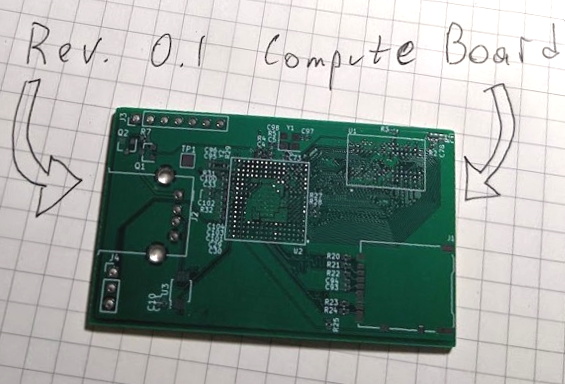
The new miniature compute board.

In this particular case, [Walker] explains that a power management chip you could get on DigiKey for $1.20 USD a few months ago is now in such short supply that the best offer he’s found so far is $49.70 a pop from an electronics broker in Shenzhen. It sounds like he’s going to bite the bullet and buy the four of them (ouch) that he needs to build a working prototype, but obviously it’s a no go for production.

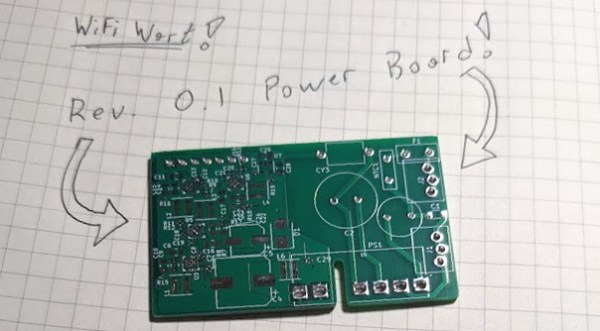
Luckily, it’s not all bad news. [Walker] has made some good progress on the power supply board, which will eventually join the diminutive computer inside the USB charger enclosure. Part of the trick is that the device is still supposed to be a functional USB charger, so in addition to 5 VDC for the output port, the power supply also needs to produce 1.1 V, 1.35 V, 2.5 V, 3.0 V, and 3.3 V for the computer. We’re glad to see he’s taking the high road with his mains circuitry, making sure to use UL listed components and maintaining proper isolation.

When we last checked in on the WiFiWart back in July, [Walker] had already managed to boot Linux on his over-sized prototype board. Now he’s got PCBs in hand that look far closer to the final size and shape necessary to tuck them into a phone charger. It’s a shame that the parts shortage is slowing down progress, but we’re confident we’ll at least get to see a one-off version of the WiFiWart powered up before the year is out.

Teardown: Sling Adapter

The consumer electronics space is always in a state of flux, but perhaps nowhere is this more evident than with entertainment equipment. In the span of just a few decades we went from grainy VHS tapes on 24″ CRTs to 4K Blu-rays on 70″ LED panels, only to end up spending most of our viewing time watching streaming content on our smartphones. There’s no sign of things slowing down, either. In fact they’re arguably speeding up. Sure that 4K TV you bought a couple years back might have HDR, but does it have HDMI 2.1 and Dolby Vision?

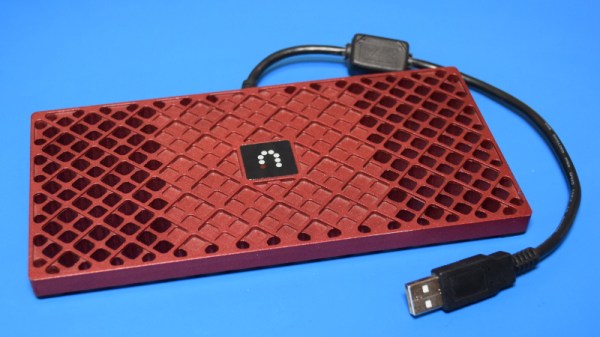
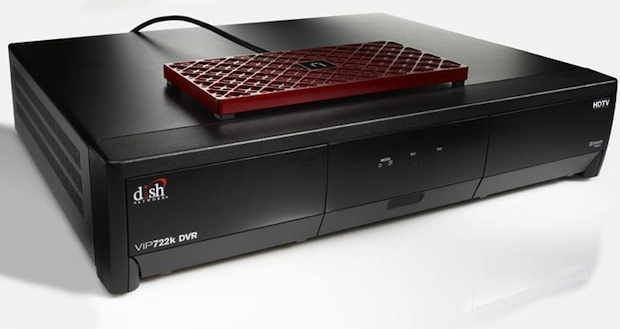
So it’s little surprise that eBay is littered with outdated A/V gadgets that can be had for a pennies on the dollar. Take for example the SB700-100 Sling Adapter we’re looking at today. This device retailed for $99 when it was released in 2010, and enabled Dish Network users to stream content saved on their DVR to a smartphone or tablet. Being able to watch full TV shows and movies on a mobile device over the Internet was a neat trick back then, before Netflix had even started rolling out their Android application. But today it’s about as useful as an HD-DVD drive, which is why you can pick one up for as little as $5.

Of course, that’s only a deal if you can actually do something with the device. Contemporary reviews seemed pretty cagey about how the thing actually worked, explaining simply that plugging it into your Dish DVR imbued the set-top box with hitherto unheard of capabilities. They assured the reader that the performance was excellent, and that it would be $99 well spent should they decide to dive headfirst into this brave new world where your favorite TV shows and movies could finally be enjoyed in the bathroom.

Now, more than a decade after its release, we’ll crack open the SB700-100 Sling Adapter and see if we can’t figure out how this unusual piece of tech actually worked. Its days of slinging the latest episode of The Office may be over, but maybe this old dog can still learn a few new tricks.

Continue reading “Teardown: Sling Adapter”

BFree Brings Intermittent Computing To Python

Generally speaking, we like our computing devices to remain on and active the whole time we’re using them. But there are situations, such as off-grid devices that run on small solar cells, where constant power is by no means a guarantee. That’s where the concept of intermittent computing comes into play, and now thanks to the BFree project, you can develop Python software that persists even when the hardware goes black.

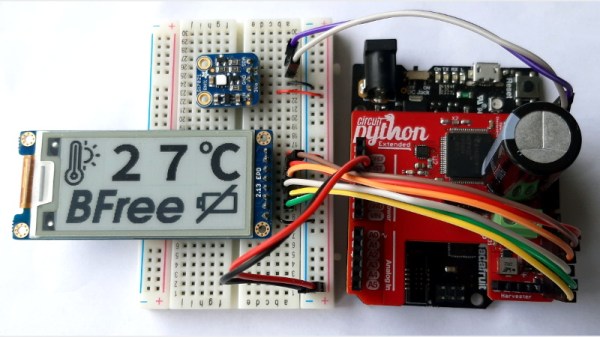
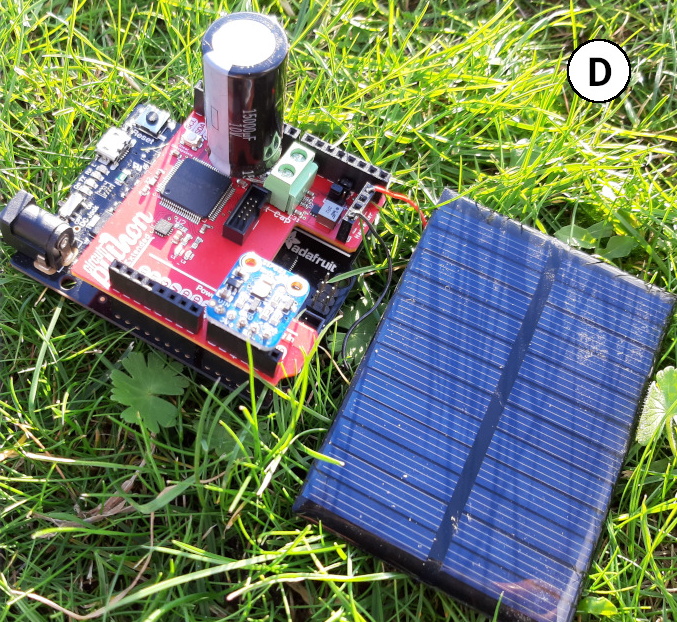
Implemented as a shield that attaches to a Adafruit Metro M0 Express running a modified CircuitPython interpreter, BFree automatically makes “checkpoints” as the user’s code is running so that if the power is unexpectedly cut, it can return the environment to a known-good state instantaneously. The snapshot of the system, including everything from the variables stored in memory to the state of each individual peripheral, is stored on the non-volatile FRAM of the MSP430 microcontroller on the BFree board; meaning even if the power doesn’t come back on for weeks or months, the software will be ready to leap back into action.

In addition to the storage for system checkpoints, the BFree board also includes energy harvesting circuity and connections for a solar panel and large capacitor. Notably, the system has no provision for a traditional battery. You can keep the Metro M0 Express plugged in while developing your code, but once you’re ready to test in the field, the shield is in charge of powering up the system whenever it’s built up enough of a charge.

The product of a collaboration between teams at Northwestern University and Delft University of Technology, BFree is actually an evolution of the battery-free handheld game they developed around this time last year. While that project was used to raise awareness of how intermittent computing works, BFree is clearly a more flexible platform, and is better suited for wider experimentation.

We’ve seen a fair number of devices that store up small amounts of energy over the long term for quick bouts of activity, so we’re very interested to see what the community can come up with when that sort of hardware is combined with software that can be paused until its needed.

Printed Adapter Puts Vintage Lens Back To Work

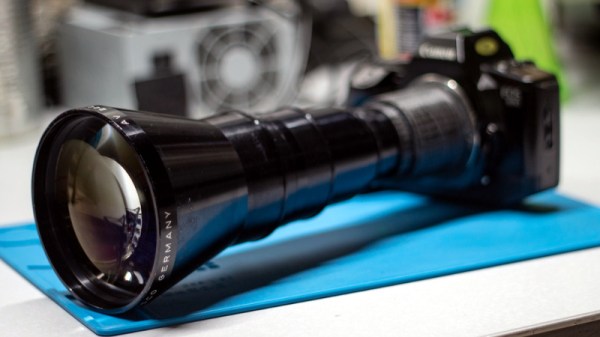
While browsing through an antiques shop, [Nick Morganti] came across a Kodak slide projector with an absolutely massive lens hanging off the front. Nearly a foot long and with a front diameter of approximately four inches, the German-made ISCO optic was a steal for just $10. The only tricky part was figuring out how to use it on a modern DSLR camera.

After liberating the lens from the projector, [Nick] noted the rear seemed to be nearly the same diameter as the threaded M42 mount that was popular with older film cameras. As luck would have it, he already had an adapter that let him use an old Soviet M42 lens on his camera. The thread pitch didn’t match at all, but by holding the lens up to the adapter he was able to experiment a bit with the focus and take some test shots.

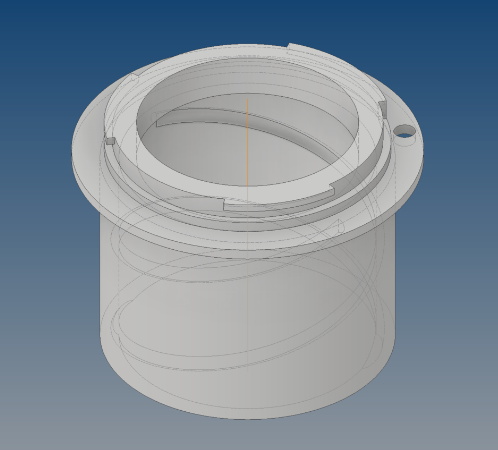
Encouraged by these early tests, [Nick] went about designing a 3D printed adapter. His first attempt was little more than a pair of concentric cylinders, and was focused like an old handheld spyglass. This worked, but it was quite finicky to use with the already ungainly lens. His second attempt added internal threads to the mix, which allowed him to more easily control focus. After he was satisfied with the design, he glued a small ring over the adapter so the lens could no longer be unscrewed all the way and accidentally fall out.

To us, this project is a perfect application of desktop 3D printing.[Nick] was able to conceptualize a one-of-a-kind design, test it, iterate on it, and arrive on a finished product, all without having to leave the comfort of his own home. To say nothing of the complex design of the adapter, which would be exceedingly difficult to produce via traditional means. Perhaps some people’s idea of a good time is trying to whittle a lens bayonet out of wood, but it certainly isn’t ours.

So it’s probably little surprise we’ve seen a number of similar projects over the years. From monstrous anamorphic adapters to upgraded optics for the Game Boy Camera, it seems there’s a healthy overlap between the 3D printing and photography communities.

NASA Is Looking For A Next-Gen Astronaut Van

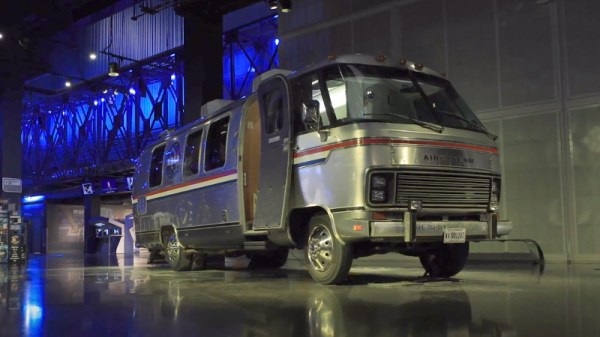
Since the Apollo program, astronauts making the nine mile trip from the Operations and Checkout Building to the launch pad have rode in a specialized van that’s become lovingly referred to as the Astrovan. The original van, technically a modified motorhome, was used from 1967 all the way to the first Shuttle missions in 1983. From then on, a silver Airstream Excella emblazoned with the NASA “meatball” carried crews up until the final Shuttle rolled to a stop in 2011.

With crewed flights for the Artemis lunar program on the horizon, NASA has put out a call to companies that want to build a new Crew Transportation Vehicle (CTV). As you might expect from rocket scientists, the space agency has provided an exacting list of specifications for the new CTV, down to the dimensions of the doors and how many amps each of its 12 VDC power jacks must be able to handle. Perhaps most notably, NASA requires that the new 8-seat Astrovan be a zero-emission vehicle; which given the relatively short distance it has to drive, shouldn’t actually be too difficult.

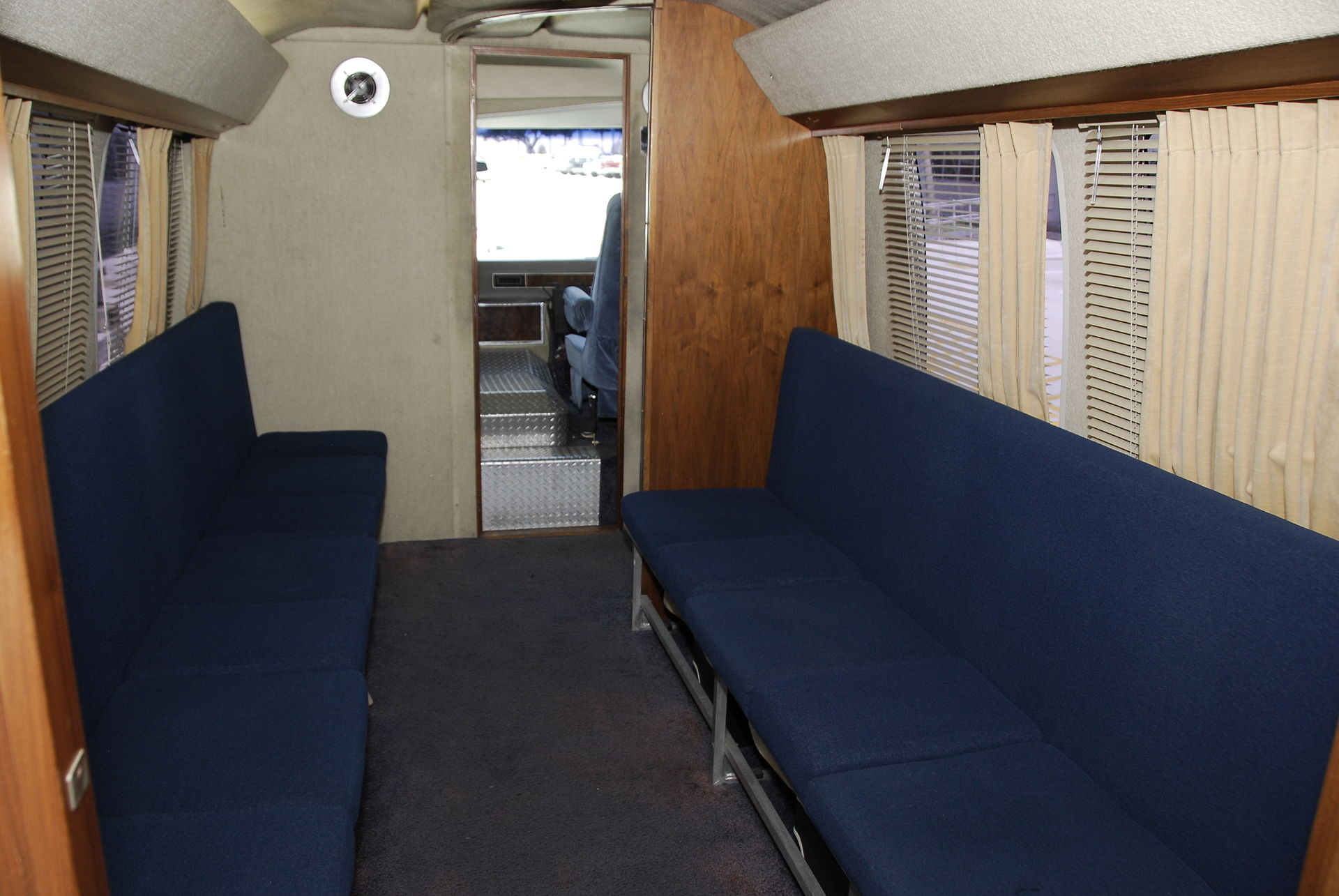
Interior of the Shuttle-era Astrovan

In the document, NASA explains that the new CTV could either be a completely new one-of-a-kind vehicle, or a commercially available vehicle that has been suitably modified, as was the case with the previous vans. But interestingly, it also says they’re open to proposals for refurbishing the Shuttle-era 1983 Airstream and putting it back into service.

This is particularly surprising, as the vehicle is currently part of the Atlantis exhibit at the Kennedy Space Center. Presumably the space agency thinks there would be some bankable nostalgia should Artemis crews ride to the pad in the same van that once carried the Shuttle astronauts, but given the vehicle’s history and the fact that it’s literally a museum piece, it seems somewhat inappropriate. This is after all the very same van that once carried the Challenger and Columbia crews to their ill-fated spacecraft. Luckily, the chances of anyone willing to turn a 1983 Airstream into a zero-emission vehicle seem pretty slim.

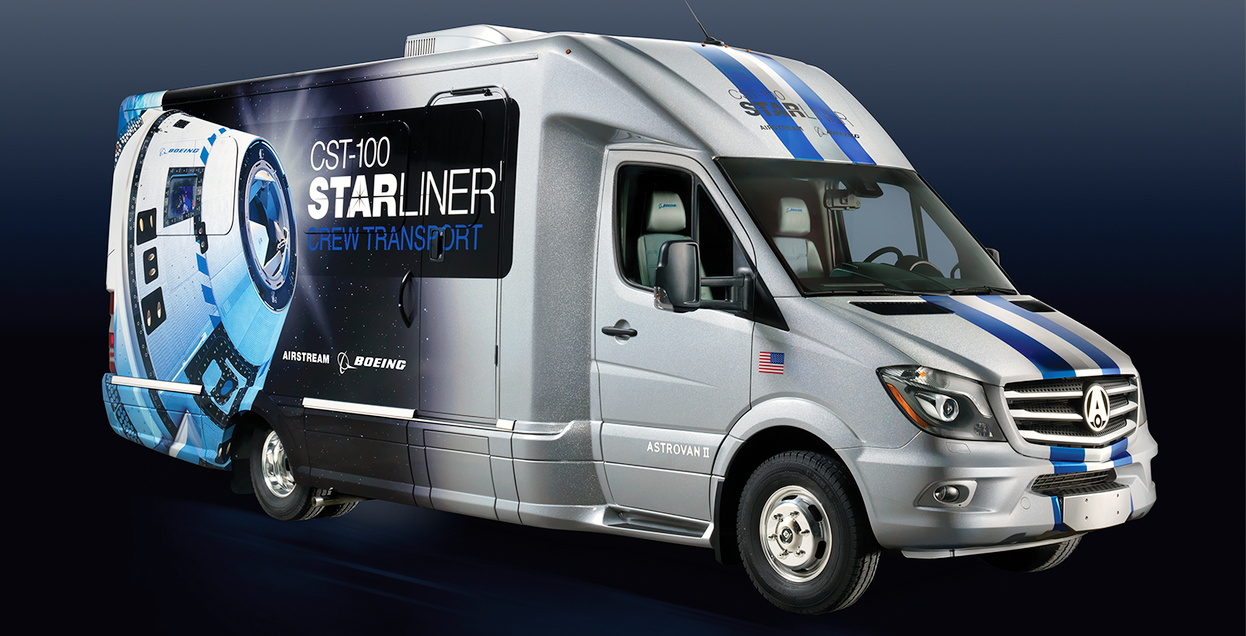
If you’re wondering, SpaceX carries astronauts to the pad in specially modified Tesla Model X luxury SUVs, and Boeing has already partnered with Airstream to build their own Astrovan II. There’s still no date on when Boeing might actually get their CST-100 Starliner up to the International Space Station, but at least the van is ready to go.

A Promising Start For The Doritos Space Program

Rocketry is tricky stuff, but as long as you’re not trying to get into space, the whole idea can basically be boiled down into a simple concept: if you put enough thrust behind it, anything can fly. At least, for awhile. It’s this basic premise that allows what hobbyists sometimes refer to as “Odd-Rocs” fly; these unusual objects might not be ideal rockets, but put a big enough motor in there, and it’ll get off the pad.

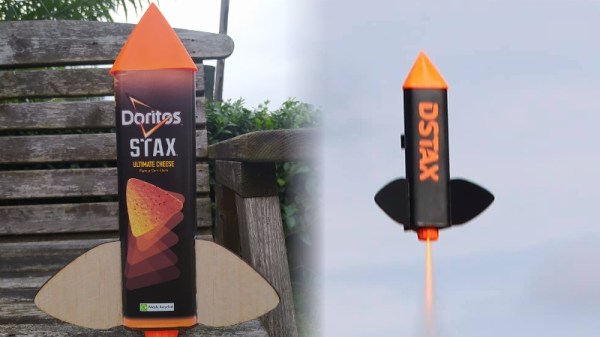
Recently, [concretedog] thought he’d try putting together his own oddball rocket, and set out to modify a Doritos STAX tube for powered flight. There’s plenty of precedent for turning Pringles tubes into rockets, but of course, that’s hardly surprising. After all, what’s a rocket if not a strong and lightweight cylinder? But the rounded triangular shape of the STAX tube promised to be an interesting change of pace. Plus it looked cool, so there’s that.

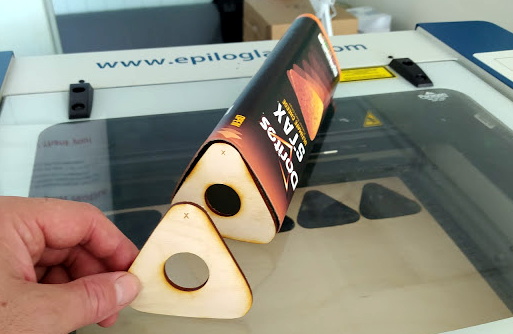
Turning the snack container into a rocket was actually pretty straightforward. To start with, [concretedog] sketched around the outside of the tube on a piece of paper, and then took a picture of that with his phone. That image was then brought into Inkscape, and turned into a vector file that he could fiddle around with in CAD.

Between the thin plywood cut on his laser and PETG loaded into his 3D printer, he was able to come up with a strong enough motor mount to take an Estes D12-5. He then created some fins to glue on the side, and a triangular nosecone. A simple recovery system was installed, and the whole thing was finished off with a Doritos-appropriate orange and black color scheme.

The unusual shape of the rocket meant simulating its flight characteristics on the computer wouldn’t work without custom software, so [concretedog] had to use the old school method of checking stability by swinging it around in a circle on a string. After trimming it out so it would orient itself properly on the tether, he was fairly sure it would fly straight under power. Sure enough, the video below shows the nacho cheese flavored rocket streaking skyward with impressive speed and stability.

It’s far from the most advanced model rocket we’ve seen recently, but we really appreciate the simplicity of this build. It’s a great reminder that fun doesn’t have to be high-tech, and that by following some basic construction principles, you can knock out a safe park flier rocket on a weekend.

Continue reading “A Promising Start For The Doritos Space Program”