Youtube-dl Makes Their Case, Returns To GitHub

Last month, the GitHub repository for the popular program youtube-dl was taken down in response to a DMCA takedown notice filed by the Recording Industry Association of America (RIAA). The crux of the RIAA complaint was that the tool could be used to download local copies of music streamed from various platforms, a claim they said was supported by the fact that several copyrighted music files were listed as unit tests in the repository.

While many believed this to be an egregious misrepresentation of what the powerful Python program was really used for, the RIAA’s argument was not completely without merit. As such, GitHub was forced to comply with the DMCA takedown until the situation could be clarified. Today we’re happy to report that has happened, and the youtube-dl repository has officially been reinstated.

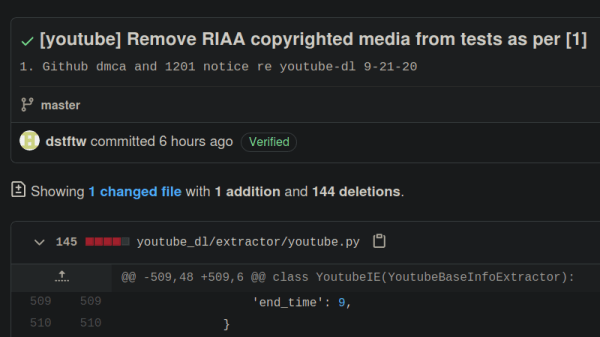
Represented by the Electronic Frontier Foundation, the current maintainers of youtube-dl made their case to GitHub’s DMCA agent in a letter this afternoon which explained how the tool worked and directly addressed the issue of copyrighted videos being used as test cases in the source code. They maintain that their program does not circumvent any DRM, and that the exchange between the client and server is the same as it would be if the user had viewed the resource with a web browser. Further, they believe that downloading a few seconds worth of copyrighted material for the purpose of testing the software’s functionality is covered under fair use. Even still, they’ve decided to remove all references to the songs in question to avoid any hint at impropriety.

Having worked closely with the youtube-dl developers during this period, GitHub released their own statement to coincide with the EFF letter. They explained that the nature of the RIAA’s original complaint forced their hand, but that they never believed taking down the repository was the right decision. Specifically, they point out the myriad of legitimate reasons that users might want to maintain local copies of streamed media. While GitHub says they are glad that this situation was resolved quickly, they’ll be making several changes to their internal review process to help prevent further frivolous takedowns. Specifically the company says they will work with technical and legal experts to review the source code in question before escalating any further, and that if there’s any ambiguity as to the validity of the claim, they’ll side with the developers.

The Internet was quick to defend youtube-dl after the takedown, and we’re happy to see that GitHub made good on their promises to work with the developers to quickly get the repository back online. While the nature of open source code meant that the community was never in any real danger of losing this important tool, it’s in everyone’s best interest that development of the project can continue in the open.

Teardown: Recon Sentinel

It might be hard to imagine now, but there was a time when the average home had only a single Internet connected device in it. This beige box, known as a “desktop computer” in those olden days, was a hub of information and productivity for the whole family. There was a good chance you might even need to wait for your turn to use it, since it’s not like you had a personal device in your pocket that let you log on from the bathroom whatever room you might be in at the time. Which is just as well, since even if you had broadband back then, you certainly weren’t shooting it around the house with the Magic Internet Beams that we take for granted now.

Things are a lot more complicated today. Your computer(s) are only part of the equation. Now there’s mobile phones and tablets sharing your Internet connection, in addition to whatever smart gadgets you’ve brought into the mix. When your doorbell and half the light bulbs in the house have their own IP address, it takes more than a fresh copy of Norton AntiVirus to keep everything secure.

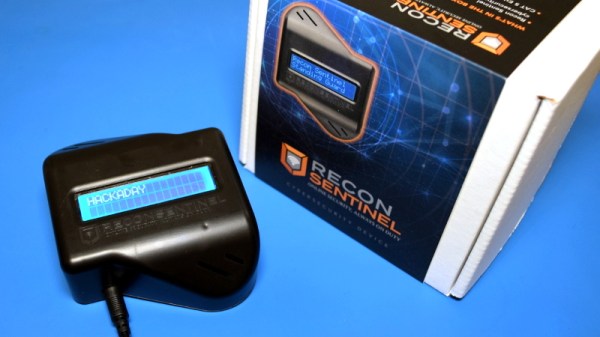
Which is precisely what Cigent Technology says the Recon Sentinel was designed for. Rather than protecting a single computer or device, this little gadget is advertised as being able to secure your entire network by sniffing out suspicious activity and providing instant notifications when new hardware is connected. According to the official whitepaper, it also runs a honeypot service Cigent calls a “cyber deception engine” and is capable of deploying “Active Defense Countermeasures” to confuse malicious devices that attempt to attack it.

It certainly sounds impressive. But for $149.99 plus an annual subscription fee, it better. If you’re hoping this teardown will tell you if it’s worth springing for the $899.99 Lifetime Subscription package, don’t get too excited. This isn’t a review, we’re only interested in cracking this thing open and seeing what makes it tick.

Continue reading “Teardown: Recon Sentinel”

Illuminated 3D Printed Guitar Is Ready To Rock

When we think of 3D printed parts for our projects, most of us imagine little bits like brackets and mounting plates. Perhaps the occasional printed project enclosure. But if you’ve got a big custom printer as [Joshendy] does, plus plenty of time, it opens up a whole new world of large scale projects. Take for example the gorgeous RGB LED guitar body he recently completed.

Despite the considerable 300 x 300 mm build area of his custom 3D printer, [Joshendy] still had to design the guitar body in sections that could be bolted together after being printed in ABS. It took around 60 hours to run off all the parts, with the large central section taking the longest to print at 28 hours. With the generous application of heat-set inserts, the assembled guitar should be plenty strong.

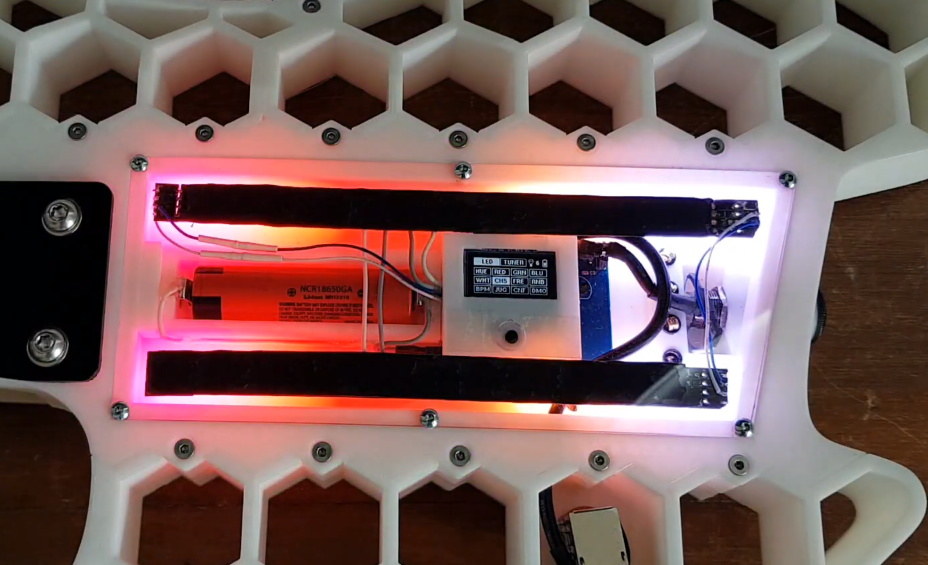
The white ABS of the guitar body helps diffuse the LEDs.

While the skeletal plastic body of the guitar is certainly visually interesting in itself, it only makes up for half of the final look. Inside the central cavity, [Joshendy] has embedded two strips of RGB LEDs, a 128×64 OLED screen, and a custom PCB that plays host to a STM32L4 microcontroller the appropriate voltage regulators necessary to run it all on a battery pack.

The board taps into the audio being produced by the guitar and uses a fast Fourier transform (FFT) to get the LEDs reacting to the beat. As demonstrated in the video after the break, you can use the screen to navigate through the different lighting modes in real-time right on the instrument itself.

We covered the equally impressive large-format 3D printer that [Joshendy] used to produce this guitar earlier in the month, and it’s quite exciting to see the sort of things he’s printing on it already. This project has already set the bar very high, and we can’t wait to see what he comes up with next.

Continue reading “Illuminated 3D Printed Guitar Is Ready To Rock”

Dremel 3D20 Printer Gets Modern Overhaul

Dremel’s attempt at breaking into the 3D printer market back in 2014 was respectable, if not particularly exciting. Rather than design their own printer, their 3D20 “Idea Builder” was a lightly customized Flashforge Dreamer (itself a Makerbot Replicator clone) with a new warranty and support contract tacked on. It wasn’t necessarily the 3D printer of choice for the hacker and maker crowd, but it was a fairly solid option for folks who wanted a turn-key experience.

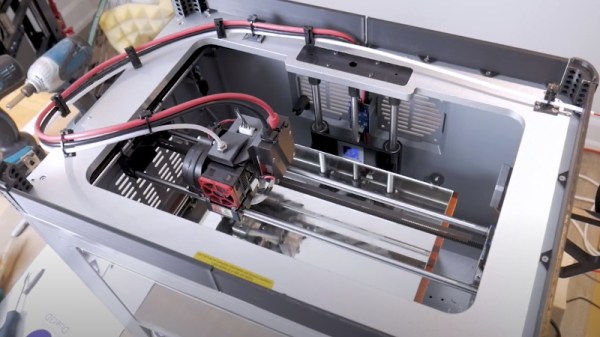
[Chris Chimienti] says he got about 1,000 hours of printing out of his 3D20 before it gave up the ghost. Given the age of the machine and its inherent limitations, he decided to use the Dremel’s carcass as the base for a very impressive custom 3D printer with all the modern bells and whistles. He kept the enclosure, rods, bearings, and the stepper motors, but pretty much everything else was tossed out. Some of the replacements are off-the-shelf parts, but it’s the custom designed elements on this build that really help set it apart.

A print bed strong enough to park your car on.

Under the machine, [Chris] has installed a new power supply and a Duet 2 WiFi controller which itself is connected to the new LCD control panel on the front. There’s an external case fan to keep the electronics cool, but otherwise things look a lot neater under the hood than they did originally.

Moving upwards, he’s designed a gorgeous adjustable print bed and a new extruder assembly that cleverly uses RJ45 jacks and Ethernet cables to connect back to the control board. All told, the custom components have taken this once relatively mid-range 3D printer and turned it into something that looks like it wouldn’t be out of place on the International Space Station.

While custom 3D printer builds like this still trickle in from time to time, we’re seeing far fewer now than we did back when machines like the 3D20 hit the market. Most people are more than satisfied with commercial entry-level desktop printers, and aren’t looking for yet another project to tinker with. There’s nothing wrong with that, though we certainly wouldn’t complain if the recent interest into more advanced high-temperature filaments triggered something of a bespoke 3D printer renaissance.

Continue reading “Dremel 3D20 Printer Gets Modern Overhaul”

Tensions High After Second Failed Cable At Arecibo

Today we’re sad to report that one of the primary support cables at the Arecibo Observatory has snapped, nudging the troubled radio telescope closer to a potential disaster. The Observatory’s 300 meter reflector dish was already badly in need of repairs after spending 60 years exposed to the elements in Puerto Rico, but dwindling funds have made it difficult for engineers to keep up. Damage from 2017’s Hurricane Maria was still being repaired when a secondary support cable broke free and smashed through the dish back in August, leading to grave concerns over how much more abuse the structure can take before a catastrophic failure is inevitable.

The situation is particularly dire because both of the failed cables were attached to the same tower. Each of the remaining cables is now supporting more weight than ever before, increasing the likelihood of another failure. Unless engineers can support the dish and ease the stress on these cables, the entire structure could be brought down by a domino effect; with each cable snapping in succession as the demands on them become too great.

Workers installing the reflector’s mesh panels in 1963.

As a precaution the site has been closed to all non-essential personnel, and to limit the risk to workers, drones are being used to evaluate the dish and cabling as engineers formulate plans to stabilize the structure until replacement cables arrive. Fortunately, they have something of a head start.

Back in September the University of Central Florida, which manages the Arecibo Observatory, contacted several firms to strategize ways they could address the previously failed cable and the damage it caused. Those plans have now been pushed up in response to this latest setback.

Unfortunately, there’s still a question of funding. There were fears that the Observatory would have to be shuttered after Hurricane Maria hit simply because there wasn’t enough money in the budget to perform the relatively minor repairs necessary. The University of Central Florida stepped in and provided the funding necessary to keep the Observatory online in 2018, but they may need to lean on their partner the National Science Foundation to help cover the repair bill they’ve run up since then.

The Arecibo Observatory is a unique installation, and its destruction would be an incredible blow for the scientific community. Researchers were already struggling with the prospect of repairs putting the powerful radio telescope out of commission for a year or more, but now it seems there’s a very real possibility the Observatory may be lost. Here’s hoping that teams on the ground can safely stabilize the iconic instrument so it can continue exploring deep space for years to come.

Scratch Built 3D Printer Goes Big

There was a time, not so very long ago, that buying a reliable 3D printer was a fairly expensive proposition. Many chose to build their own printer instead, and for a few years, we were flooded with very impressive custom designs. But as you might expect, with the prices on decent 3D printers now having hit rock bottom, the custom builds have largely dried up.

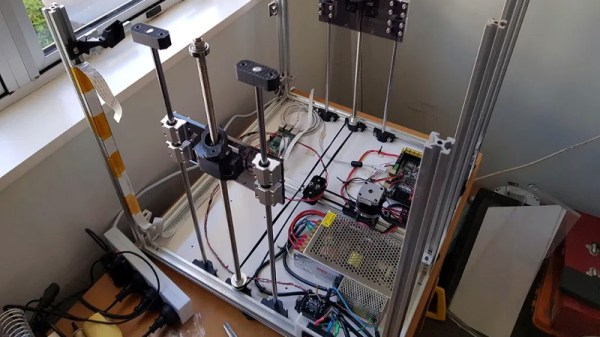
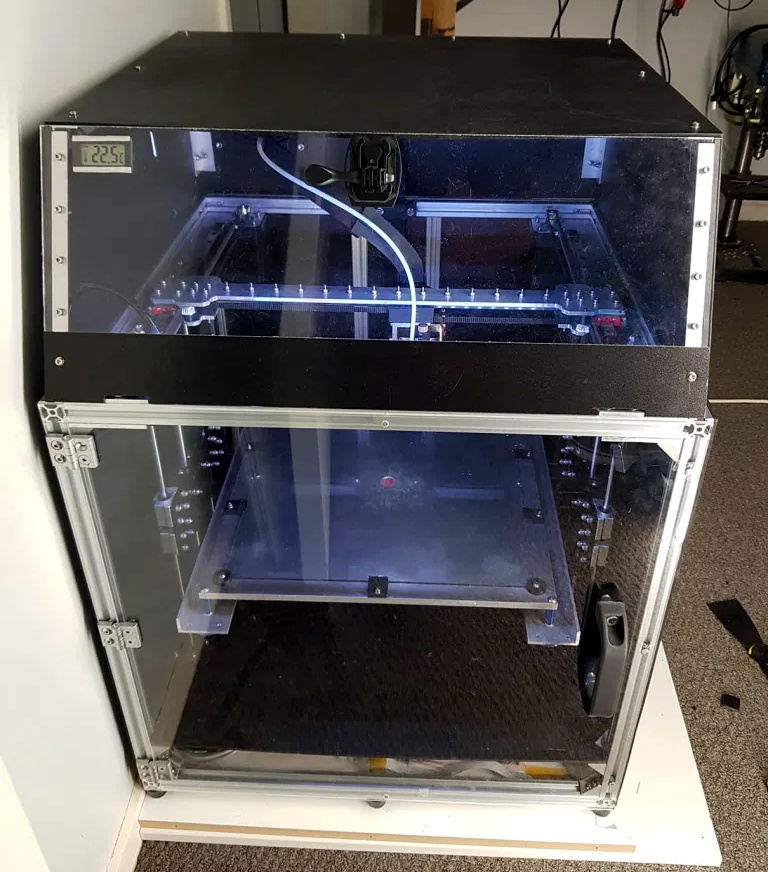
Arguably, the only reason you’d build rather than buy in 2020 is if you want something very specific. Which is precisely how [Joshendy] ended up building the Big F… Printer or BFP. No doubt the F stands for Fun, or Friendly. Either way, it’s certainly something special. With a 300 mm³ build volume and heavy-duty Z axis, this fully enclosed CoreXY machine is ready to handle whatever he throws at it.

It did take [Joshendy] a few attempts to get everything the way he wanted though. In fact, the prototype for the machine wasn’t even CoreXY, it started as an H-Bot. In his write-up he goes over the elements of the BFP did that didn’t quite live up to his expectations, and what he replaced them with. So when wobbly leadscrews and a knock-off V6 hotend both left something to be desired, they ended up getting replaced with ball screws and an authentic E3D Hemera, respectively.

To control this monster, [Joshendy] is using OctoPrint on a Raspberry Pi and a BigTreeTech SKR Pro running Klipper. OctoPrint gives him the ability to control and monitor the printer remotely, complete with a camera mounted inside the enclosure to keep an eye on things, while the Klipper firmware on the SKR board pushes all the computationally expensive aspects of 3D printing onto the vastly more powerful ARM chip in the Pi. The end result is faster and more accurate control of the steppers through the TMC2130 drivers than would be possible otherwise.

If you don’t mind tinkering, a cheap entry-level desktop 3D printer is good enough for most of hackers and makers. If you need something more capable or more reliable, there’s always higher-end options from the likes of Prusa and Ultimaker. Very few people need to build something as serious as the BFP, but when the do, we’re glad they send them our way.

Continue reading “Scratch Built 3D Printer Goes Big”

E-Paper Weather Display Is A Great Base To Build From

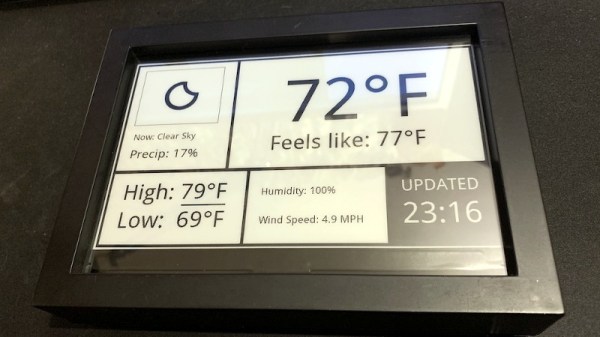
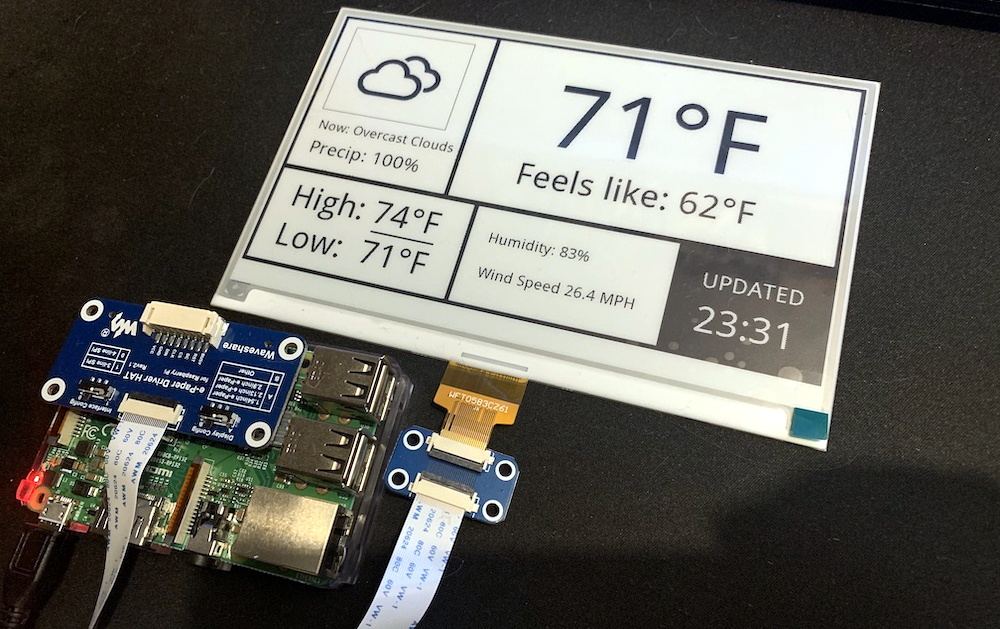
As e-paper modules have become more affordable, we’ve started to see them pop up more and more in hacker projects. It used to be that you had to force a second-hand Kindle to do your bidding, but now you can buy just the screen itself complete with a header to plug right into your Raspberry Pi. It will still cost you as much as a used Kindle…but at least it comes with some documentation and there are Python libraries to talk to it.

But where to start? If you need some inspiration, and perhaps a little source code, this very slick weather display put together by [James Howard] is a great as baseline. Not that it really needs any additional refinement, as we think it already looks gorgeous. But rather than starting from scratch for your own project, it would be much easier to graft some additional functionality onto his code.

A lot of that has to do with how concise and well commented his code is. We’ve seen enough of these projects to know the kind of spaghetti that’s often running on the backend, but there’s none of that here. [James] assembles the display using the powerful Pillow graphics library, which lets you draw primitives and drop in text and icons with just a couple lines of code.

Once all the data is plugged in, the entire screen is saved as an image file which is then opened up on the e-paper display. Even if you aren’t a Python expert, you should be able to understand what’s happening and how to bend it to your will.

We’ve always had high hopes for electronic paper, and it seems the technology might finally be hitting critical mass. While it’s still a bit expensive, we’ve started seeing it pop up in unexpected places to great effect. Hopefully projects like this one will inspire others to take the B&W plunge.