Cheap 3D Printers Make Cheaper(er) Bioprinters

In case you missed it, prices on 3D printers have hit an all time low. The hardware is largely standardized and the software is almost exclusively open source, so it makes sense that eventually somebody was going to start knocking these things out cheap. There are now many 3D printers available for less than $300 USD, and a few are even dipping under the $200 mark. Realistically, this is about as cheap as these machines are ever going to get.

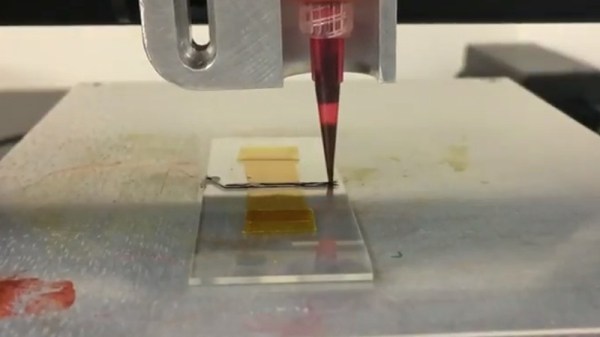
A startup by the name of 3D Cultures has recently started capitalizing on the availability of these inexpensive high-precision three dimensional motion platforms by co-opting an existing consumer 3D printer to deliver their Tissue Scribe bioprinter. Some may call this cheating, but we see it for what it really is: a huge savings in cost and R&D time. Why design your own kinematics when somebody else has already done it for you?
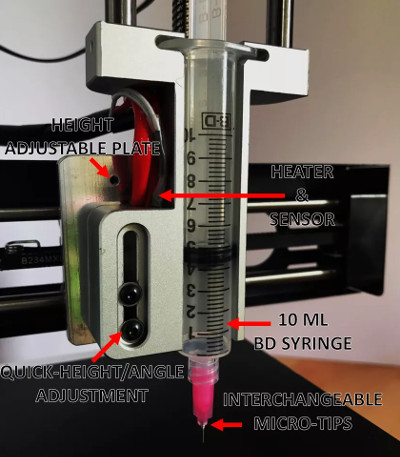
Despite the C-3PO level of disguise that 3D Cultures attempted by putting stickers over the original logo, the donor machine for the Tissue Scribe is very obviously a Monoprice Select Mini, the undisputed king of beginner printers. The big change of course comes from the removal of the extruder and hotend, which has been replaced with an apparatus that can heat and depress a standard syringe.

At the very basic level, bioprinting is performed in the exact same way as normal 3D printing; it’s merely a difference in materials. While 3D printing uses molten plastic, bioprinting is done with organic materials like algae or collagen. In the Tissue Scribe, the traditional 3D printer hotend has been replaced with a syringe full of the organic material to be printed which is slowly pushed down by a NEMA 17 stepper motor and 8mm leadscrew.

The hotend heating element and thermistor that once were used to melt plastic are still here, but now handle warming the metal frame used to hold the syringe. In theory these changes would have only required some tweaks to the firmware calibration to get working. Frankly, it makes perfect sense, and is certainly a much easier to pull off than some of the earlier attempts at homebrew biological printers we’ve seen.

We won’t comment on the Tissue Scribe’s price point of $999 USD except to say that in the field of bioprinters, that’s pocket change. Still, it seems inevitable that somebody will build and document their own bolt-on biological extruder now that 3D Cultures has shown how simple it really is, so they may find themselves undercut in the near future.

If all this talk of hot extruded collagen has got you interested, we’ve seen some excellent resources on the emerging field of bioprinting that will probably be right up your alley.

Continue reading “Cheap 3D Printers Make Cheaper(er) Bioprinters”
Encrypt Data On The Fly On A Pi With Cryptopuck

There was a time that encryption was almost a dirty word; a concept that really only applied to people with something to hide. If you said you wanted to encrypt your hard drive, it may as well have been an admission to a crime. But now more than ever it’s clear that encryption, whether it’s on our personal devices or on the web, is a basic necessity in a digital society. The age of Big Data is upon us, and unless you’re particularly fond of being a row in a database, you need to do everything you can to limit the amount of plaintext data you have.

Of course, it’s sometimes easier said than done. Not everyone has the time or desire to learn how the different cryptographic packages work, others may be working on systems that simply don’t have the capability. What do you do when you want to encrypt some files, but the traditional methods are out of reach?

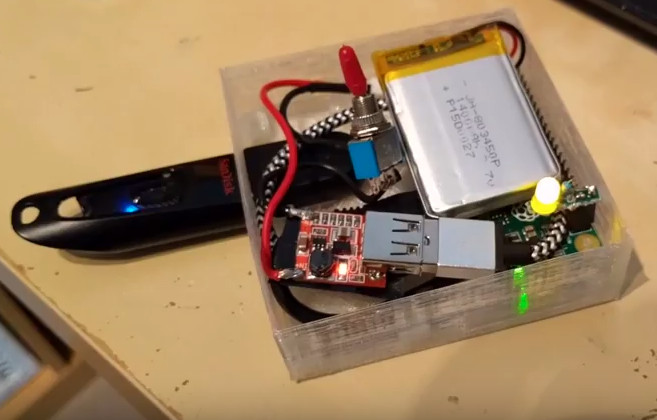
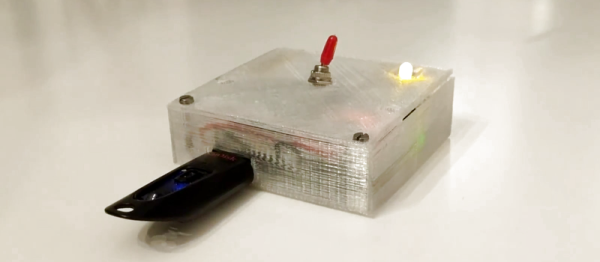
Enter the latest project from [Dimitris Platis]: Cryptopuck. By combining the ever-versatile Raspberry Pi Zero, some clever Python programs, and a few odds and ends in a 3D printed case, he has created a completely self-contained encryption device that anyone can use. Stick a USB flash drive in, wait for the LED to stop blinking, and all your files are now securely encrypted and only accessible by those who have the private key. [Dimitris] envisions a device like this could be invaluable for reporters and photographers on the front lines, protesters, or really anyone who needs a discreet way of quickly securing data but may not have access to a computer.

The hardware side is really just the Pi, a switch, a single LED for notifications, and a battery. The real magic comes from the software, where [Dimitris] has leveraged PyCrypto to perform the AES-256 encryption, and a combination of pyinotify and udiskie to detect new mounted volumes and act on them. The various Python scripts that make up the Cryptopuck suite are all available on the project’s GitHub page, but [Dimitris] makes it very clear the software is to be considered a proof of concept, and has not undergone any sort of security audit.

For some background information on how the software used by the Cryptopuck works you may want to check out this excellent primer from a few years back; though if you’d like to read up on why encryption is so important, you don’t need to go nearly as far back in time.

Continue reading “Encrypt Data On The Fly On A Pi With Cryptopuck”

Making Ice Cream With Heavy Metal

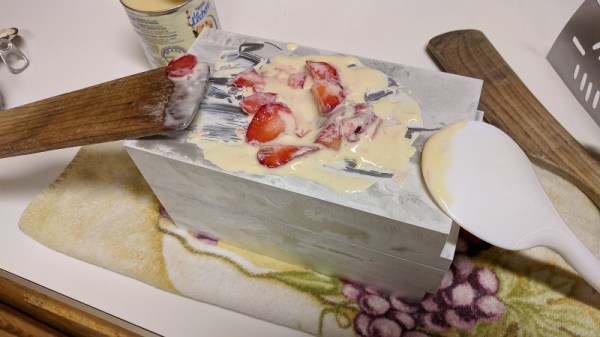
After his last project left him with an eleven-pound block of aluminum, [Jason] got to thinking of what most of us would in that situation: fresh made ice cream. His mind was on the frozen concoctions of the aptly named Cold Stone Creamery, a mall food court staple where a chilled stone is used to turn fresh ingredients into made to order sundaes.

[Jason] did the math and found that an eleven-pound chunk of aluminum can absorb a little over 67,000 joules, which is over twice the energy required to freeze 100 g of water. In place of water he would be using cream, condensed milk, and strawberries, but believed there was a large enough safety factor to account for the differences between his ingredients and pure water.

His first attempt didn’t go exactly as planned, but with his Flir One he was able to back up his theoretical numbers with some real-world data. He found that he needed to start the aluminum block at a lower temperature before adding his ingredients, and through experimentation determined the block only had enough energy to freeze 30 g of liquid.

In the end [Jason] was satisfied with the frozen treat he managed to make from the leftovers of his radial mill project, but theorizes that an ever better solution would be to use a brine solution and drop the aluminum block all together.

Of course, if putting food on a slab of metal from your workshop doesn’t sound too appealing, you could always go the NASA route and freeze dry it. Either method will probably make less of a mess than trying to print objects with it.

Neural Network Gimbal Is Always Watching

[Gabriel] picked up a GoPro to document his adventures on the slopes and trails of Montreal, but quickly found he was better in front of the camera than behind it. Turns out he’s even better seated behind his workbench, as the completely custom auto-tracking gimbal he came up with is nothing short of a work of art.

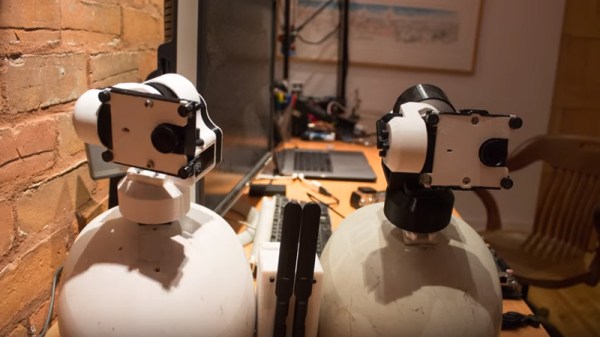
There’s quite a bit going on here, and as you might expect, it took several iterations before [Gabriel] got all the parts working together. The rather GLaDOS-looking body of the gimbal is entirely 3D printed, and holds the motors, camera, and a collection of ultrasonic receivers. The Nvidia Jetson TX1 that does the computational heavy lifting is riding shotgun in its own swanky looking 3D printed enclosure, but [Gabriel] notes a future revision of the hardware should be able to reunite them.

In the current version of the system, the target wears an ultrasonic emitter that is picked up by the sensors in the gimbal. The rough position information provided by the ultrasonics is then refined by the neural network running on the Jetson TX1 so that the camera is always focused on the moving object. Right now the Jetson TX1 gets the video feed from the camera over WiFi, and commands the gimbal hardware over Bluetooth. Once the Jetson is inside the gimbal however, some of the hardware can likely be directly connected, and [Gabriel] says the ultrasonics may be deleted from the design completely in favor of tracking purely in software. He plans on open sourcing the project, but says he’s got some internal house keeping to do before he takes the wraps off it.

From bare bones to cushy luxury, scratch-built camera gimbals have become something of a right of passage for the photography hacker. But with this project, it looks like the bar got set just a bit higher.

Continue reading “Neural Network Gimbal Is Always Watching”