Clay Makes For DIY Power Source, Just Add Water

[Robert Murray-Smith] starts out showing us some clay formations that house bees. He couldn’t take any of that clay home, but that’s no problem — clay is plentiful, and apparently, you can make a battery with it. Well, perhaps not really a battery. Adding water to zeolite — a clay often used as a filter material — generates heat, and where there’s heat, there can be electricity.

[Robert] uses a salvaged Peltier device, as you find in small electric refrigerators. These solid-state heat pumps usually convert electricity into a temperature differential, but in this case, it is used as a thermocouple, generating electricity from a temperature difference.

The clay used is a very fine aluminosilicate crystal known as zeolite 13X. Once it comes into contact with plain ordinary water, it immediately starts to boil. It’s a neat experiment, and with the Peltier underneath the metal container holding the clay, enough power is produced to spin a small motor. Of course this won’t power anything large, but on the other hand, plenty of things these days don’t take much power. This technique would work with any exothermic reaction of course, but there’s something compelling about the shelf-stability of water and clay.

Beats a potato, we suppose. Batteries don’t have to be difficult to make. It is only hard to make really good ones.

Continue reading “Clay Makes For DIY Power Source, Just Add Water”

Google Home Scripting

It is always controversial to have home assistants like the ones from Google or Amazon. There are privacy concerns, of course. Plus they maddeningly don’t always do what you intend for them to do. However, if you do have one, you’ve probably thought about something you wanted to do that would require programming. Sure, you can usually do a simple list, but really writing code wasn’t on the menu. But now, Google Home will allow you to write code. Well, at least script using a YAML file.

The script language is available in the web app and if you opt in on the mobile app as well. There’s a variety of ways you can trigger scripts and many examples you can start with.

Continue reading “Google Home Scripting”

Linux Fu: Easy And Easier Virtual Networking

One of the best things about Linux is that there are always multiple ways to do anything you want to do. However, some ways are easier than others. Take, for example, virtual networking. There are plenty of ways to make a bunch of Internet-connected computers appear to be on a single private network. That’s nothing new, of course. Linux and Unix have robust networking stacks. Since 2018, though, Wireguard has been the go-to solution; it has a modern architecture, secure cryptography, and good performance.

There’s only one problem: it is relatively difficult to set up. Not impossible, of course. But it is a bit difficult, depending on what you want to accomplish.

How Difficult?

You must set up a wireguard server and one or more clients. You’ll need to pick a range of IP addresses. You might need to turn on routing. You have to generate keys. You might need to configure DNS and other routing options. You’ll certainly need to modify firewall rules. You’ll also need to distribute keys.

None of these steps are terribly difficult, but it is a lot to keep straight. The wg program and wg-quick script do most of the work, but you have a lot of decisions and configuration management to keep straight.

Browse the official “quick start,” and you’ll see that it isn’t all that quick. The wg-quick script is better but only handles some use cases. If you want really limited use cases, there are third-party tools to do a lot of the rote work, but if you need to change anything, you’ll still need to figure it all out.

That being said, once you have it set up, it pretty much works without issue and works well. But that initial setup can be very frustrating. Continue reading “Linux Fu: Easy And Easier Virtual Networking”

The Crystal (High Voltage) Method

Do high voltages affect the resonant frequency of a crystal? Honestly, we never thought about it, but [Joe] did and decided to risk his analyzer to find out. He started with some decidedly old-school crystals like you might have found in a 1960-era Novice rig. Since the crystal is piezoelectric, he wondered if using a high DC voltage to bend the crystal to move the frequency to create a variable crystal oscillator (sometimes called a VXO).

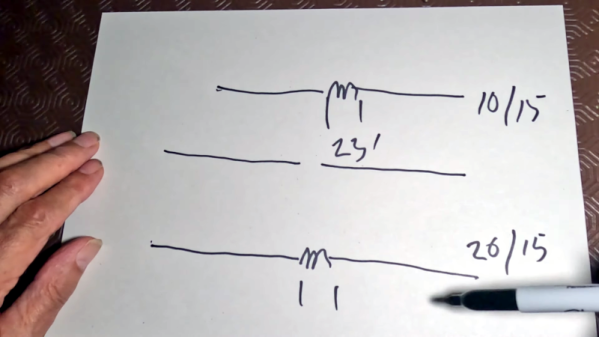
He created a rig to block DC away from the network analyzer and then feed voltage directly across the crystal. The voltage was from an ESD tester that provides over 1000 volts.

Getting a crystal to change much in frequency is difficult, which is why they are useful. So we weren’t surprised that even at very high voltages, the effect wasn’t very large. It did change the frequency, but it just wasn’t very much.

At one point, it looked like he might have killed the test equipment. There was a time when letting the smoke out of a network analyzer would have been a costly mistake, but these days the cost isn’t that prohibitive. In the end, this experiment probably doesn’t produce any practical results. Still, it is interesting, and we always enjoy watching anything that gives us more intuition about the behavior of circuits or, in this case, circuit elements.

If you need a refresher on crystal oscillators, we can help. There are other ways to modify a crystal’s frequency, of course.

Continue reading “The Crystal (High Voltage) Method”

Spy Tech: Unshredding Documents

Bureaucracies generate paper, usually lots of paper. Anything you consider private — especially anything that could get you in trouble — should go in a “burn box” which is usually a locked trash can that is periodically emptied into an incinerator. However, what about a paper shredder? Who hasn’t seen a movie or TV show where the office furiously shreds papers as the FBI, SEC, or some other three-letter-agency is trying to crash the door down?

That might have been the scene in the late 1980s when Germany reunified. The East German Ministry of State Security — known as the Stasi — had records of unlawful activity and, probably, information about people of interest. The staff made a best effort to destroy these records, but they did not quite complete their task.

The collapsing East German government ordered documents destroyed, and many were pulped or burned. However, many of the documents were shredded by hand, stuffed into bags, and were awaiting final destruction. There were also some documents destroyed by the interim government in 1990. Today there are about 16,000 of these bags remaining, each with 2,500 to 3,000 pieces of pages in them.

Machine-shredded documents were too small to recover, but the hand-shredded documents should be possible to reconstruct. After all, they do it all the time in spy movies, right? With modern computers and vision systems, it should be a snap.

You’d think so, anyway.

Continue reading “Spy Tech: Unshredding Documents”

Modern Brownie Camera Talks SD And WiFi

If you’re at all into nostalgic cameras, you’ve certainly seen the old Brownie from Kodak. They were everywhere, and feature an iconic look. [JGJMatt] couldn’t help but notice that you could easily find old ones at a good price, but finding and developing No. 117 film these days can be challenging. But thanks to a little 3D printing, you can install an ESP32 camera inside and wind up with a modern but retro-stylish camera. The new old camera will work with a memory card or send data over WiFi.

The Brownie dates back to 1900 and cost, initially, one dollar. Of course, a dollar back then is worth about $35 now, but still not astronomical. After cleaning up and tuning up an old specimen, it was time to fire up the 3D printer.

There are also mods to the camera to let it accept an M12 lens. There are many lenses of that size you can choose from. There are a few other gotchas, like extending the camera cable, but it looks like you could readily reproduce this project if you wanted one of your very own.

We’ve seen old cameras converted before. Or, you can just start from scratch.

What Do You Want In A Programming Assistant?

The Propellerheads released a song in 1998 entitled “History Repeating.” If you don’t know it, the lyrics include: “They say the next big thing is here. That the revolution’s near. But to me, it seems quite clear. That it’s all just a little bit of history repeating.” The next big thing today seems to be the AI chatbots. We’ve heard every opinion from the “revolutionize everything” to “destroy everything” camp. But, really, isn’t it a bit of history repeating itself? We get new tech. Some oversell it. Some fear it. Then, in the end, it becomes part of the ordinary landscape and seems unremarkable in the light of the new next big thing. Dynamite, the steam engine, cars, TV, and the Internet were all predicted to “ruin everything” at some point in the past.

History really does repeat itself. After all, when X-rays were discovered, they were claimed to cure pneumonia and other infections, along with other miracle cures. Those didn’t pan out, but we still use them for things they are good at. Calculators were going to ruin math classes. There are plenty of other examples.

This came to mind because a recent post from ACM has the contrary view that chatbots aren’t able to help real programmers. We’ve also seen that — maybe — it can, in limited ways. We suspect it is like getting a new larger monitor. At first, it seems huge. But in a week, it is just the normal monitor, and your old one — which had been perfectly adequate — seems tiny.

But we think there’s a larger point here. Maybe the chatbots will help programmers. Maybe they won’t. But clearly, programmers want some kind of help. We just aren’t sure what kind of help it is. Do we really want CoPilot to write our code for us? Do we want to ask Bard or ChatGPT/Bing what is the best way to balance a B-tree? Asking AI to do static code analysis seems to work pretty well.

So maybe your path to fame and maybe even riches is to figure out — AI-based or not — what people actually want in an automated programming assistant and build that. The home computer idea languished until someone figured out what people wanted to do with them. Video cassette didn’t make it into the home until companies figured out what people wanted most to watch on them.

How much and what kind of help do you want when you program? Or design a circuit or PCB? Or even a 3D model? Maybe AI isn’t going to take your job; it will just make it easier. We doubt, though, that it can much improve on Dame Shirley Bassey’s history lesson.