It’s A Sander! No, It’s A Toothbrush! Relax, Relax, It’s Both

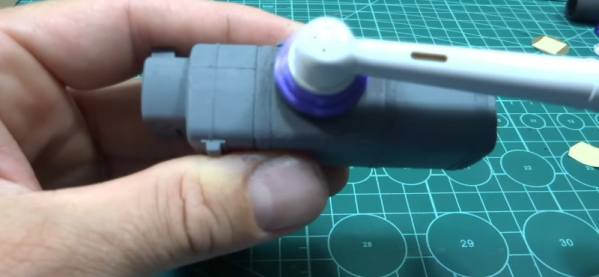
We always enjoy a project that transforms some common object into something useful for us. [Modelkitsdeluxe] fits the bill by modifying a power toothbrush into a miniature sander. If you want to practice your Spanish, you can watch the video below. Or you can try the automatically translated captions.

As you can guess from the user name, he is mainly interested in working with small models, but it struck us that this might also be useful for general 3D printing. Honestly, once you have the idea, there isn’t much to it. You mutilate a brush head that fits the toothbrush to accept a small sanding disk.

There are probably a dozen ways to attach your sandpaper or emery cloth to the head. [Modelkitdeluxe] used double-sided tape and Velcro. While we applaud the upcycling, we’ll probably stick with a hobby tool. Our toothbrush makes an annoying buzz every 30 seconds or so to remind you to move to another part of your mouth. That doesn’t seem like a great feature when doing precision sanding. On the other hand, you could probably yank the controller out of the toothbrush and use it for the motor, drive, and batteries to avoid that.

If you want to tackle that, here’s something to get you started. If sanding doesn’t turn your crank, maybe you can try turning your deadbolt.

Continue reading “It’s A Sander! No, It’s A Toothbrush! Relax, Relax, It’s Both”
PCB Toaster Oven Solders Your Boards

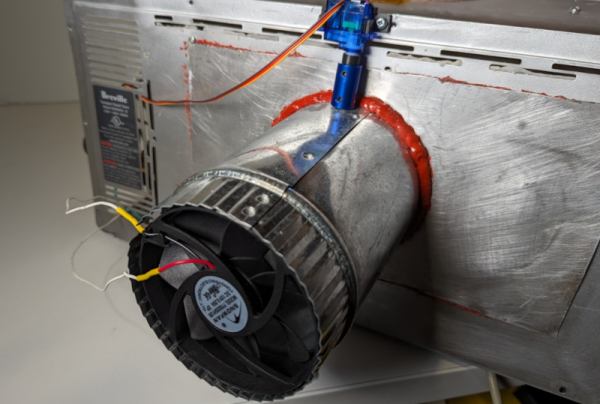
Using a toaster oven to reflow PCBs isn’t anything new, but just using a toaster oven has some limitations. Making toast isn’t as complex as reflowing PCBs. [Nabil] decided to modify an oven to get better results. In fact, this was the second iteration and involved making a custom PCB to replace the one in the oven. You can see the unit in the video below.

Of course, unless you have the exact oven (a Breville BOV450XL), you won’t want to duplicate the board, but it might give you some good ideas. The new board has a 2.8-inch capacitive LCD, an ESP32, and a few sensors and actuators.

Continue reading “PCB Toaster Oven Solders Your Boards”

Take A PEEK At This 3D Printer

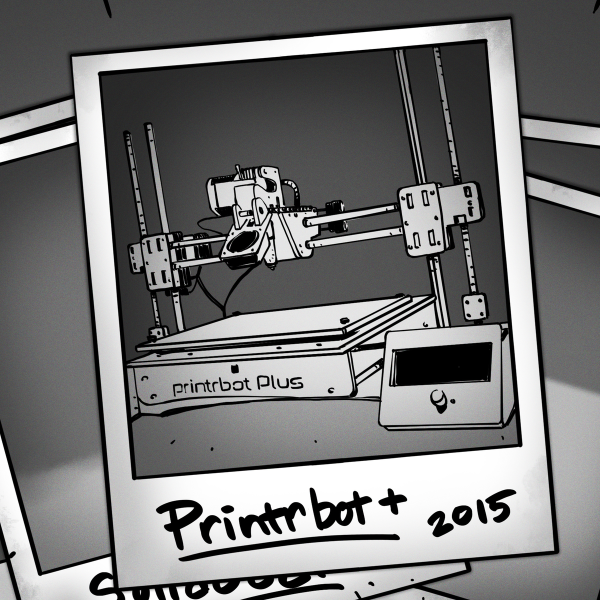
Normally, when you think of PEEK in 3D printing, you think of a part made of PEEK, suitable for lower-temperature plastics. [ND-3D] has a different idea: printing with PEEK. You can get the details over on Hackaday.io, and there are a few YouTube videos below. Using a special controller and a halogen lamp, you can modify your own printer to use this exotic material often found in printer hot ends.

Logically, if PEEK is used near the hot end of regular printers, it must need a higher temperature to print. PEEK has a glass transition temperature of about 143 °C and melts at 343 °C. Compare this to PLA, which melts between 150 °C and 180 °C and has a glass transition temperature of only 60 °C.

Continue reading “Take A PEEK At This 3D Printer”

Linux On A Commodore 64

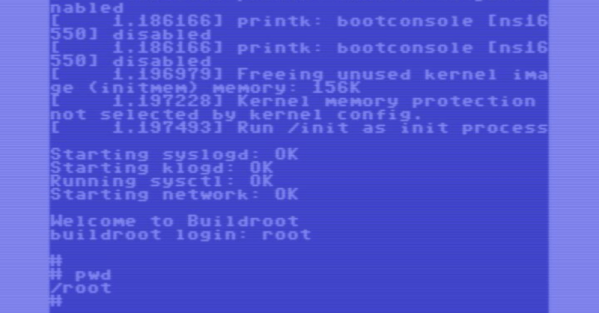
We are used to seeing Linux running on almost everything, but we were a bit taken aback to see [semu-c64] running Linux on a Commodore 64. But between the checked-out user name and the caveat that: “it runs extremely slowly and it needs a RAM Expansion Unit”, one can already start piecing together what’s happening here.

The machine running Linux is really a RISC-V32. It just so happens that the CPU is virtual, with the C64 pretending it is a bigger machine. The boot-up appears to take hours, so this is in no way practical, even though the comment is that optimization might be able to get a 10X speed up. It would still be about as slow as you can imagine.

To further add a layer of abstraction, the code hasn’t run yet on real Commodore hardware. Instead, it is running on an emulator. The emulator has “warp” mode to run faster than a real machine, and it is still slow. So think about that before you rush out to volunteer to boot this on your real hardware.

Tricks like this fall into the talking dog category. If a dog can talk, it isn’t that you think it will have something important to say. You just marvel that it can do it at all. Still, we get it. We spend a lot of time doing things at least as pointless. But at least it is fun!

Maybe emulate the whole thing in VR? Or maybe write some virtualization code for the C64 so you can emulate a Linux box and a quantum computer simultaneously.

Kitchen Steganography With Turmeric

It is a classic rite of passage for nerdy kids to write secret messages using lemon juice. If you somehow missed that, you can’t see the writing until you heat the paper up with, say, an old-fashioned light bulb. If you were a true budding spy, you’d write a boring normal letter with wide spacing and then fill in the blanks between the lines with your important secrets written in juice. This is a form of steganography — encoding secret messages by hiding them in plain sight. [Randomona] shares a different technique that seems to be way cooler than lemon juice using, of all things, turmeric. This isn’t like the invisible ink of our childhood.

That’s probably a good thing. We doubt an LED bulb makes enough heat to develop our old secret messages. [Ranomona’s] ink doesn’t use heat, but it uses a developer. That means you must make two preparations: the ink and the developer. The results are amazing, though, as shown in the video below.

Continue reading “Kitchen Steganography With Turmeric”

Linux Fu: The Old School Terminal

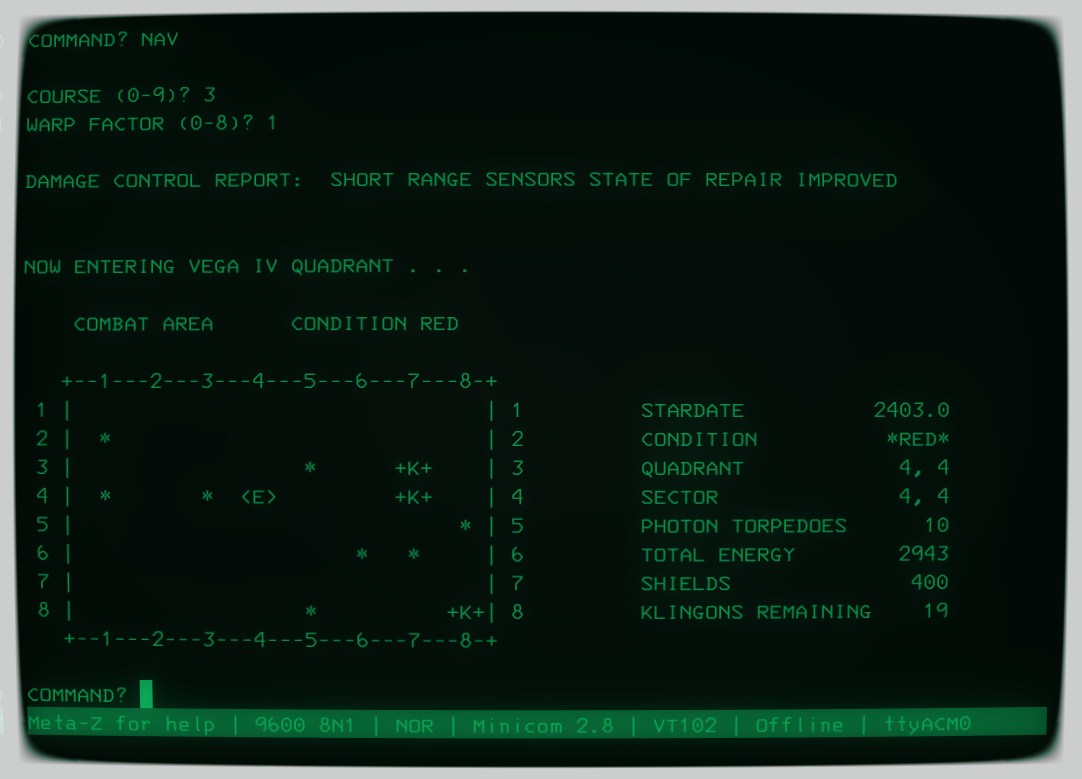
Maybe you have a vintage old-school computer. Maybe you have a replica. Maybe you just want to run SIMH and relive the glory days of CP/M or VMS. The problem is, it looks kind of silly to have CP/M running in your beautiful X11 terminal window full of 3D animations, opacity effects, and special fonts. You could buy an old CRT monitor. That would be cool, too, because on a modern screen, you don’t get scan lines and all the crummy artifacts that go along with an electron beam and phosphor display device. Or you can grab retro-cool-term.

Star Trek on CP/M

Even if you don’t have an old computer, the program will work fine to simply run your shell for everyday use. Confound the youngsters when they see your terminal with scan lines and CRT jitter updating the latest packages.

What Is It?

If you want a shell in a GUI, you used to use xterm, although most people use something more modern. I use Konsole, but some like RXVT or whatever terminal your distro favors. Cool-retro-term is just a replacement for this. By default, it only opens a shell prompt.

Continue reading “Linux Fu: The Old School Terminal”

A Bubble Machine Built From Scrap

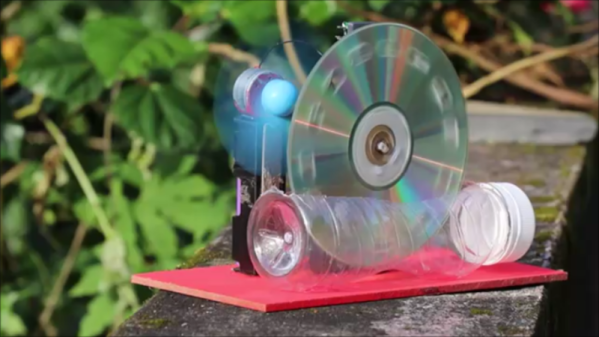
Not every project has to be an AI-powered particle accelerator using lasers. Sometimes simple projects can be very satisfying, and a simple project can be a great gateway to introduce a friend or a child to our hacker ways. That’s why we noticed [Crazy Science’s] bubble machine upcycled from a CD and a water bottle. It isn’t likely to figure in anyone’s Ph.D. dissertation any time soon, but that isn’t the point

Once you see the pictures, you can probably figure out how to build it. For extra points, consider scrounging everything from stuff you already have. We were curious about drilling holes in the CD as we’d imagine they’d crack with an ordinary drill bit. Apparently, a soldering iron will pierce the disk, but we would advise doing that in a well-ventilated area.

Continue reading “A Bubble Machine Built From Scrap”