The PDP8 That Never Was: Hollow State Logic

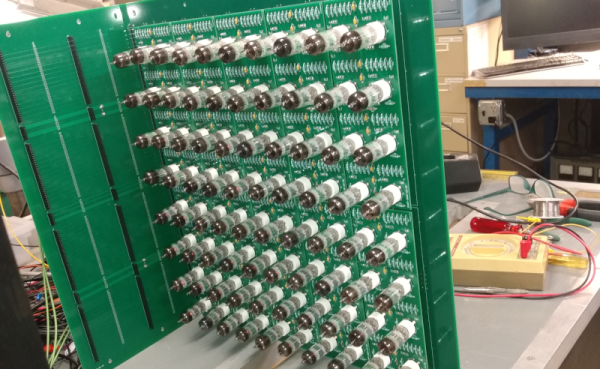
[Outer World Apps] noted that there was no PDP-8/V made by DEC — a variant that used vacuum tubes. So he’s decided to make one using about 320 6J6A tubes. He’s got a plan and a few boards completed — we can’t wait to see it finished.

The logic is actually done by crystal rectifiers, but the tubes do inversion. To make an and/or/invert gate requires a single triode or half of a 6J6A. A D flip flop requires three tubes or two tubes for a latch. In addition to the “crystal diodes,” the memory and I/O are a Raspberry Pi, and there are transistors to do level conversion between the tube logic and the Pi.

Continue reading “The PDP8 That Never Was: Hollow State Logic”

Gesture Sensor Teardown Reveals Intel Heritage

A few years ago, there was a rush of products on the market to detect motion. The idea being you could interact with your computer like they do on science fiction movies, with giant expressive hand motions in the air. Most of these were aimed at desktop computer users but one company, YouSpace, wanted to bring this technology to retail stores. [IMSAI Guy] got one of their sensor devices and decided to see what was inside it. You can see, too, in the video below.

The device appeared to have a laser inside, which motivated the teardown. We aren’t sure exactly what YouSpace had planned, but you can see their now-defunct website on the Wayback machine. The use cases listed didn’t really help us get a clear picture, so maybe that was part of the problem.

Getting into the device was the first challenge. Like many modern smartphones, there didn’t appear to be any fasteners, so you simply had to pry the case apart. Inside the case: a tiny circuit board and a metal assembly containing the laser and cameras that were easy to remove. The main PCB appears to be an Intel off-the-shelf board that was in many Intel RealSense products, and currently go for about $50 on eBay. The camera assembly looks a bit like an Intel D430, so it is possible the entire thing was off-the-shelf hardware. Even the little connector board is, technically, a D400 Interposer.

The peek into the structured light project under the microscope was interesting. We expected it would look different, and [IMSAI Guy] clearly didn’t expect its appearance either. The chip was made to beam a known pattern that the cameras would use to deduce the shape of the surfaces it hits.

If you can find these on the surplus market, they would probably be a good deal if you need this hardware which is typically pretty expensive. Just beware, though. Intel announced in late 2021 they were “winding down” RealSense. We don’t know if there will be third-party support in the future or if the whole product line will just be orphaned.

We’ve seen the occasional project that uses structured light. The technique can be very precise.

Continue reading “Gesture Sensor Teardown Reveals Intel Heritage”

Contrary View: Chatbots Don’t Help Programmers

[Bertrand Meyer] is a decided contrarian in his views on AI and programming. In a recent Communications of the ACM blog post, he reveals that — unlike many others — he thinks AI in its current state isn’t very useful for practical programming. He was responding, in part, to another article from the ACM entitled “The End of Programming,” which, like many other articles, is claiming that, soon, no one will write software the way we do and have done for the last few decades. You can see [Matt Welsh] describe his thoughts on this in the video below. But [Bertrand] disagrees.

As we have also noted, [Bretrand] says:

“AI in its modern form, however, does not generate correct programs: it generates programs inferred from many earlier programs it has seen. These programs look correct but have no guarantee of correctness.”

Continue reading “Contrary View: Chatbots Don’t Help Programmers”

Royal Navy Tests Quantum Navigation

GPS has changed the way we get around the globe. But if you command a warship, you must think about what you would do if an adversary destroyed or compromised your GPS system. The Royal Navy and Imperial College London think a quantum navigation system might be the answer.
Of course, Heisenberg says you can’t know your speed and position simultaneously. But at the real-world level, you can apparently get close enough. The quantum sensors in question are essentially accelerometers. Unlike conventional accelerometers, though, these devices use ultracold atoms to make very precise measurements using a laser optical ruler, which means they do not drift as rapidly as, say, the accelerometer in your phone. Navigating with accelerometers is well understood, but the issue is how often you have to correct your computed position with an actual reference due to drift and other error accumulation. You can see a Sky News report on the trial below. Continue reading “Royal Navy Tests Quantum Navigation”

Plastic Welding Revisited

Last time we talked about a video that purported to do plastic welding, we mentioned that the process wasn’t really plastic welding as we understood it. Judging by the comments, many people agreed, but it was still an interesting technique. Now [Inventor 101] has a video about plastic repair that also talks about welding, although — again, we aren’t sure all of the techniques qualify.

That’s not to say there aren’t some clever ideas, though. There are several variations on a theme, but the basic idea is to use a bolt or something similar in a soldering iron, metal reinforcement from things like wires and staples, and donor plastic from a zip tie. While we don’t think the nylon in a typical zip tie is the best way to repair anything other than nylon, if you were repairing something 3D printed, you could easily swap out the tie for filament of the same material, which — we think — would bond better.

Continue reading “Plastic Welding Revisited”

Billion Year Clock Is LEGO Genius Or Madness

If you are a fan of LEGO bricks or Rube Goldberg, you should have a look at [Brick Technology’s] billion-year LEGO clock. Obviously, it hasn’t been tested for a billion years, and we wonder if ABS would last that long, but the video below is still worth watching.

Even if you aren’t a LEGO fan, the demonstration of a pendulum clock and escapement is worth something and really shows the practical side of things. Of course, making a pendulum clock that keeps time isn’t anything magic — people have been doing that for centuries. But then more and more elements join to keep track of more time.

You might wonder how the pendulum keeps going for a billion years. Well, honestly, it can’t. But a solar panel charges a battery that rewinds the clock when the drive weight reaches the bottom. We imagine the solar cell and battery would be maintenance items if you expected the billion-year life cycle.

Some will ask why, but we get it. If you must explain why you build everything you do with LEGO, you are doing it wrong. The clock even keeps track of the galaxy’s rotation which, apparently, completes every 230 million solar years.

We’d be impressed with this clock even if it weren’t made with LEGO. Sure, it isn’t as posh as the fancy clock in Denmark. But it does work longer — at least, in theory — than most other LEGO clocks we’ve seen.

Continue reading “Billion Year Clock Is LEGO Genius Or Madness”

Want Lower Power? Add More Cores!

[Jacob Beningo] over at Embedded.com recently posted his thoughts on how to do a low-power microcontroller design. On the surface, some of his advice seems a little counter-intuitive. Even he admits, “…I’m suggesting adding more cores! I must be crazy!” There are a few tips, but the part he’s talking about is that you can save power by using CPUs with multiple cores and optimizing for speed.

This seems strange since you think of additional cores and speed to consume more power. But the idea is that the faster you get your work done, the faster you can go to sleep. We’ve seen that in our own projects — faster work means more napping, and that’s good for power consumption.

Of course, it isn’t just that simple. Multiple cores don’t help you if you don’t use them. The overarching goal is to get done quickly so you can get back to sleep. You know, kind of like work. The other advice in the post is generally good, too. Measure your power consumption, respond to events, and — maybe slightly surprising — with modern CPUs, variations within the CPU family, according to [Jacob], isn’t very significant. Instead, he reports that the big changes are switching to the least-capable processor family.

Naturally, Hackaday readers are no strangers to low-power design. If you get your power consumption low enough, you can consider a low-tech battery or even a potato.