MicroPython ESP32 IDE Makes Life Simpler

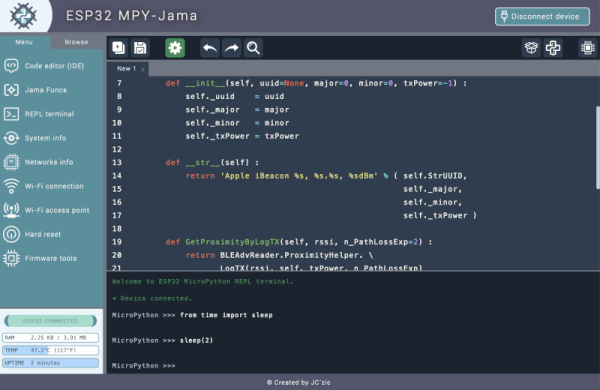
In theory, using MicroPython on the ESP32 is easy —  just flash an image and connect using a serial port. But that leaves a lot of things you still have to do. You need to move files between the two platforms. You’ll want to manage network configurations. You might want better editing and assistance, too. So there are a number of IDEs made to help you and one we recently noticed was MPY-Jama.

The IDE provides source code editing, of course. But it also allows you to do things like pull information about the network using a dashboard or connect to a WiFi network easily. You can even create your own AP with a simple interface.

Although the front part of the README mentions it is for Windows or Mac, if you scroll down you’ll find instructions for installing under Linux. The IDE is extensible using “Jama Funcs” and can handle the flashing operation from inside the IDE.

Of course, there is an IDE from Arduino (but not the Arduino IDE) that handles MicroPython. You can also find a rundown of several similar alternatives online.  If you need some inspiration for a MicroPython project, perhaps you’d like to play a game?
Spy Drone Propeller Makes For A Quiet PC

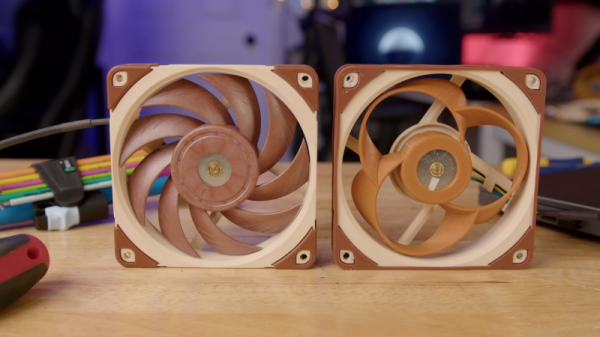
MIT recently announced its research on toroidal propellers to create quieter drones. That got [Major Hardware] thinking about noisy PC fans. The obvious solution was to adapt the toroidal shape for a PC fan. He was familiar with the idea from similar screws on boats that are commercially available. You can see his tests in the video below.

The shape of the blades on the MIT drones is visible in video and pictures, but there were no available 3D models. [Major] did a design and 3D printed the blades. Watching the comparison with a conventional fan using smoke was pretty impressive.

Continue reading “Spy Drone Propeller Makes For A Quiet PC”

SDR Scanner Listens To Everything

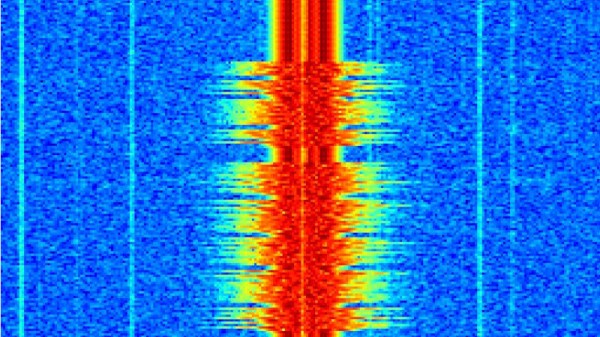
In the old days, scanners would listen to a bunch of channels in a round-robin fashion. If a signal breaks the squelch, the scanner stops and scanning continues scanning after a few seconds of inactivity. But with modern SDRs, you don’t have to listen to one channel at a time. You can listen to all of them. [Tech Minds] shows RTL-SDR Scanner on Linux to record up to 20 MHz of the band simultaneously. It records all the channels in the band of interest. The actual project is on GitHub.

Once recorded, you can use a web interface to listen to the channels and see some statistics about them. [Tech Minds] tried recording aircraft traffic. It worked, but the program doesn’t know how to demodulate AM yet so if you want to record the entire shortwave band, aircraft, or other AM sources, you’ll have to wait a bit before this software is ready for your use case.

If you need to run the program under Windows like [Tech Minds] did, you can use VMWare Workstation Player to get a free copy of Linux on Windows. We wondered if WSL version two might work, too, but we don’t know. Once you have Linux running, Docker makes the installation straightforward.  Since the interface is a web interface, you could probably run this on a small computer on the network and then access it at your leisure from another computer.

Of course, old-fashioned scanners were often used to listen to police and fire radios. Those have all gone trunked these days. This isn’t a new idea, but it did seem like a well-packaged solution.

Continue reading “SDR Scanner Listens To Everything”

Arduino Does SDI Video With FPGA Help

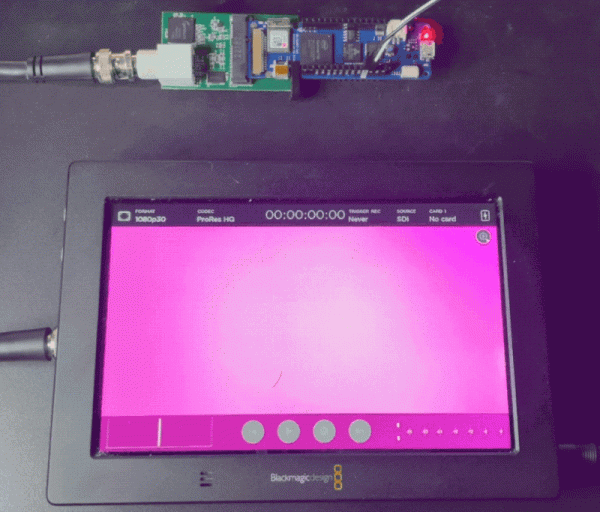
If you are running video around your home theater, you probably use HDMI. If you are running it in a professional studio, however, you are probably using SDI, Serial Digital Interface. [Chris Brown] looks at SDI and shows a cheap SDI signal generator for an Arduino.

On the face of it, SDI isn’t that hard. In fact, [Chris] calls it “dead simple.” The problem is the bit rate which can be as high as 1.485 Gbps for the HD-SDI standard. Even for a super fast processor, this is a bit much, so [Chris] turned to the Arduino MKR Vidor 4000. Why? Because it has an FPGA onboard. Alas, the FPGA can’t do more than about 200 MHz, but that’s fast enough to drive an external Semtech GS296t2 serializer which is made to drive SDI signals.

The resulting project contains the Arduino, the serializer, a custom PCB, and both FPGA and microcontroller code. While the total cost of the project was a little under $200, that’s still better than the $350 to $2000 for a commercial SDI signal generator.

If you want to play along, the files are out on GitHub. We used the Vidor back in 2018 when it first came out. If you need a quick start on FPGAs, there’s always our boot camp.

Ikea Clock Gets Wanderlust

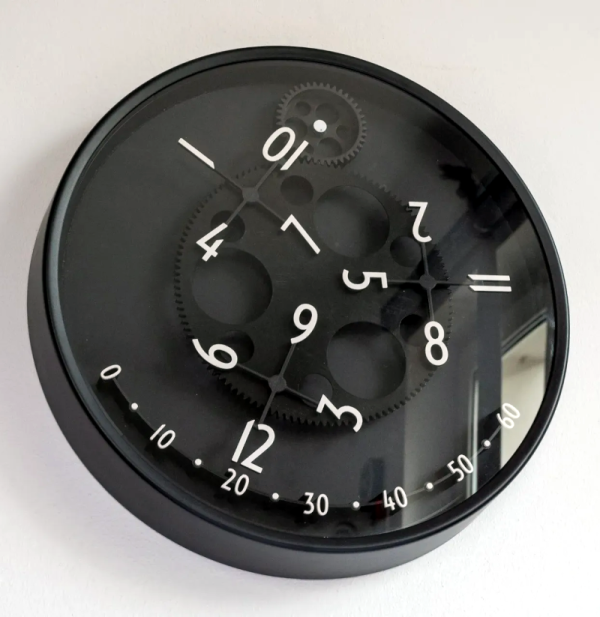
We always enjoy unique clocks, and a recent 3D print from [David Kingsman] caught our eye. It converts an Ikea clock into a very unusual-looking “wandering hour” clock that uses a Geneva drive to show a very dynamic view of the current time. The concept is based on an earlier wandering clock, but [David] utilized a different mechanism.

To read the clock, you note which hour numeral is in range of the “minute arc” and read the time directly. So if the 12 hour is over the 20-minute mark, the time is 12:20. Besides the clock, you need a fair number of printed parts, although they all look like relatively simple prints. You’ll also need 13 bearings and some metric hardware. A piece of cardboard used for the face rounds out the build.

Modifying the clock is more than just taking it apart. There is a template file to print, and you’ll need to align it and drill holes as indicated.

If you haven’t seen a Geneva drive before, it translates a continuous rotation into intermittent rotation. This isn’t the first clock we’ve seen use this kind of drive, although the last one we saw represented time differently. If you want something even more mechanical, try a chain-driven clock.

Hacking The Python For Loop

In the early days of C, you’d occasionally see someone — probably a former Pascal programmer — write something like this:

#define BEGIN {
#define END }

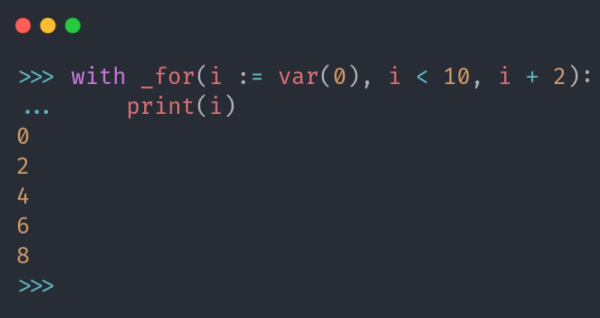
This would usually initiate complaints about abusing the preprocessor and generally being anti-C. Surely no modern language would permit such things, right? Perhaps not. Consider [Tushar Sadhwani] who wanted to create a classic C-style for loop inside of Python. He did it, and the journey is perhaps more interesting than the result.

First, you can’t just transport straight C for loops into Python. There has to be some concession to Python syntax. The initial attempt was clever but not clever enough. However, the disassembly of the Python code was telling. The second attempt, however, was particularly interesting.

That attempt used an odd feature to examine the interpreter’s tree structure for the code and then modify it. This is sort of like a very painful C preprocessor but more powerful. That version works although it is pretty convoluted.

Ironically, [Tushar] then set up a third attempt after seeing code that tries to replace Python indentation with braces using a codec. In Python-speak, a codec lets you convert different text encodings. However, you can do other things than text encoding conversion. This is closest in spirit to the C preprocessor method. You can wade through the source code ahead of processing and make whichever changes you see fit.

Is any of this really useful? Probably not as it is. But you never know when you might need to do something exotic and one of these techniques could save the day. You probably couldn’t get away with some of this on MicroPython, of course. Your mileage may vary depending on where you find your Python running — like the Web.

Sundial Collection Is 2D Printed

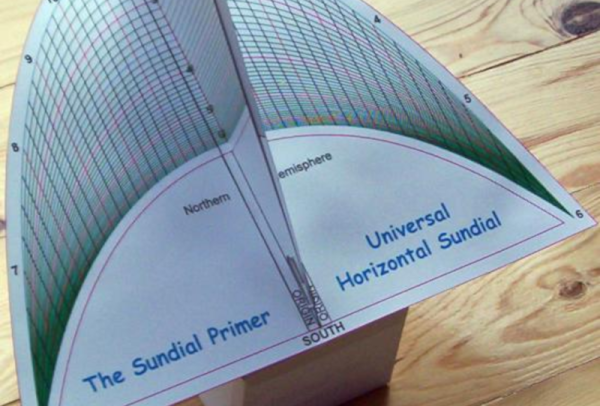
We see a lot of clocks, and many of the better ones have some 3D printed elements to them. But [Carl Sabanski] shows us his kits for making sundials for either hemisphere using a conventional printer (you know, one that puts ink on paper), some styrofoam, and possibly some other materials like wire coat hangers, threaded rods, thumbtacks, glue, and different papers like transparencies or card stock.

In all, there are 21 different kinds of sundials. Some are pretty standard-looking fare, but there are others, like the pinwheel equatorial sundial or the cycloid polar sundial, which might be surprising. One even uses a CD as a kind of indicator.

Continue reading “Sundial Collection Is 2D Printed”