Nanoparticles Rip Hydrogen From Water

Hydrogen fuel is promising, and while there’s plenty of hydrogen in the air and water, the problem is extracting it. Researchers have developed a way to use aluminum nanoparticles to rip hydrogen out of water with no additional energy input. It does, however, require gallium to enable the reaction. The reaction isn’t unknown (see the video below), but the new research has some interesting twists.

Aluminum, of course, is cheap and plentiful. Gallium, not so much, but the process allows recovery and reuse of the gallium, so that makes it more cost-effective. There is a patent pending for the process and — of course — the real trick is making the aluminum nanoparticles. But if you have that, this is a simple way to extract hydrogen from water with no extra energy and at room temperature. Since the reaction of creating aluminum oxide and releasing hydrogen with gallium is pretty well-known, it appears the real research here is determining the optimal properties of the aluminum and the ratio of aluminum to gallium.

While gallium isn’t a common item around the typical hacker’s workshop — unless you count the stuff bound up in semiconductors — it isn’t that expensive and it is relatively easy to handle. Hydrogen, though, not so much — so if you do decide to use this method to produce hydrogen, be careful!

We’ve seen gallium robots and even an antenna. So if you do get some of the liquid metal, there are plenty of experiments to try.

The 7805 Is Dead! Long Live The 7805!

The 78XX series of regulators are very handy to use. If you need, say, a 5V regulator, you grab a 7805, add a capacitor for stability, and send in enough voltage for the regulator to work with. Cheap and easy. However, the part is not without its faults.

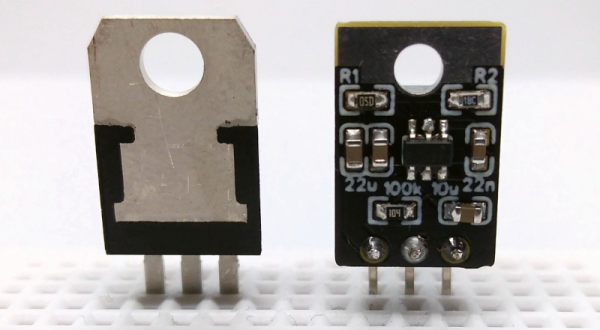
A stock 7805 can’t convert 5.1V to 5V. You need to have a good bit more voltage coming in. But the more voltage you put in, the more the part is going to dump out as heat. So running from 9V is going to be cooler than running from 24V. All that heat isn’t very energy efficient on batteries, either. [Stefan] wanted to do better, so he made a drop-in replacement for these venerable regulators some time ago. But he’s recently made the board layouts available so you can build your own replacement, too.

The device accepts 4.5 to 16V, and you can select the output voltage using two resistors. You can draw up to 2A out of the regulator, which is more than you can say for a stock 7805.

Continue reading “The 7805 Is Dead! Long Live The 7805!”

It’s A Plane… It’s A Train… Um… It’s Both?

What kind of electric vehicle travels at 620 miles per hour (998 km/h)? According to Canadian and French company TransPot, their FluxJet will do it and they want to use it to virtually shrink the Great White North. An electric jet? Not exactly. The FluxJet is a magnetic levitation (maglev) train riding in a vacuum tube with contactless power delivery.

The company claims it can carry 54 passengers or 10 tons of cargo. You can see two videos about the concept below. Judging by the second video, the device might be controlled by a serial port — well, probably not, but we were still amused to see the directory of tty devices on the screen.

Pipe dream (no pun intended)? Maybe. But they did get $550 million in funding and a plan to build a line between Calgary and Edmonton that will take 45 minutes to traverse. Reports are that they did demonstrate a 1-ton 18-foot-long prototype, although we couldn’t find any actual video footage of that — just hints of it in the marketing videos.

Of course, this isn’t the first such system proposed as a “hyperloop” but they do seem to be building momentum financially. We aren’t clear what they are talking about with the “veillance flux,” but we also know that since they are a French-speaking organization, it may just be another way to say “sensors” because — we think —  veillance is a French word that means watching. We also aren’t sure how a train in a vacuum has much in common with an airplane. Maglev isn’t new, either.

Continue reading “It’s A Plane… It’s A Train… Um… It’s Both?”

Backup Camera, Digital Dash, Road Assist… In 1969?

If your friend told you their car had a backup camera, a digital dashboard, climate control, could scan for radio stations, and even helped stay on the road, you wouldn’t think much about it. Unless the year was 1969. The car — the Hurricane by Australian automaker Holden — was never a production vehicle. But it was way beyond the state of the art in 1969 and isn’t too dated, even today.  The concept car was actually found in 1988 and restored by 2011. Honestly, it still looks great.

The car looks amazing and was meant to be a research vehicle and — probably — nice eye candy for the car shows. Seating two passengers with a mid-mounted 253 cubic inch V8, it featured many things we take for granted now: a backup camera, temperature control, and a  (somewhat) digital dashboard, for example. There was a system to help it stay in lane, but that required magnets in the road — it was 1969, after all.

The fiberglass body was unique and had a canopy instead of doors. The power seats lifted up when the canopy came up and went down for driving. The passenger compartment was a steel cage. The vehicle featured headrests, a foam-lined fuel tank, and a fire warning system. Two of the brakes were even oil-cooled.

Continue reading “Backup Camera, Digital Dash, Road Assist… In 1969?”

Pi Pico Gives Its Life For Overclocking

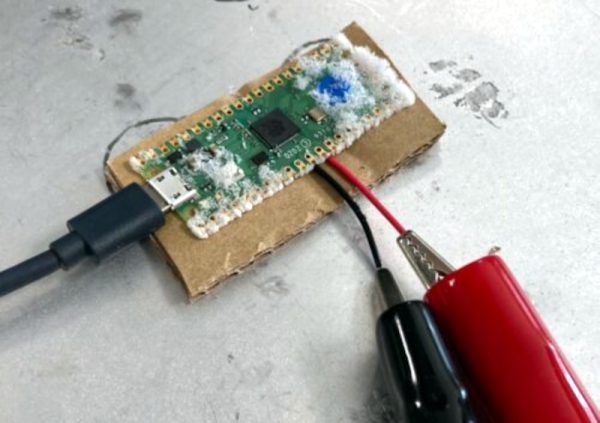
How fast can a Raspberry Pi Pico go? Well, apparently the answer is 1 GHz if you freeze it and give it over twice the voltage it normally gets. Oh, one catch. After a few minutes, the chip will fry itself.

That’s the results reported by [David] who took a Peltier cooler and a pretty serious over-voltage. The dhrystone scores went from around 200 to over 1100. Of course, there’s that pesky early death to worry about, so you probably won’t want to try this at home.

Even before the chip bites the dust, there are other problems to address. For example, once you get much over 250 MHz, the Pico’s SPI flash can’t keep up, so all the software you want to run has to be put in RAM first. You’ll also want to do some poking at the system clock parameters.

Honestly, we enjoy overclocking PCs or just about anything else. The good news is if you fry a Pico, it won’t make a sizable dent in your wallet. It is also a fun way to learn a bit more about the internals of the processor. According to [David], the cooler took the part to -40 C. We wonder how it would fare in a bath of LN2?

Of course, you can push a regular Pi, too. If you really need a 1 GHz overclocked microcontroller, maybe check out the Teensy.

Tech In Plain Sight: Rain-Sensing Wipers

While it is definitely a first-world problem that you don’t want to manually turn on your windshield wipers when it starts raining, it is also one of those things that probably sounds easier to solve than it really is. After all, you can ask a four-year-old if it is raining and expect a reasonable answer. But how do you ask that question of a computer? Especially a tiny cheap computer that is operating pretty much on its own.

You might want to stop here and try to think of how you’d do it. Measure the conductivity of the glass? Maybe water on the glass affects its dielectric constant and you could measure the resulting capacitance? Modern cars don’t do either. The problem is complicated because you need a solution that works with the glass and isn’t prone to false positives due to dirt or debris.

Continue reading “Tech In Plain Sight: Rain-Sensing Wipers”

I3C — No Typo — Wants To Be Your Serial Bus

Remember old hard drives with their giant ribbon cables? They went serial and now the power cables are way thicker than the data cables. We’ve seen the same thing in embedded devices. Talking between chips these days tends to use I2C or SPI or some variation of these to send and receive data over a handful of pins. But now there is I3C, a relatively new industry standard that is getting a bit of traction.

I2C and SPI are mature but they do have problems. I2C can be relatively slow and SPI usually requires extra pins for each device. Besides that, there is poor support for adding and removing devices dynamically or discovering devices automatically.

I3C, created by the MIPI Alliance, aims to fix these problems. It does use the usual two wires, SCL for the clock and SDA for data.  One device acts as a controller. Other devices can be targets or secondary controllers. It is also backward compatible with I2C target devices. Depending on how you implement it, speeds can be quite fast with a raw speed of 12.5 Mbps and using line coding techniques can go to around 33 Mbps.

Continue reading “I3C — No Typo — Wants To Be Your Serial Bus”