Injection Molds: Aluminum Or Resin?

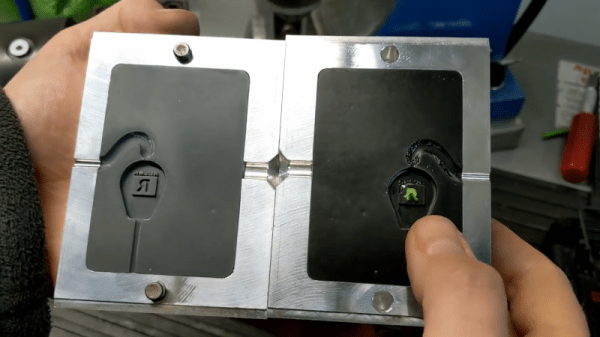
[JohnSL] and his friend both have injection molding machines. They decided to compare the aluminum molds they usually use with some 3D printed molds created with a resin printer. They used two different resins, one on each side of the mold. You can see a video of the results below.

One half of the mold used ordinary resin while the other side used a resin that is made to hold up to higher temperatures. As you might expect, the lower-temperature resin didn’t stand up well to molten plastic. However, the higher temperature resin did somewhat better. It makes sense, though, that an aluminum mold draws more heat out of the plastic which is helpful in the molding process.

The higher temperature — and more expensive — resin did seem to hold up rather well, though. Of course, this was just to test. In real life, you’d want to use the better resin throughout.

No surprise, the resin molds didn’t last nearly as long as a proper mold. After 70 shots, the mold was worn beyond what you’d want to use. So not necessarily something you’d want to use for a real production run, but it should be enough for a quick prototype before you go to the expense of creating a proper mold.

We wonder if there are some other tricks to get better results. A comment from [TheCrafsMan] suggests that clear resin UV cures better, and that might produce better results. In fact, there are a lot of interesting comments on the video from people who have varied experiences trying to do the same thing.

If nothing else, watching the mill cut through the aluminum around the 15-minute mark is always interesting to watch.  If you don’t already have an injection molding setup, you can always build one. We’ve seen more than one design.


Continue reading “Injection Molds: Aluminum Or Resin?”

Want A Break From Hardware Hacking? Try Bitburner

If you ever mention to a normal person that you’re a hacker, and they might ask you if you can do something nefarious. The media has unfortunately changed the meaning of the word so that most people think hackers are lawless computer geniuses instead of us simple folk who are probably only breaking the laws meant to prevent you from repairing your own electronics. However, if you want a break, you can fully embrace the Hollywood hacker stereotype with Bitburner. Since it is all online, you don’t even have to dig out your hoodie.

The game takes place in 2077 where, apparently, people are still using green monochrome terminals and writing JavaScript code. Who knew? The operating system is suspiciously Linux-like with commands like alias, cat, cp, kill, and the like. We were nonplussed that in 2077 they’re still using vim, but you can use nano. We always thought real hackers would be emacs users. Our machine only starts out with 8 MB of RAM, too. Good thing you can virtually buy more.

We won’t quibble that cls is a synonym for clear or that you use help instead of man. It is, after all, a game. This means you don’t have to feel bad using the buy command to purchase a program on the virtual dark web, either. Hey, if you can shoot bad guys in an FPS game, why can’t you do business with fake cyber-criminals. Why should Grand Theft Auto players have all the fun?

You know how in a video game you are a much better shot and can sustain a lot more damage than you probably can in real life? The same principle applies here. Using the scan-analyze command helpfully tells you how many open ports connected computers have and how much hacking skill it will require to break in. That’d be handy in real life, we bet.

We did think it was bad form that the tutorial admonished us for not entering the commands it wanted us to. What kind of hacker wouldn’t try something else? Anyway, it’s probably a better diversion than whatever Facebook or phone game your friends are wasting time with. It probably doesn’t impart any real hacking skills, but not everything has to be useful.

If you want a game that might teach you something, try the Bash crawl adventure. Or, go write and play some BASIC games in your browser.

Quantum Circuit Uses Just A Few Atoms

Researchers at the University of New South Wales and a startup company, Silicon Quantum Computing, published results of their quantum dot experiments. The circuits use up to 10 carbon-based quantum dots on a silicon substrate. Metal gates control the flow of electrons.  The paper appears in Nature and you can download the full paper from there.

What’s new about this is that the dots are precisely arranged to simulate an organic compound, polyacetylene. This allowed researchers to model the actual molecule. Simulating molecules is important in the study of exotic matter phases, such as superconductivity. The interaction of particles inside, for example, a crystalline structure is difficult to simulate using conventional methods. By building a model using quantum techniques on the same scale and with the same topology as the molecule in question, simulation is simplified.

The SSH (Su-Schreffer-Heeger) model describes a single electron moving along a one-dimensional lattice with staggered tunnel couplings. At least, that’s what the paper says and we have to believe it. Creating such a model for simple systems has been feasible, but for a “many body” problem, conventional computing just isn’t up to the task. Currently, the 10 dot model is right at the limit of what a conventional computer can simulate reasonably. The team plans to build a 20 dot circuit that would allow for unique simulations not feasible with classic computing tech.

The dots are made with a scanning tunneling microscope and there is a Goldilocks effect regarding the size of the dots. If they are too small, the energy levels are overwhelmed by phosphorous donors. Too large, and capacitive coupling between dots makes the system unstable.

We’ll admit, the science in the paper is pretty dense. But the Methods section outlines what it takes to create something like this. You’ll need silicon, high-temperature ovens, and the ability to handle exotic gasses and perform lithography. Pretty much an IC fab in your basement. However, we did wonder if anyone homebrewing chips had ever tried STM lithography like this as an alternative to optical lithography. Seems like it might be possible.

We can’t help with some of the more exotic gear, but if you want to build an STM, it has been done. While you can make quantum dots in your kitchen, we don’t think they are going to work the same.

NASA Called, They Want Their Cockroaches Back

News hit earlier this month that the infamous “cockroach moon dust” was up for auction? Turns out, NASA is trying to block the sale as they assert that they own all the lunar material brought back from the Apollo missions. What? You didn’t know about cockroach moon dust? Well, it is a long and — frankly — weird story.

It may sound silly now, but there was real concern in 1969 that Apollo 11 might bring back something harmful. So much so that NASA tricked out an RV and kept the astronauts and a volunteer in it for about three weeks after they came home. During that time they were tested and some experiments were done to see if they’d been exposed to anything nasty.

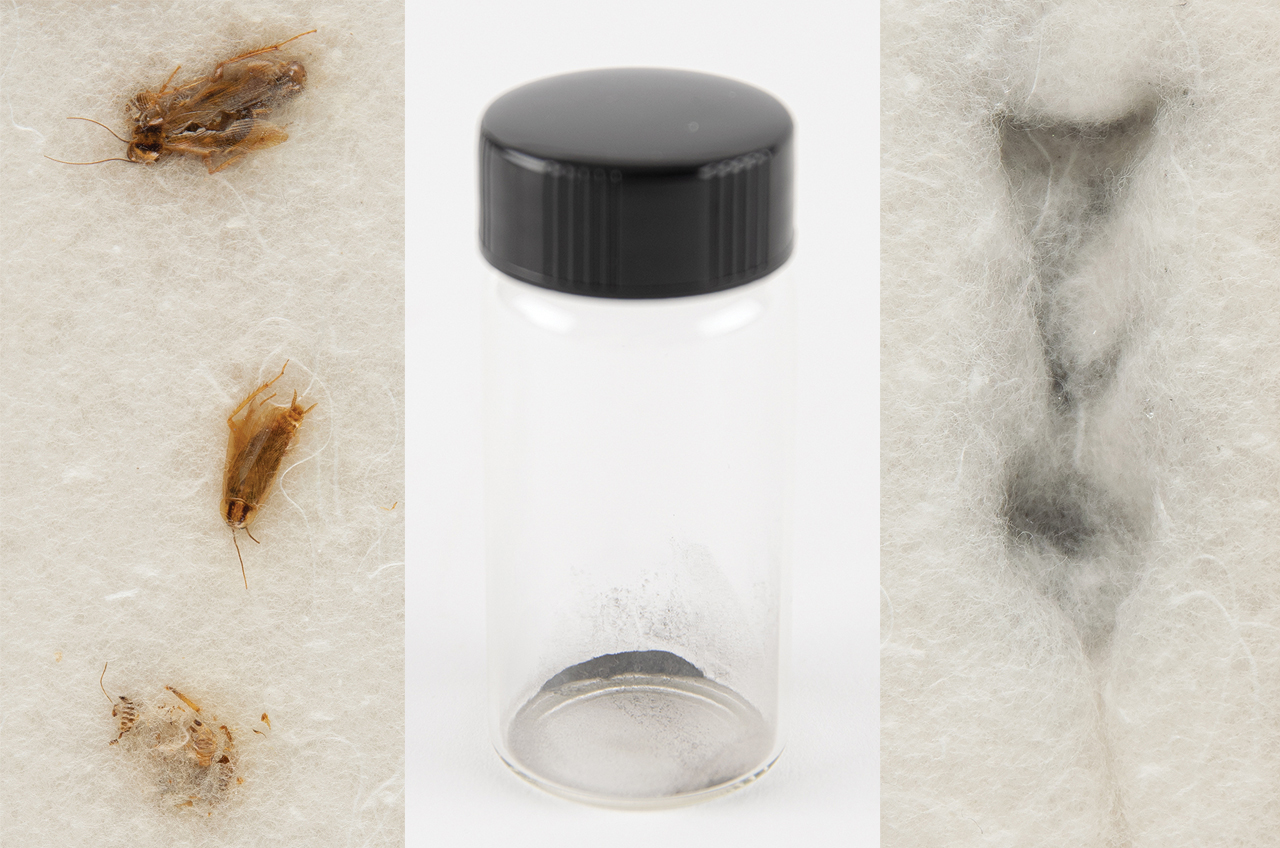
One of those experiments was to feed lunar dust to cockroaches (by the way, the table of contents has a mistake in it — check out page 8). Seriously. But that isn’t even the really weird part. A scientist who worked on the project by the name of Marion Brooks decided she wanted a memento, so she extracted the lunar dust from the dead cockroaches and saved it in a vial. At least we learned a new word: chyme.

RR Auction — the RR stands for Remarkable Rarities — was starting the bidding for some dead cockroaches and a vial of chyme at about 12 grand but it was sure to go higher than that, perhaps up to $400,000 USD. That was before they got a cease and desist from NASA.

It appears the collection has been sold at least once before. NASA has cracked down on anyone selling lunar material as even those given to people are considered on loan from the agency. However, many of the rocks given to different countries and state governments are now unaccounted for.

Back in 2002, interns Thad Roberts and Tiffany Fowler worked in the building where NASA stores most of the moon rocks it has. They took a 600-pound safe containing about 100 grams of moon samples and some other materials. With some help, Roberts tried to fence them to an amateur rock collector who helped the FBI set up a sting. Roberts got over 8 years in federal prison for his efforts, just a little more than an accomplice, Gordon McWhorter, who claimed to have been duped by Roberts. There have been a few other cases of theft, most of which remain unsolved.

This is one of those tricky things. From NASA’s point of view, they own all the moon rocks (with a few exceptions, mostly of material that didn’t come from Apollo). If you steal them, they want them back and if you are given them on loan they don’t appreciate you giving them away, selling them, or losing them. On the other hand, outside of outright theft like the Roberts case, it is hard to imagine that you want to control old roach chyme.

There’s two things we do wonder. First, who saves roach chyme even if it did start as lunar dust? Second, if three little pebbles brought back by the Soviet Luna 16 probe sold for over $850,000 and this dust might have gone for $400,000, why aren’t more of these “New Space” startups scrambling to bring some fresh samples back? Seems like it might pay for itself.

Active Signal Tracer Probe Has AGC

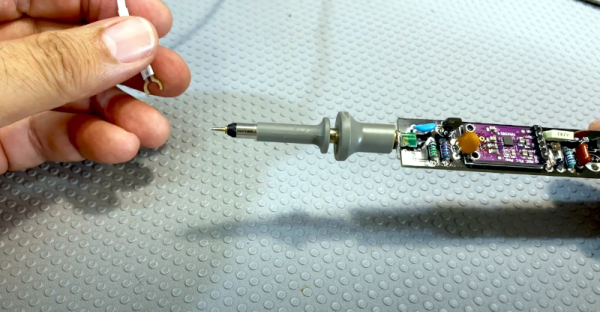
[Electronics Old and New] has a new version of one of his old projects. The original project was an active probe. He took what he learned building that probe and put it into a new probe design. He also added automatic gain control or AGC. You can see a video explanation of the design below. The probe is essentially a high-impedance input using a JFET that can amplify audio or demodulated RF signals, which is a handy device to have when troubleshooting radios.

The audio amplifier is a simple LM386 circuit. The real work is in the input stage and the new AGC circuit. Honestly, we’ve used the amplifier by itself for a similar function, although the raw input impedance of the chip is only about 50K and is less in many circuits that use a pot on the input. Having a JFET buffer and an RF demodulating diode is certainly handy. You’d think the AGC block would be in the audio stage. However, the design uses it ahead of the detector which is great as long as the amplifier can handle the RF frequency you are interested in. In this case, we think he’s mostly working on old tube AM radios, so the max signal is probably in the neighborhood of 1 MHz.

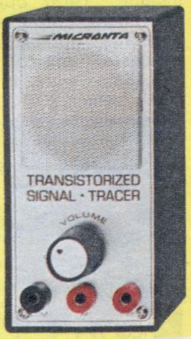
A similar device was a Radio Shack staple for many years

The module is made to amplify an electret microphone using a MAX9814 which has AGC. The module had a microphone that came off for this project. The datasheet doesn’t mention an upper frequency limit, but a similar Maxim part mentions its gain is greater than 5 at 600 kHz, so for the kind of signals this is probably used for, it should work well. We wondered if you could use the module and dispense with the JFET input. The chip probably has a pretty high input impedance, but the datasheet doesn’t give a great indication.

For years we used a signal tracer from Radio Shack which — if we could still find it — now has an LM386 inside of it after the original electronics failed decades ago. In those days, fixing an AM radio involved either using a device like this to find where you did and didn’t have a signal or injecting signals at different points in the radio. Two sides of the same coin. For example, if you could hear a signal at the volume control — that indicated the RF stages were good and you had a problem on the audio side. Conversely, if you injected a signal at the volume control, not hearing would mean the same thing. Once you knew if the problem was in the RF or AF side, you’d split that part roughly in half and repeat the operation until you were down to one bad stage. Of course, you could use signal generators and scopes, but in those days you weren’t as likely to have those.

Heathkit, of course, had their own version. It even had on of those amazing magic eye tubes.

Continue reading “Active Signal Tracer Probe Has AGC”

Around GPS In 100 Videos

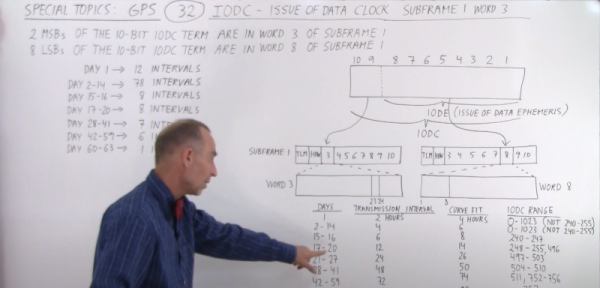
Do you know what the IODC word in GPS data means? If so, great! If not, head over to see the 32nd of [Michel van Biezen’s] 100-part video series on GPS. You probably want to watch the other 31 videos before he gets too much further ahead of you, too. [Michel] reminds you of that professor you had in college who knows a whole lot about something. In fact, scanning his YouTube channel, he knows a lot about many topics ranging from optics, chemistry, kalman filters, and lots of electronics.

There is a dedicated playlist for the GPS videos dating back to 2016. So 32 videos in about six years. So you might have a little time to catch up.  While the first video is pretty introductory as you might expect, by the time you get to video 7 the topics switch to things like the C/A code, BPSK, and gory details of all the frame data, including the IODC word.

Continue reading “Around GPS In 100 Videos”

Design Your Next Robot Hand In Minutes

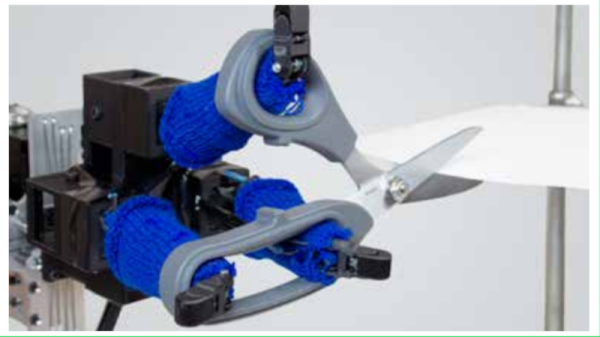
MIT complains that designing a robot hand is time-consuming and takes a lot of iterations. They want to improve that using a unique approach by giving a modular hand tactile sensors. They claim this can reduce the design time down to minutes for many practical applications. For example, cutting paper. You can see a video about the paper below as well as read the text itself.

Each style of manipulator has an associated graph. Predefined elements let you assemble a palm and specialized fingers. You deform the fingers to match the use of the hand. Then a sensor that looks like a mitten provides feedback fo the task.

Continue reading “Design Your Next Robot Hand In Minutes”