Arm Pumps Up The Volume With Mbed And A Potentiometer

Last time, I told you how to get started with the “Black Pill” STM32F411 board using the Mbed OS. The example program, admittedly, didn’t use many of the features of the OS, unless you count what the USB serial port driver uses behind the scenes. However, this time, we’ll make a practical toy that lets you adjust your PC’s volume level with a pot.
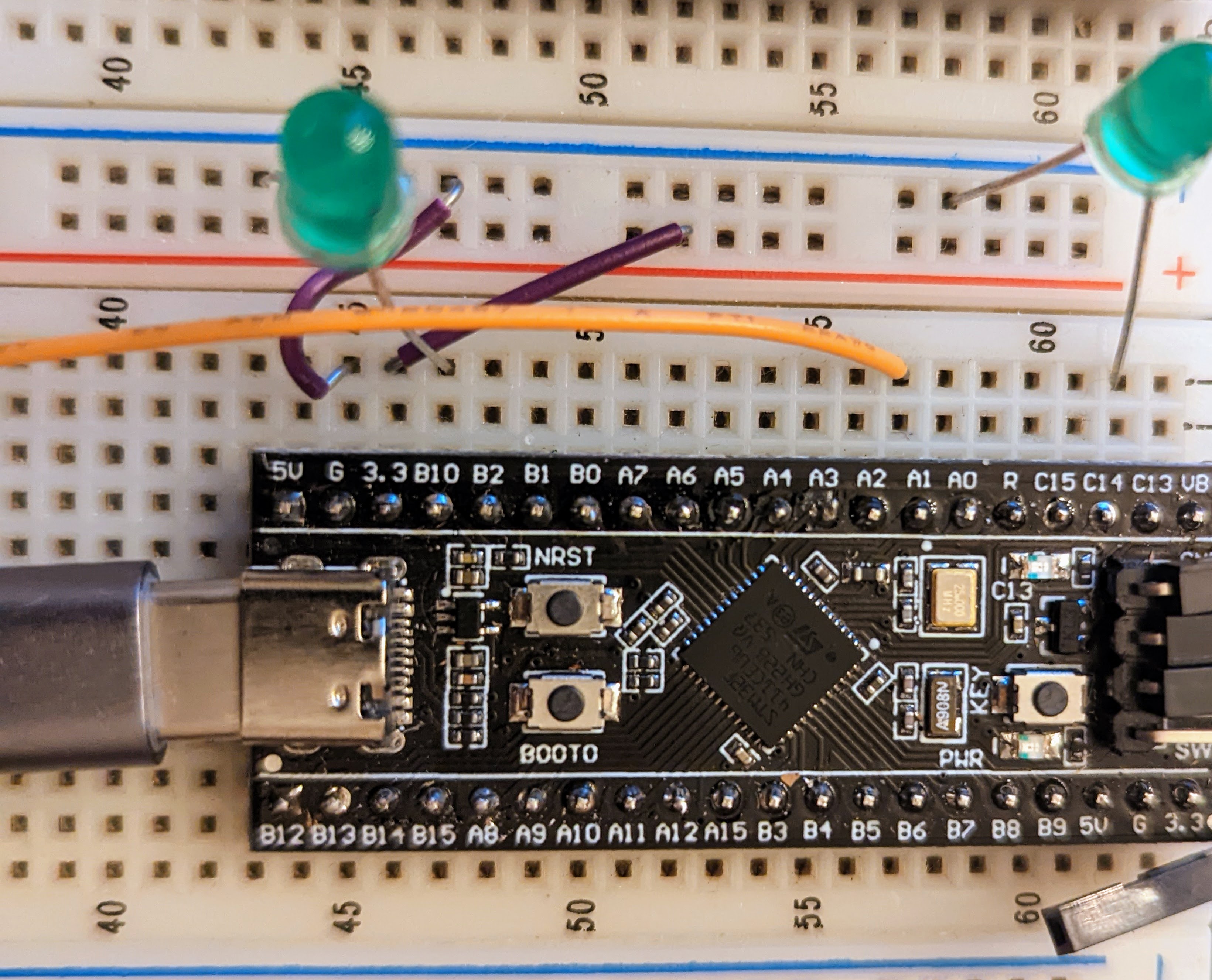
The Black Pill module on a breadboard.

The Black Pill is a good choice for this application since it has analog inputs and can act as a USB keyboard. In fact, the Mbed OS has drivers for all kinds of USB devices. We’ve seen the serial port, but you can also look like a mass storage device or a mouse, for example. Just for practice, we’ll create two threads of execution. One will read the pot and send a message over to the other thread. That thread will communicate with the PC as a USB keyboard. Any computer that understands media keys on a keyboard should work with the device.

Threads

Creating threads is very simple. For many cases, you just define a void function that takes no arguments and use it with a Thread object:

readknobThread.start(vol_thread);

Of course, the function shouldn’t return unless you want the thread to end. As I mentioned in the last post, you can sleep with the ThisThread::sleep_for call. There is also a yield call if you simply want to give up the time slice without sleeping for a specific amount of time.

Continue reading “Arm Pumps Up The Volume With Mbed And A Potentiometer”

Honey, Did You Feed The Lamp? Company Wants To Create Living Light Bulbs

The BBC’s [Peter Yeung] had an interesting post about a small French town experimenting with using bioluminescent organisms to provide lighting. A firm called Glowee is spearheading the effort in Rambouillet and other towns throughout France, using a variety of biological techniques to harness nature’s light sources.

Glowing animals are reasonably common ranging from fireflies to railroad worms. In the case of the French street lighting, Glowee is using a marine bacterium known as aliivibrio fischeri. A salt-water tube contains nutrients and when air is flowing through the tube, the bacteria glow with a cool turquoise light. The bacteria enter an anaerobic state and stop glowing if you shut off the air.

Continue reading “Honey, Did You Feed The Lamp? Company Wants To Create Living Light Bulbs”

Solaris Might Be Free If You Want It

There was a time when “real” engineering workstations ran Linux Unix. Apollo and Sun were big names and Sun’s version was Solaris. Solaris has been an iffy proposition since Oracle acquired Sun, but Oracle announced last month that you can download and use Solaris 11.4 CBE free for non-production use.

Do you care? If you ever wanted to run “real” Unix this is an option although, honestly, so is Free BSD and it probably has better community support. On the other hand, since you can virtualize a machine to spin up, it might be worth a little time to install it.

On the other hand, if you have an old SPARC machine — this could be big news. We aren’t sure how far back the hardware this will support will go, but this could be just what you need to breathe new life into that eBay pizza box from Sun you’ve had in the basement. Of course, if you have an FPGA SPARC system, this might be interesting too, but we have no idea how much other stuff you need to implement to be able to benefit from Solaris.

Will you install Solaris? If so, tell us why. We are sure we won’t have to prompt you to tell us why not. In 2017, we thought we’d seen the end of Solaris, but apparently not. Maybe this will help those folks still on Solaris 9.

KiCAD Plugin Gives Your PCBs That Handmade Look

The first PCBs we built involved a draftsman laying out large pieces of tape. The finished artwork would be photographically reduced to produce the board. This solved a few problems. It was easier to work on the large pieces and any errors were reduced by the scale amount. Boards from this era have a distinct appearance because the tracks are generally curved. But when computer-aided drafting took over, the early packages couldn’t deal with wavy lines making all sorts of angles. So traces started appearing at very common angles like 45 degrees or 90 degrees only. If you use KiCAD, though, there’s no reason to have rectilinear traces. Now there is a plugin to help make your boards appear like old-fashioned circuit boards.

The video by [mitxela] below talks about how we got here and debunks some common myths about PCB design. The plugin produces rounded corners and teardrop-shaped pads. There’s also a second post on the topic with more details. The effect isn’t just ornamental. There are some reasons graceful traces might be better than sharp angles.

Continue reading “KiCAD Plugin Gives Your PCBs That Handmade Look”

Taking A Close Look At Parallel Plate Capacitors

Of course, we all know that capacitors are conceptually two conductors separated by a dielectric of some sort. But outside of air-variable capacitors you normally don’t see them looking like that. For example, a film capacitor has its plates rolled up in a coil with an insulating film in between. You can’t really see that unless you take them apart. But [Electronoobs] makes some giant capacitors using large plates and does a few experiments to demonstrate their characteristics. You can see his work in the video below.

The arrangement reminded us of a Leyden jar except there’s no physical motion. He also had some entertaining footage of electrolytic capacitors exploding when connected backwards. The reason, by the way, is that electrolytic capacitors have conductive goo in them. By putting a controlled current through them during manufacturing, a very thin insulating layer forms on one electrode. The thinner the layer, the higher the potential capacitance is. The downside is that putting current in the opposite way of the formation current causes catastrophic results, as you can see.

The value of a capacitor depends on the area, the spacing, and the type of dielectric between the plates. The video covers how each of those alters the capacitor value. Real capacitors also have undesirable characteristics like leakage and parasitic resistance or inductance.

It used to be that capacitance meters were exotic gear, but these days many meters have that capability. This would be a great set of experiments for a classroom or as the basis for a kid’s science project. For example, measuring different dielectric materials to determine which is the best for different purposes.

Granted, capacitors are pretty basic physics, but it is easy to get wrapped up in using them and not think about what’s going on inside. This video is a good introduction or a refresher, if you need one. It is easy enough to make your own variable capacitors or even special capacitors for high voltages.

Continue reading “Taking A Close Look At Parallel Plate Capacitors”

Javascript Is Everywhere. Even MSDOS

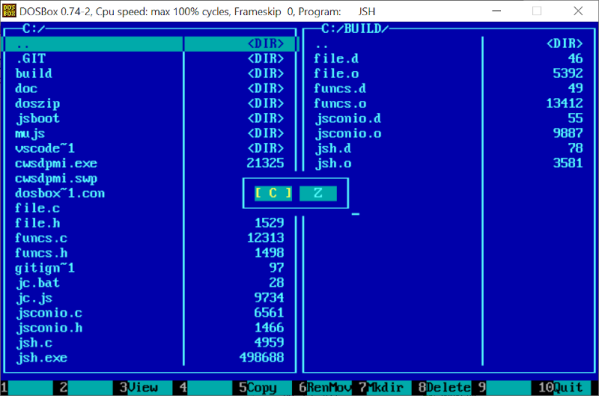
Although pundits have joked that Java’s “write once, run everywhere” slogan might be better expressed as “write once, debug everywhere,” a relative of Java — JavaScript — has delivered on both promises better than its namesake. Thanks to its proliferation in browsers, JavaScript is a veritable lingua franca of computer languages which has led to entire applications being written in it using tools like Node.js and Electron, and not just browsers. But what if you are still using MSDOS or Windows 98? We know some of you do, at least on retro machines. Don’t feel left out, the DOjS project has jSH, a JavaScript engine for DOS and related operating systems.

Continue reading “Javascript Is Everywhere. Even MSDOS”

Printable Carbide Opens Up Interesting Possibilities

Sandvik, a large company headquartered in Sweden, has apparently been producing cemented carbide for a long time — according to them, since 1932. The material is known for being highly wear-resistant. Now the company says they have a process to 3D print the material. You can see a video about the new material, below.

If you haven’t encountered this material, it is essentially fine carbide particles bound in metal. You’ll find the material widely used in cutting tools. The slogan “Freedom of Design has Never Been Harder” is both clever and confusing, but we took their point.

The process is more or less like other metal binder technology. A powder of tungsten carbide and cobalt mixed with glue creates a green body which you still need to fire to get to the finished part.

What kind of things can you make? Here’s a quote from one of Sandvik’s engineers:

For instance, in wire drawing, productivity is usually limited by how fast the wire can be drawn with maintained quality, which in turn depends on the temperature in the wire drawing die. People have been trying to solve this problem for decades, but it’s been extremely difficult. A 3D printed, cooled wire nib is the answer to this riddle. It took a mere four days to produce, from the first basic sketch to the fully sintered product – thanks to our materials and proprietary process.

Don’t plan on loading up your Ender 3 with cemented carbide filament. This is, after all, a metal material. However, 3D printing can offer geometries that would be difficult to obtain with traditional methods. So even if you have to turn to a professional 3D printing shop, it is good to know you can create in this ultra-hard material.

Printing in metal has a different set of issues than using plastics. If you really want your current printer to do metal, it can, but you’ll have to cheat a bit. Or try electroplating.

Continue reading “Printable Carbide Opens Up Interesting Possibilities”