Eavesdropping By LED

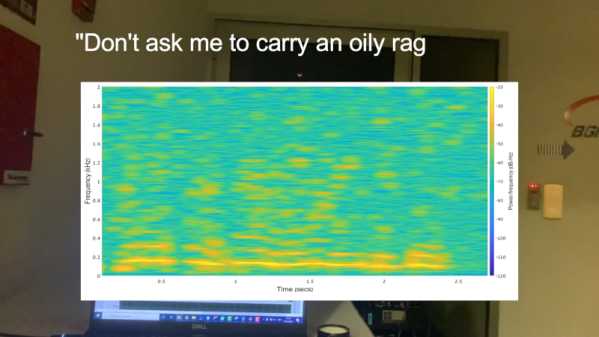
If you ever get the feeling someone is watching you, maybe they are listening, too. At least they might be listening to what’s coming over your computer speakers thanks to a new attack called “glow worm.” In this novel attack, careful observations of a power LED on a speaker allowed an attacker to reproduce the sound playing thanks to virtually imperceptible fluctuations in the LED brightness, most likely due to the speaker’s power line sagging and recovering.

You might think that if you could see the LED, you could just hear the output of the speaker, but a telescope through a window 100 feet away appears to be sufficient. You can imagine that from a distance across a noisy office you might be able to pull the same trick. We don’t know — but we suspect — even if headphones were plugged into the speakers, the LED would still modulate the audio. Any device supplying power to the speakers is a potential source of a leak.

Continue reading “Eavesdropping By LED”

Automatic Nut Sorter For A Tidy Workspace

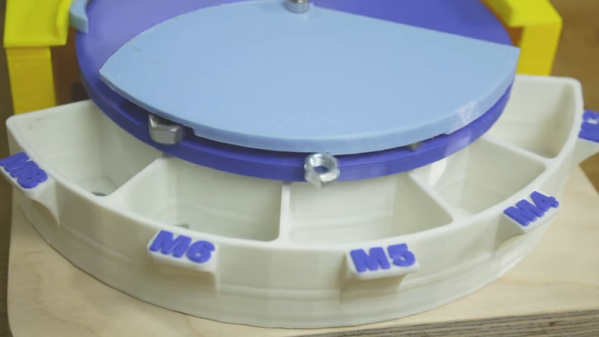
We all have that one drawer or box full of random hardware. You don’t want to get rid of anything because as soon as you do, that’s the one thing you’ll need. But, honestly, you’ll be lucky to find what you need in there, anyway. EnterĀ  [Mr. Innovative’s] nut sorting machine. As you can see in the video below, it will make order out of the chaos, at least for nuts.

You might think the device would need optical recognition software or some other high-tech mechanism. But, in fact, it is nothing more than a motor with a speed controller. The sorting is done by a plastic piece built like stairs. When a nut is too tall to fit under the next step, it slides out into the output hopper. You could probably turn the whole thing with a crank and no electricity at all if you wanted to.

Drilling out the shaft required a bit of machine tool usage, so this might not be a great weekend project without a lathe. Like many of the commenters on the video mentioned, we probably wouldn’t have used a rod holder as a rotating bearing, either, but for as little as something like this would probably operate, it is likely to last a fair amount of time. It would be easy to replace it or even affix a shaft to the motor with a coupler, sidestepping several issues.

Apparently, the device isn’t perfect. You do get some missorts. We imagine that’s from a larger nut pushing a smaller nut on the way to the hopper. The Thingiverse files seem to be missing, but this is something you’d probably adapt to your own design, anyway.

It isn’t as automated, but we’ve seen a gadget that can help sort drill bits, too. Sometimes you want to sort little parts by color, too.

Continue reading “Automatic Nut Sorter For A Tidy Workspace”

Sad clown holding melted ice cream cone

Freezing Out Ice Cream Machine Competition

We always knew that McDonald’s soft serve (you can’t really call it ice cream) machines are known to be finicky. There’s even a website that tracks where the machines are broken and, apparently, it is usually about 10% or more of them at any given time. But when we saw a news article about a judge issuing a restraining order, we knew there must be more to the story. Turns out, these $18,000 soft serve machines are in the heart of something we are very interested in: when do you own your own technology?

Cold Tech

There are apparently 13,000 or so of these machines and they are supposedly high-tech marvels, able to produce soft serve and milkshakes at the same time. However, they are also high maintenance. Cleaning the machine every two weeks (try not to think about that) involves a complete teardown. Worse, if anything breaks, you need a factory-authorized service person.

Continue reading “Freezing Out Ice Cream Machine Competition”

3D Printing Liquid Crystal

If you think at all about liquid crystals, you probably think of display technology. However, researchers have worked out a way to use an ink-jet-like process to 3D print iridescent colors using a liquid crystal elastomer. The process can mimic iridescent coloring found in nature and may have applications in things as diverse as antitheft tags, art objects, or materials with very special optical properties.

For example, one item created by the team is an arrow that only appears totally green when viewed from a certain angle. The optical properties depend on the thickness of the material which, being crystalline, self-organizes. Controlling the speed of deposition changes the thickness of the material which allows the printer to tune its optical properties.

The ink doesn’t sound too exotic to create, although the chemicals in it are an alphabet soup of unpronounceable organic compounds. At least they appeared available if you know where to shop for exotic chemicals.

The iridescent coloring is common in nature, so art objects like butterfly wings are natural with this method. While inkjet printers aren’t common in the hacker community, they aren’t that hard to create, so this seems like it would be repeatable in a garage lab.

Liquid crystals have all kinds of interesting properties and we wonder if this material would help you print those sorts of things. If you want to experiment, we have seen a few hacked inkjet printers.

Thanks [jscotta] for the tip.

radio direction finding

Where’s That Radio? A Brief History Of Direction Finding

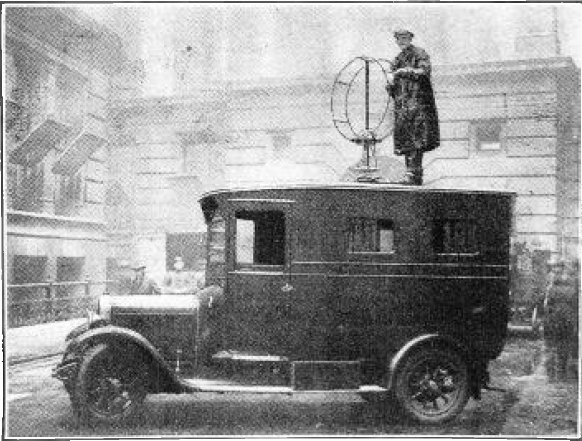
We think of radio navigation and direction finding as something fairly modern. However, it might surprise you that direction finding is nearly as old as radio itself. In 1888, Heinrich Hertz noted that signals were strongest when in one orientation of a loop antenna and weakest 90 degrees rotated. By 1900, experimenters noted dipoles exhibit similar behavior and it wasn’t long before antennas were made to rotate to either maximize signal or locate the transmitter.

British radio direction finding truck from 1927; public domain

Of course, there is one problem. You can’t actually tell which side of the antenna is pointing to the signal with a loop or a dipole. So if the antenna is pointing north, the signal might be to the north but it could also be to the south. Still, in some cases that’s enough information.

John Stone patented a system like this in 1901. Well-known radio experimenter Lee De Forest also had a novel system in 1904. These systems all suffered from a variety of issues. At shortwave frequencies, multipath propagation can confuse the receiver and while longwave signals need very large antennas. Most of the antennas moved, but some — like one by Marconi — used multiple elements and a switch.

However, there are special cases where these limitations are acceptable. For example, when Pan Am needed to navigate airplanes over the ocean in the 1930s, Hugo Leuteritz who had worked at RCA before Pan Am, used a loop antenna at the airport to locate a transmitter on the plane. Since you knew which side of the antenna the airplane must be on, the bidirectional detection wasn’t a problem.

Continue reading “Where’s That Radio? A Brief History Of Direction Finding”

Boat Brings Bathers Beverages

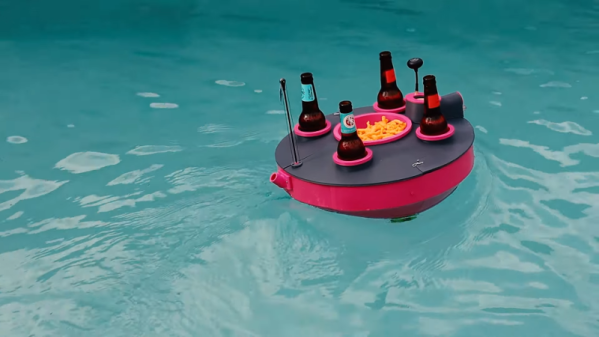
Chilling in the pool is great, but what a drag to have to get out to grab a cold brew. [Alister] had his eye on a commercial drink float, but the company was out of business. But 3D printing, of course, comes to the rescue in this video, also embedded below.

The payload amounts to four bottles and some snacks. Brushless thrusters allow the bartender to steer the little robot around the pool to deliver libations.

Continue reading “Boat Brings Bathers Beverages”

Packing Heat With A Homemade Portable Soldering Iron

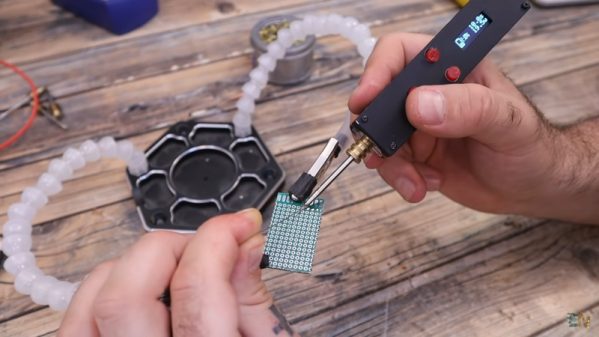
Small portable soldering irons are all the rage so [electronoobs] decided to build one on his own. While the design isn’t quite as sleek as a commercial unit, considering it holds its own batteries, it looks pretty good.

Of course, the question is: does it work? You can see in the video below that it does, melting solder in about ten seconds. The weight is about 100 g, so it should be very comfortable to use.

Continue reading “Packing Heat With A Homemade Portable Soldering Iron”