Lego Drone Finally Takes Off

We were concerned when we saw [Brick Experiment Channel] test a drone propulsion pod made with Lego. After all, the thrust generated was less than the weight of the assembly. But a few tweaks got enough lift to overcome the assembly weight, as you can see in the video below.

The next step was to build three more pods and add some lightweight avionics and a battery. The first flight was a little dicey because the sensor orientation was off. Then there was some more software tuning before things really got airborne.

Continue reading “Lego Drone Finally Takes Off”

In Soviet Russia, Doorbell Rings You

We can imagine that the origin of the doorbell is truly ancient. if you lived in a cave, you probably had a stick and a rock nearby for people to get your attention without invading your cave. In 1817 a Scot named William Murdoch had a bell in the house that visitors rang via a compressed air system, but the electric doorbell had to wait until 1831. Since then, little has changed with the basic idea. [Erientes] — who lives in the Netherlands, not Russia — wanted a smarter doorbell. In particular, he’s read about older people being victimized by people who ring the doorbell for entry. So [Erientes] used a Raspberry Pi to make a doorbell that supports facial recognition.

The exercise is really more of an operations challenge than a technical one thanks to a high-quality Python library for face recognition powered by DLib. However, we did like the user interface aimed at non-technical users. The metaphor is a traffic light in which a red light means do not allow entry. The lights are buttons, so you can use them to whitelist or blacklist a particular person.

Continue reading “In Soviet Russia, Doorbell Rings You”

3DBuzz Closes With A Final Gift

If you wanted to learn about creating modern computer games, 3DBuzz had some of the best tutorials around. In fact, some of the tutorials about C#, C++, Android, and math would be useful for anyone, while the ones about game art and modeling in Maya are probably mostly for game developers. While these were once available only by subscription, the company — now defunct — has left them available for download via this BitTorrent file.

We don’t know enough about things like Blender and Maya to evaluate the material, but it is well regarded and the ones we do know something about seem very high quality. There are, for example, many videos about C++ and C# that are very professional and cover quite a few topics.

Continue reading “3DBuzz Closes With A Final Gift”

Why Do Resistors Have A Color Code?

One of the first things you learn in electronics is how to identify a resistor’s value. Through-hole resistors have color codes, and that’s generally where beginners begin. But why are they marked like this? Like red stop signs and yellow lines down the middle of the road, it just seems like it has always been that way when, in fact, it hasn’t.

Before the 1920s, components were marked any old way the manufacturer felt like marking them. Then in 1924, 50 radio manufacturers in Chicago formed a trade group. The idea was to share patents among the members. Almost immediately the name changed from “Associated Radio Manufacturers” to the “Radio Manufacturer’s Association” or RMA.  There would be several more name changes over the years until finally, it became the EIA or the Electronic Industries Alliance. The EIA doesn’t actually exist anymore. It exploded into several specific divisions, but that’s another story.

This is the tale of how color bands made their way onto every through-hole resistor from every manufacturer in the world.

Continue reading “Why Do Resistors Have A Color Code?”

Maze Solving Via Text Editing

Linux scripters usually know about sed — the stream editor. It has a simple job: transform text as it whizzes from input to output. So if you wanted to solve a maze, this wouldn’t be the tool you’d think to use, right? Well, if you were [xsot], you’d disagree.

You build a maze using spaces for empty space and # for walls. There’s an S to mark the start position and an E to mark the end. Of course, the maze can also contain newlines. The sed script does an amazing job of solving the problem.

Continue reading “Maze Solving Via Text Editing”

NanoVNA Tests Antenna Pattern

When [Jephthai] wanted to build his own Yagi antenna, he turned to MMANA software for antenna modeling. This is an antenna analysis program that uses the moment method to calculate parameters for different antenna geometries. After building the Yagi, the predicted tuning and impedance matched the real antenna nicely. But what about the radiation pattern? To test that, he used a NanoVNA and a clever test setup.

He needed a test spot out of the antenna’s near field so he set up his workstation 18 feet away from the test antenna which was on a mount that could rotate. On the edge of the workstation table — affixed with painter’s tape — is a NanoVNA connected to a laptop.

Continue reading “NanoVNA Tests Antenna Pattern”

Arduino Pedometer Counts Your Steps

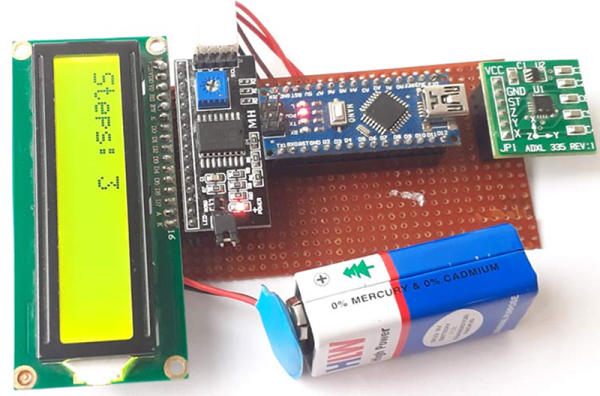
There’s a trend in corporate America that has employees wear a step counter — technically a pedometer — and compete in teams to see who can get the most number of steps. We wonder how many people attach the device to an electric drill and win the competition easily. However if you want to do your own measurements, [Ashish Choudhary] has plans for making a pedometer with an Arduino. The device isn’t tiny, but as you can see in the video below it seems to work.

For the extra size, you do get some features. For one, there is a 16×2 LCD display and an ADXL335 accelerometer, and you can probably imagine some other cool features for such a device.

Continue reading “Arduino Pedometer Counts Your Steps”