1980s Plotter Plays Flappy Bird

Should you happen to have an HP7440A or similar plotter hanging around, you could have a quick game of Flappy Bird — or Plotty Bird as [WesleyAC] calls it. Just be sure you have some blank paper. The whole thing fits in about 200 lines of Rust code and — according to the author — gets to about 20 frames per second.

Watching the thing go, it appears that it draws a random set of pipes and then traces your flight path on the same page in real time.

Continue reading “1980s Plotter Plays Flappy Bird”

Circuit VR: Resistance Measurement With Four Wires

If you want to measure resistance and you know Ohm’s law, it seems like you have an easy answer, right? Feed a known current through the thing you want to measure and read the voltage required. A little math, and that’s it. Or is it? If you are measuring reasonably large resistance and you don’t mind small inaccuracies, sure. But for tiny measurements or highly accurate measurements, you’d be better off using the four-wire method. What’s more is, understanding why you want to use the four-wire method is a great example of using an understanding of electronics to find solutions to problems.
Continue reading “Circuit VR: Resistance Measurement With Four Wires”

Biological Hacking In The 19th Century Or How The World Almost Lost Wine

While it isn’t quite universal, a lot of people enjoy a glass of wine now and again. But the world faced a crisis in the 1800s that almost destroyed some of the world’s great wines. Science — or some might say hacking — saved the day, even though it isn’t well known outside of serious oenophiles. You might wonder how biological hacking occurred in the 19th century. It did. It wasn’t as fast or efficient, but fortunately for wine drinkers, it got the job done.

When people tell me about new cybersecurity threats, I usually point out that cybercrime isn’t new. People have been stealing money, tricking people into actions, and impersonating other people for centuries. The computer just makes it easier. Even computing itself isn’t a new idea. Counting on your fingers and counting with electrons is just a matter of degree. Surely, though, mashing up biology is a more recent scientific advancement, right? While it is true that CRISPR can make editing genes a weekend garage project, people have been changing the biology of plants and animals for centuries using techniques like selective breeding and grafting. Not as effective, but sometimes effective enough.

Continue reading “Biological Hacking In The 19th Century Or How The World Almost Lost Wine”

Atomic Power Gets Small

There was a time when nuclear power plants were going to save the world. Barring accidents, the plants are clean and generate a lot of power. However, a few high-profile accidents and increased public awareness of some key issues have made nuclear power a hard sell, at least in the United States. The fastest growing nuclear power-related business in the US — according to sources — is companies decommissioning nuclear power plants. However, there’s a move afoot to make nuclear power a viable solution again. The company behind it says their plants will be cheaper to build, cheaper to operate, and are much safer than conventional plants. Are those claims reasonable?

Continue reading “Atomic Power Gets Small”

Virtual Reality For Alzheimer’s Detection

You may think of Alzheimer’s as a disease of the elderly, but the truth is people who suffer from it have had it for years — sometimes decades — before they notice. Early detection can help doctors minimize the impact the condition has on your brain, so there’s starting to be an emphasis on testing middle-aged adults for the earliest signs of the illness. It turns out that one of the first noticeable symptoms is a decline in your ability to navigate. [Dennis Chan] at Cambridge Biomedical Research Centre and his team are now using virtual reality to determine how well people can navigate as a way to assess Alzheimer’s earlier than is possible with other techniques.

Current tests mostly measure your ability to remember things, but by the time that’s a problem, things have often progressed. The test has the subject walk to different cones and remember their locations, and has already proven more effective than the standard test.

Continue reading “Virtual Reality For Alzheimer’s Detection”

Microphones Listen To Your… Monitor?

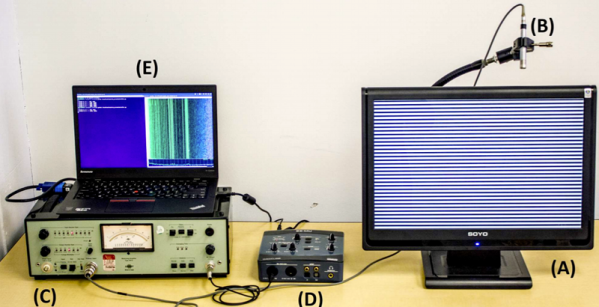
A song by Rockwell, “Somebody’s Watching Me” might be the anthem for the tin foil hat crowd. But a new paper reveals that it might be just as scary to have someone listening to you. Researchers have used common microphones to listen in on computer monitors. The demonstration includes analyzing audio to determine input from virtual keyboards and even a way to tell if people are surfing the web during a Google Hangout session.

Reading monitors based on electronic emissions is nothing new — ask Wim van Eck or read about TEMPEST. What makes this worrisome is that we constantly have live microphones around our computers. Webcams, phones, the latest smart assistant. Even some screens have built-in microphones. According to the paper, you could even pick up data from recorded audio. The paper has three main goals: extract display text, distinguish between different websites on screen, and extracting text entered with a virtual keyboard.

The analysis looked at 31 different screens. There were 12 distinct models from 6 different vendors. They did use a special VGA cable to tap the vertical sync to help manage the data, but they claim this was only an aid and not essential. They also used a high-end sound setup with a 192 kHz sampling rate.

Measuring the sound made by different display patterns was empirical. The authors think the mechanism is from subtle changes in the vibrations of the power supply components due to changes in current consumption. The refresh rate of the monitor also plays a part.

Armed with the proof of concept, the team went on to use an LG V20 cellphone and via a Hangouts call. Imagine if the person on the other end of your call could tell when you were reading Hackaday instead of paying attention to the call.

Different types of monitors need to be learned for best accuracy. It appears that reading small text may have problems, too. Even website detection depends on training. Still, maybe the tin hat people aren’t exactly wrong.

If you want to try your hand at reading the RF emissions, software defined radio is your friend. We’ll be interested to see if anyone duplicates the acoustic method in this paper, though.


One-Legged Robot Does The Hop

At first, we thought this robot was like a rabbit until we realized rabbits have a 300% bonus in the leg department. SALTO — a robot from [Justin Yim], [Eric Wang], and [Ronald Fearing] only has one leg but gets around quite well hopping from place to place. If you can’t picture it, the video below will make it very obvious.

According to the paper about SALTO, existing hopping robots require external sensors and often are tethered. SALTO is self-contained. The robot weighs a tenth of a kilogram and takes its name from the word saltatorial (adapted for leaping ) which itself comes from the Latin saltare which means to jump or leap.

Continue reading “One-Legged Robot Does The Hop”