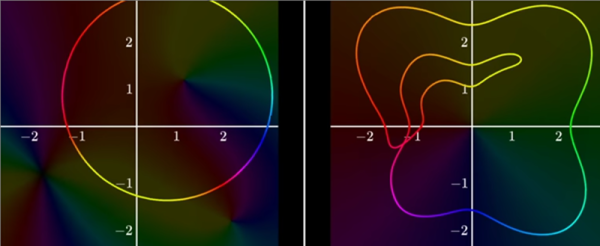
Solve 2D Math Equations Colorfully

Electronics can be seen as really just an application of physics, and you could in turn argue that physics is the application of math to the real world. Unfortunately, the way most of us were taught math was far from intuitive. Luckily, the Internet is full of amazing texts and videos that can help you get a better understanding for the “why” behind complex math topics. Case in point? [3Blue1Brown] has a video showing how to solve 2D equations using colors. If you watch enough, you’ll realize that the colors are just a clever way to represent vectors and, in fact, the method would apply to complex numbers.

Honestly, we don’t think you’d ever solve equations like this by hand — at least not with the colors. But the intuitive feel this video can give you for how things work is very valuable. In addition, if you were trying to implement an algorithm in software this would be tailor-made for it, although you wouldn’t really use colors there either we suppose.


Continue reading “Solve 2D Math Equations Colorfully”

Norman Borlaug Saves A Billion

Everyone loves a hero. Save someone from a burning building, and you’ll get your fifteen minutes of fame. That’s why I’m always surprised that more people don’t know Norman Borlaug, who would have celebrated his 104th birthday on Sunday. He won the Nobel prize in 1970 and there’s good reason to think that his hacking efforts saved about a billion people from starving to death. A billion people. That’s not just a hero, that’s a superhero.

To understand why that claim is made, you have to go back to the 1970s. The population was growing and was approaching an unprecedented four billion people. Common wisdom was that the Earth couldn’t sustain that many people. Concerns about pollution were rampant and there were many influential thinkers who felt that we would not be able to grow enough food to feed everyone.

Paul Ehrlich, in particular, was a Stanford University biologist who wrote a book “The Population Bomb.” His forecast of hundreds of millions starving to death in the 1970s and 1980s, including 65 million Americans, were taken very seriously. He also predicted doom for India and that England would not exist by the year 2000.

Here we are 40 or 50 years later and while there are hungry people all over the world, there isn’t a global famine of the proportions many people thought was imminent. What happened? People are pretty good problem solvers and Norman Borlaug — along with others — created what’s known as the Green Revolution.

Continue reading “Norman Borlaug Saves A Billion”

Quantum Electric Material Borrows From Japanese Basketweaving

Kagome is a pattern used to weave baskets from bamboo strips. The pattern is a symmetrical pattern of interlaced triangles that share corners. Scientists from MIT, Harvard, and Lawrence Berkeley National Laboratory have produced a kagome metal and found that it has exotic quantum properties.

Their paper, published in Nature (paywall), reports that the crystal made from layers of iron and tin atoms, causes electrons to flow in strange ways. The electrons bend into tight circular paths and flow along the edges without losing energy.

Continue reading “Quantum Electric Material Borrows From Japanese Basketweaving”

3D Printed Magnetic Stirrer Could Hardly Be Simpler

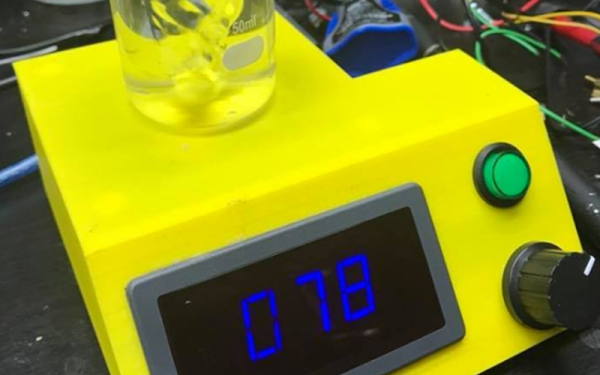
If you’ve spent much time in a chemistry or biology lab, you’ve probably seen a magnetic stirrer. This is a little table that you put a beaker on. A little bar (often called a flea or a pill) goes in the solution and spins to stir the beaker’s contents. Simple versions are not that expensive, but nicer ones can cost a bit. [John] decided to build his own using 3D printing and the design is delightfully simple.

The electronics is nothing more than a PC fan, an off-the-shelf fan controller with a display, and a 3D printed bracket with some magnets. The flea is also 3D printed, although we’d probably buy cheap commercial fleas since they are usually coated with Teflon or some other non-reactive substance. Depending on what you are stirring, the reactivity of your 3D printed plastic and its porosity could be a concern. In addition, a commercial flea has a pivot ring that helps it spin smoothly, although we are sure the 3D printed one will work in most cases.

Continue reading “3D Printed Magnetic Stirrer Could Hardly Be Simpler”

Icoboard Software Defined Radio Platform

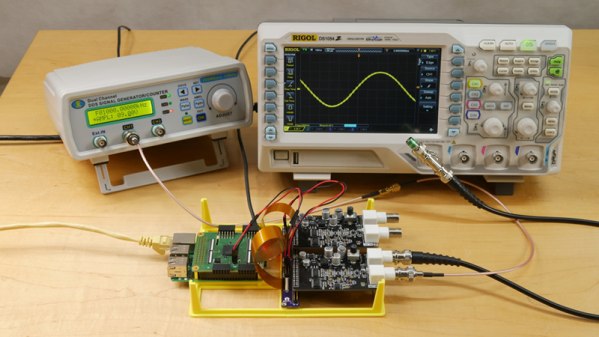
The Icoboard is a plug-in for the Raspberry Pi with a Lattice iCE FPGA onboard. Combined with a cheap A/D converter, [OpenTechLab] build a software-defined radio using all open source tools. He found some inexpensive converters that cost about $25 and were fast enough (32 MHz) for the purpose at hand. The boards also had a digital to analog converter and he was able to find the data sheets. You can see a video with the whole project covered, below.

The video, by the way, is pretty extensive (about an hour’s worth) and covers the creation of a PC board to connect from the Icoboard to the converters. There’s also a 3D printed frame, and that’s explained in detail as well.

Continue reading “Icoboard Software Defined Radio Platform”

Uber Has An Autonomous Fatality

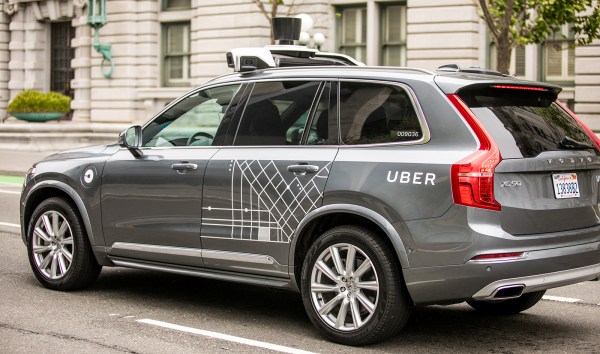
You have doubtlessly heard the news. A robotic Uber car in Arizona struck and killed [Elaine Herzberg] as she crossed the street. Details are sketchy, but preliminary reports indicate that the accident was unavoidable as the woman crossed the street suddenly from the shadows at night.

If and when more technical details emerge, we’ll cover them. But you can bet this is going to spark a lot of conversation about autonomous vehicles. Given that Hackaday readers are at the top of the technical ladder, it is likely that your thoughts on the matter will influence your friends, coworkers, and even your politicians. So what do you think?

Continue reading “Uber Has An Autonomous Fatality”

All Your IPhone Are Belong To Us

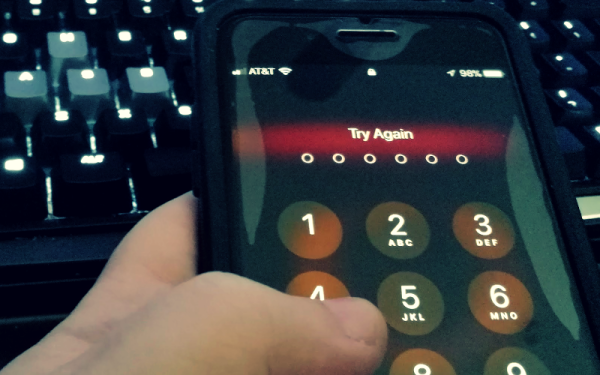
Apple’s commitment to customer privacy took the acid test after the San Bernadino shooting incident. Law enforcement demanded that Apple unlock the shooter’s phone, and Apple refused. Court cases ensued. Some people think that the need to protect the public outweighs the need for privacy. Some people think that once they can unlock one iPhone, it won’t stop there and that will be bad for everyone. This post isn’t about either of those positions. The FBI dropped their lawsuit against Apple. Why? They found an Israeli firm that would unlock the phone for about $5,000. In addition, Malwarebytes — a company that makes security software — reports that law enforcement can now buy a device that unlocks iPhones from a different company.

Little is known about how the device — from a company called Grayshift — works. However, Malwarebytes has some unverified data from an unnamed source. Of course, the exploit used to break the iPhone security is secret because if Apple knew about it, they’d fix it. That’s happened before with a device called IP-box that was widely used for nefarious purposes.

Continue reading “All Your IPhone Are Belong To Us”