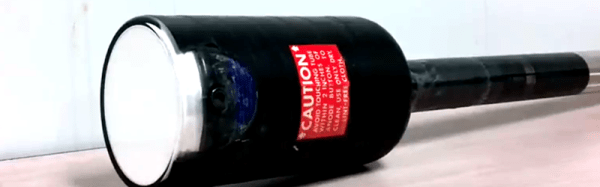
Stromberg Carlson Charactron Tube

Flat panel TVs have spoiled us. It used to be that a big display took up a lot of room on your desk or living room because of the depth of the CRT’s electron gun. We wonder what the designers of the charactron would think if they could see our big flat screens today. Never heard of a charactron? Check out [uniservo’s] video of one of these old character display tubes.

You might think the device is just a simple small CRT. However, it is much stranger than that. Inside the tube was a stencil that contained all the characters the device could display. A deflection coil would move an electron beam to light up a particular character. Then another coil would deflect the patterned electron beam to the desired space on the screen. In some cases, the entire set of stencils would get the beam and the first deflection coil would pick which character made it through an aperture. Either way, the tube was not just a display, but a character generator.
Continue reading “Stromberg Carlson Charactron Tube”

There Are 10 Kinds Of Computers In The World

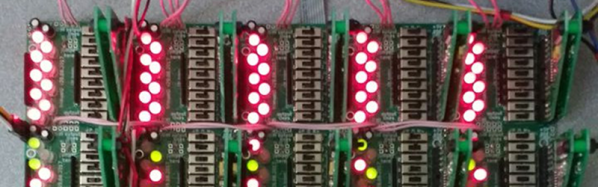
There’s an old joke that there are 10 kinds of people in the world. Those who know binary, those who don’t, and those who didn’t see a base three joke coming. Perhaps [Dmitry Sokolov] heard that joke because he’s built a ternary (base 3) computer. He claims it is the first one to be built in the last 50 years. You can see a video about the device below. There’s also a video of the device with a nixie tube output.

You may not think of it often, but bit is a contraction of binary digit, so a ternary computer doesn’t have those. It has trits. The CPU operates on 3 trit words and uses nothing but multiplexers as building blocks. Instructions use 5 trits, some of which are a two-trit opcode and a 3 trit address of one of the 13 registers. The allure of using ternary, by the way, is that you can represent more numbers in fewer bits — um, trits, rather.

Continue reading “There Are 10 Kinds Of Computers In The World”

Neural Network Learns SDR Ham Radio

Identifying ham radio signals used to be easy. Beeps were Morse code, voice was AM unless it sounded like Donald Duck in which case it was sideband. But there are dozens of modes in common use now including TV, digital data, digital voice, FM, and more coming on line every day. [Randaller] used CUDA to build a neural network that could interface with an RTL-SDR dongle and can classify the signals it hears. Since it is a neural network, it isn’t so much programmed to do it as it is trained. The proof of concept has training to distinguish FM, SECAM, and tetra. However, you can train it to recognize other modulation schemes if you want to invest the time into it.

Continue reading “Neural Network Learns SDR Ham Radio”

Hangprinter Build Videos

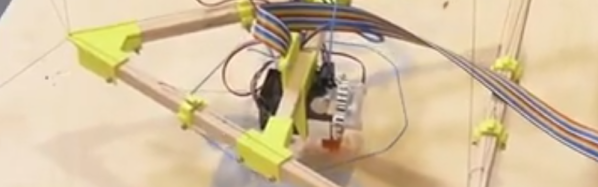
We figure with the rise in 3D printing, it is time for a new Finagle’s law: Any part you want to print won’t fit on your print bed. There was a time when a 100 mm x 100 mm bed was common for entry-level printers. These days, more printers have beds around (200 mm)2. A hangprinter’s work area can be larger. Much larger. [Thomas Sanladerer] is building one, and has a series of videos about the build. You can see the first one below, but there are several posted, including about 11 hours of recordings of live sessions of the build.

If you haven’t heard of a hangprinter, it is essentially a 3D print head that — well — hangs from cables and can turn an entire room into a 3D printer. When we looked at the original, it was printing a five-foot tall model of the tower of Babel.

Continue reading “Hangprinter Build Videos”

Better 3D Printing Through Holography

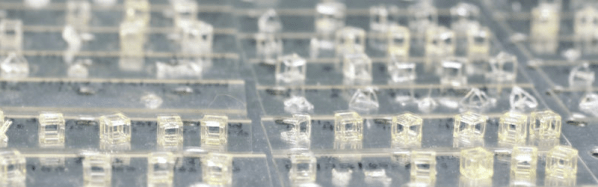
When most of us think about 3D printing, we usually think about a machine that melts plastic filament and extrudes it through a nozzle. But we all know that there are other technologies out there that range from cutting and laminating paper, to printing with molten metal or glass. Many of those are out of range for the common hacker. Probably the second most common method uses photo resin and some light source to build the layers in the resin. Researchers at Lawrence Livermore National Laboratory (LLNL) and several universities are experimenting with a new technique that exposes photo resin using three lasers, printing an entire object at one time. You can see a cube formed using the technique in the video below.

In all fairness, the process really isn’t holography but LLNL refers to it as “hologram-like.” In fact, it appears the lasers project more like an oblique projection (you know, like in drafting) which is considerably simpler. Simple enough, that we can’t help but wonder if the hacker community couldn’t develop machines based on this principle. The key would be arranging for the resin to only cure where laser light overlaps.

Continue reading “Better 3D Printing Through Holography”

Thermistors And 3D Printing

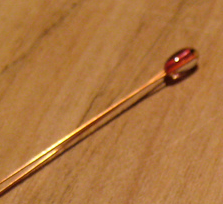
I always find it interesting that 3D printers — at least the kind most of us have — are mostly open-loop devices. You tell the head to move four millimeters in the X direction and you assume that the stepper motors will make it so. Because of the mechanics, you can calculate that four millimeters is so many steps and direct the motor to take them. If something prevents that amount of travel you get a failed print. But there is one part of the printer that is part of a closed loop. It is very tiny, very important, but you don’t hear a whole lot about it. The thermistor.

The hot end and the heated bed will both have a temperature sensor that the firmware uses to keep temperatures at least in the ballpark. Depending on the controller it might just do on-and-off “bang-bang” control or it might do something as sophisticated as PID control. But either way, you set the desired temperature and the controller uses feedback from the thermistor to try to keep it there.

If you print with high-temperature materials you might have a thermocouple in your hot end, but most machines use a thermistor. These are usually good to about 300 °C. What got me thinking about this was the installation of an E3D V6 clone hot end into my oldest printer which had a five-year-old hot end in it. I had accumulated a variety of clone parts and had no idea what kind of thermistor was in the heat block I was using.

Continue reading “Thermistors And 3D Printing”

Hacking An AUX Port For A Google Home Mini

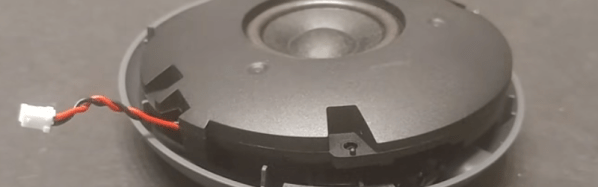
Even if you don’t want to add an AUX audio output port to your Google Home Mini, you’ll still want to see a pair of videos from [SnekTek]. After all, you’ll eventually want to open it up, and putting it over some boiling water might not have been your first idea. You can see both videos, below.

However, he did want to add an AUX port. The biggest challenge was finding a place to put the connector. Even after identifying a likely spot, a bolt interfered with the case closing and so he removed it. The one bolt didn’t seem to bother the final result.

Continue reading “Hacking An AUX Port For A Google Home Mini”