Linux Fu: System Administration Made Easier

Linux can have a somewhat split personality. If you use it as a desktop OS, it has a lot of GUI tools, although sometimes you still need to access the command line. If you use it as a headless server, though, you probably ought to know your way around the command line pretty well. This is especially true if you don’t want to litter up your hard drive (and CPU) with X servers and other peculiarities of the graphical user interface.

Personally, I like the command line, but I am realistic enough to know that not everyone shares that feeling. I’ll also admit that for some tasks — especially those you don’t do very often — it is nice to have some helpful buttons and menus. There are several administration tools that you might be interested in using to handle administration tasks on your Linux machines. I’m going to look at two of them you might want to experiment with that both use a Web browser to provide their interface.

Continue reading “Linux Fu: System Administration Made Easier”

Take Robby Home

Ok, we’ll stipulate it right up front: this isn’t a hack. But you have to admit, it would make a fine starting point for a truly epic one. Robby the Robot — the robot from the 1956 movie Forbidden Planet is up for sale. Well, technically he isn’t so much a robot as he is a suit with some animatronics. The auction lot includes Robby, his (non-functioning) vehicle, a control panel, and some other accouterments. If you have deep pockets, you’ll need to bid before November 21.

MGM reportedly spent $125,000 on Robby which was a crazy amount of money in the 1950s. In today’s currency, that would be well over a million bucks. They got their money’s worth, though, as Robby appeared in movies and TV shows including Lost in Space and several episodes of the Twilight Zone. He even made a motionless cameo on The Big Bang Theory.

Continue reading “Take Robby Home”

Key-tar Lets You Jam At The Hackerspace

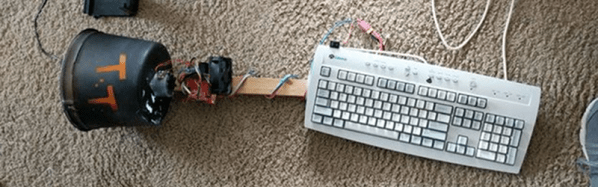
We’ve seen our share of stepper motors making music, but [Tanner Tech’s] key-tar takes it to a whole new level. Incorporating an acoustic drum to accentuate the stepper motor sounds and a preamp to feed a guitar amplifier, the key-tar is a fully playable instrument.

Moving the stepper via an Arduino at different speeds creates different notes. The user interface is an old PC keyboard. Apparently, [Tanner] recycled most of the parts in his model. The stepper came from an old printer and the keyboard was a dumpster rescue.

Continue reading “Key-tar Lets You Jam At The Hackerspace”

Bionic Eye Trial Approved

Pixium Vision, a French company, has received the approval to begin in-human trials of a miniature wireless sub-retinal implant. Named PRIMA, the device may help those with advanced dry age-related macular degeneration get improvements in their eyesight. The company is in talks to also conduct trials in the United States.

The PRIMA implant is a photovoltaic chip about 2mm square and only 30 microns thick. That’s tiny, but the device has 378 electrodes. The patient uses a device that looks like a conventional pair of glasses but contains an integrated camera that sends data wirelessly to a small pocket-sized image processing computer. This computer then commands the glasses to send data to the implant via invisible infrared light. The chip converts the light to electrical impulses and conducts them to the optic nerve. You can see a video about how the system works below.

Continue reading “Bionic Eye Trial Approved”

Roll Your Own JBC Soldering Station

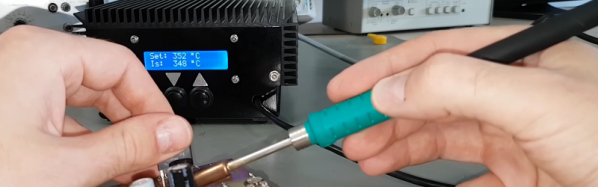
[Marco Reps] was soldering some boards with a lot of thermal mass and found his usual soldering iron was not up to the task. He noticed some professional JBC soldering stations that he liked, but he didn’t like the price. Even an entry-level JBC station is about $500 and they go up from there. He decided to build his own, but it did take awhile to complete. You can see two videos about the project, below.

How can you build your own soldering station and still claim it is a JBC? [Marco] noticed that the real performance of the iron came from the tip — what JBC calls a cartridge. In addition, the handle provides good ergonomics. You can buy the tips and handles from JBC for considerably less than a complete station. You just have to add the electronics to make it all work.

Continue reading “Roll Your Own JBC Soldering Station”

Circuit Challenge: Two Transistor 3.3V Regulator

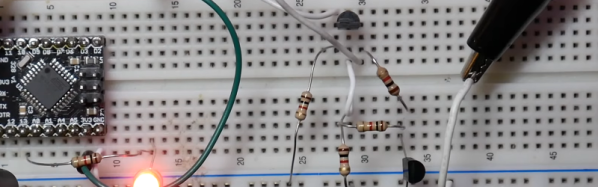
[Kevin Darrah] wanted to make a simple 3.3V regulator without using an integrated circuit. He wound up using two common NPN transistors and 4 1K resistors. The circuit isn’t going to beat out a cheap linear regulator IC, but for the low component count, it is actually pretty good.

In all fairness, though, [Kevin] may have two transistors, but he’s only using one of them as a proper transistor. That one is a conventional pass regulator like you might find in any regulator circuit. The other transistor only has two connections. The design reverse biases the base-emitter junction which results in a roughly 8V breakdown voltage. Essentially, this transistor is being used as a poor-quality Zener diode.

Continue reading “Circuit Challenge: Two Transistor 3.3V Regulator”

Listening For Hand Gestures

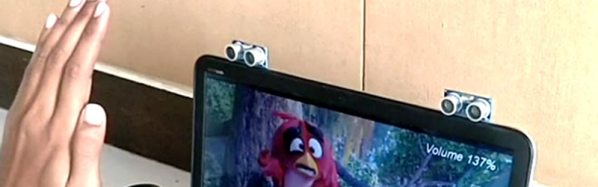
[B. Aswinth Raj] wanted to control a VLC player with hand gestures. He turned to two common ultrasonic sensors and Python to do the job. There is also, of course, an Arduino. You can see a video of the results, below.

The Arduino code reads the distance from both sensors — one for the left hand and the other for the right. This allows the device to react to single hand gestures that get closer or further away from one sensor as well as gestures involving both hands. For example, raising your left hand and moving it closer or further away will adjust the volume. The right hand controls rewind and fast forward. Raising both hands will start or stop playback.

Continue reading “Listening For Hand Gestures”