Beyond A Boot Print: The Lasting Effect Of Apollo On Humanity

July 20th, 1969 was the day that people from Earth set foot on different soil for the first time. Here we are 48 years later, and the world’s space programs are — well — not very close to returning to the moon. If you aren’t old enough to remember, it was really amazing. The world was in a lot of turmoil in the 1960s (and still is, of course) but everyone stopped to look at the sky and listen to the sound of [Neil Armstrong] taking that first step. It was shocking in a good way and almost universally observed. Practically everyone in the world was focused on that one event. You can see some of that in the NASA video, below.

Space flight was an incredible accomplishment, but it paled in comparison with the push to actually landing a person on the moon and bringing them home safely. The effort is a credit to the ability of people to work together (on the order of thousands of minds) to overcome a difficult challenge. We can learn a lot from that alone, and it makes a compelling argument to continue taking on tough problems. Today, as we remember the Apollo landings, let’s take a moment to recognize what came of it beyond an iconic boot-print in the floury lunar soil.

Continue reading “Beyond A Boot Print: The Lasting Effect Of Apollo On Humanity”
The Site Of A Hundred Languages

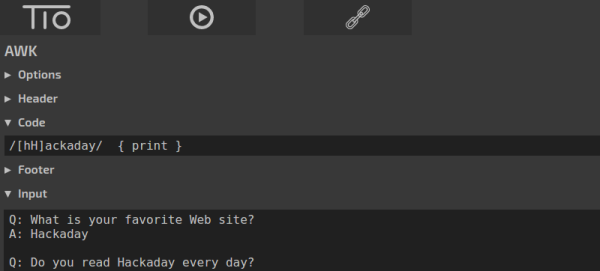
Silent film star [Lon Chaney] had the nickname “man of a thousand faces.”  The Try It Out website (tio.run) might well be the site of a hundred languages. Well, in all fairness, they only have 97 “practical” languages, but they do have 172 “recreational languages” but the site of 269 languages doesn’t trip off the tongue, does it? The site lets you run some code in each of those languages from inside your browser.

By the site’s definition, practical languages include things like C, Java, Python, and Perl. There’s also old school stuff like FOCAL-69, Fortran, Algol, and APL. There’s several flavors of assembly and plenty of other choices. On the recreational side, you can find Numberwang, LOLCODE, and quite a few we’ve never heard of.

Continue reading “The Site Of A Hundred Languages”

Using The GPU From JavaScript

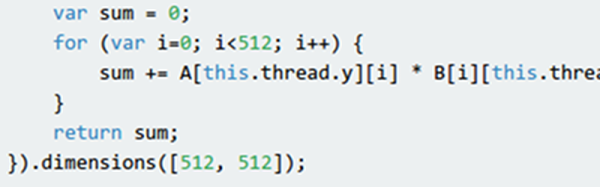
Everyone knows that writing programs that exploit the GPU (Graphics Processing Unit) in your computer’s video card requires special arcane tools, right? Well, thanks to [Matthew Saw], [Fazil Sapuan], and [Cheah Eugene], perhaps not. At a hackathon, they turned out a Javascript library that allows you to create “kernel” functions to execute on the GPU of the target system. There’s a demo available with a benchmark which on our machine sped up a 512×512 calculation by well over five times. You can download the library from the same page. There’s also a GitHub page.

The documentation is a bit sparse but readable. You simply define the function you want to execute and the dimensions of the problem. You can specify one, two, or three dimensions, as suits your problem space. When you execute the associated function it will try to run the kernels on your GPU in parallel. If it can’t, it will still get the right answer, just slowly.

Continue reading “Using The GPU From JavaScript”

PLC Vs Arduino Show Down

Hackaday readers don’t need an introduction to the Arduino. But in industrial control applications, programmable logic controllers or PLCs are far more common. These are small rugged devices that can do simple things like monitor switches and control actuators. Being ruggedized, they are typically reasonably expensive, especially compared to an Arduino. [Doug Reneker] decided to evaluate an Arduino versus a PLC in a relatively simple industrial-style application.

The application is a simple closed-loop control of flow generated by a pump. A sensor measures flow for the Arduino, which adjusts a control valve actuator to maintain the specified setpoint. The software uses proportional and integral control (the PI part of a PID loop).

Continue reading “PLC Vs Arduino Show Down”

The Cheapest Meter On Banggood

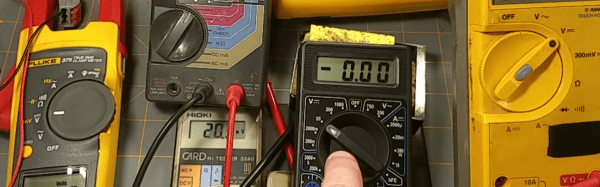
According to [pileofstuff], he didn’t really need another digital multimeter. However, when he saw a DT-832 meter on Banggood for the princely sum for $4.99 he wondered just what kind of meter you’d get for that price. You can see his conclusions in his recent video (below). He does make it clear, by the way, that he wasn’t paid for the review or given the meter. He just decided to see what $5 would buy in a meter.

Depending on your predisposition to cheap Asian electronics, you may or may not be surprised. After all, for $5 you can’t expect a top-of-the-line lab instrument. The device measures AC and DC voltage, DC amperage, ohms, transistor beta, and has a diode tester and continuity buzzer. It also has some frequency measurement capability. You can’t be too surprised it doesn’t auto range, though. To be fair, although he mentions Banggood as the source of the meter, a quick Google search shows you can get them from all the usual sources, and the price is down to $3.73 as long as you let them ship it from Canada.

Continue reading “The Cheapest Meter On Banggood”

Radiohead’s Greatest Hits For The ZX Spectrum

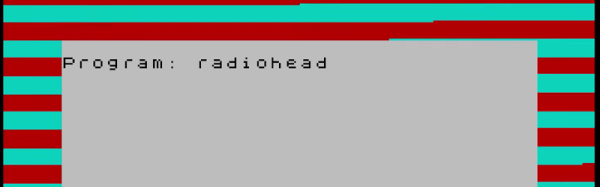
We’ll admit that only a few of us here at Hackaday are Radiohead fans. However, we all couldn’t help but appreciate their new remastered release of OK Computer. The new release contains some bonus material. At the end of the bonus material is a strange noise that turns out to be a ZX Spectrum Basic program.[OooSLAJEREKooO] managed to find it, play it, and record it for all of us (see video below).

The two minutes of tones might sound unfamiliar to a modern computer user, but back in the day, audio tones were used to communicate over phone lines and to load and save programs via cassette tape recorders. You might be asking yourself: why the ZX Spectrum? Radiohead is from the UK, but that’s not the complete picture. Of all home computers, the ZX Spectrum had a higher effective bit rate when storing data on tape. Basically, it takes less time (and less tape) to put it on a Speccy than a C64 or Apple.

Continue reading “Radiohead’s Greatest Hits For The ZX Spectrum”

The Sound Of (Synthesized) Music

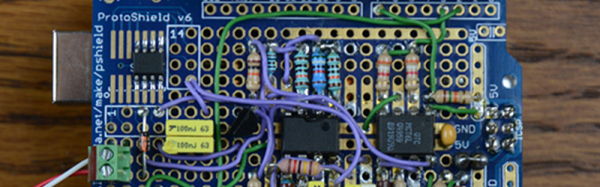
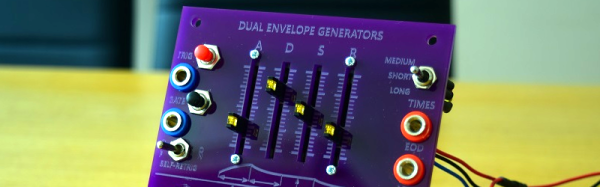
What’s an ADSR envelope generator? If you are a big music hacker, you probably know. If you are like the rest of us, you might need to read [Mich’s] post to find out that it is an attack-decay-sustain-release (ADSR) envelope generator. Still confused? It is a circuit used in music synthesis. You can see a demo of the device in the video below.

Before the Altair–which was sort of the first hobbyist computer you could actually buy–electronics magazines were full of music synthesizer projects that had a lot in common with the analog computers of old. A lot of people took that very seriously and then computers took over the collective consciousness and we found musical hackers started working with (digital) computer-based synthesizers. But the old analog synth designs just won’t die. [Mich’s] ADSR is based on an ancient design, and the amount of information and additions he provides makes it worth a read, even if you don’t fancy building one.

Continue reading “The Sound Of (Synthesized) Music”