Rotary Phones And The Birth Of A Network

I can’t help but wonder how long it will be before the movie title  “Dial M for Murder” becomes mysterious to most of the population. After all, who has seen a dial phone lately? Sure, there are a few retro phones, but they aren’t in widespread use. It may not be murder, but it turns out that the dial telephone has its roots in death — or at least the business of death. But to understand why that’s true, you need to go back to the early days of the telephone.

Did you ever make a tin can phone with a string when you were a kid? That dates back to at least 1667. Prior to the invention of what we think of as the telephone, these acoustic phones were actually used for specialized purposes.

We all know that [Alexander Graham Bell] made a working telephone over a wire, drawing inspiration from the telegraph system. However, there’s a lot of dispute and many others about the same time were working on similar devices. It is probably more accurate to say that [Bell] was the first to successfully patent the telephone (in 1876, to be exact).

Continue reading “Rotary Phones And The Birth Of A Network”

KIM-1 To COSMAC Elf Conversion — Sort Of

In the mid-1970s, if you had your own computer, you probably built it. If you had a lot of money and considerable building skill, you could make an Altair 8800 for about $395 — better than the $650 to have it built. However, cheaper alternatives were not far behind.

In 1976, Popular Electronics published plans for a computer called the COSMAC Elf which you could build for under $100, and much less if you had a good junk box. The design was simple enough that you could build it on a piece of perf board or using wire wrap. We featured the online archive of the entire Popular Electronics collection, but hit up page 33 of this PDF if you want to jump right to the article that started it all. The COSMAC Elf is a great little machine built around a 40-pin RCA 1802 processor, and for many was the first computer they owned. I lost my original 1802 computer in a storm and my recent rebuild in another completely different kind of storm. But there is a way to reclaim those glory days without starting from scratch.  I’m going to repurpose another retro-computing recreation; the KIM-1.

I’ll admit it, Rewiring a real KIM-1 to take an 1802 CPU would be difficult and unnecessary and that’s not what this article is about. However, I did have a KIM UNO — [Oscar’s] respin of the classic computer using an Arduino mini pro. Looking at the keyboard, it occurred to me that the Arduino could just as easily simulate an 1802 as it could a 6502. Heck, that’s only two digits different, right?

The result is pretty pleasing. A “real” Elf had 8 toggle switches, but there were several variations that did have keypads, so it isn’t that far off. Most Elf computers had 256 bytes of memory (without an upgrade) but the 1802 UNO (as I’m calling it) has 1K. There’s also a host of other features, including a ROM and a monitor for loading and debugging programs that doesn’t require any space in the emulated 1802.

Continue reading “KIM-1 To COSMAC Elf Conversion — Sort Of”

Ok Google. Navigate To The International Space Station

If you’d have asked most people a few decades ago if they wanted a picture of every street address in the world, they would have probably looked at you like you were crazy. But turns out that Google Street View is handy for several reasons. Sure, it is easy to check out the neighborhood around that cheap hotel before you book. But it is also a great way to visit places virtually. Now one of those places is the International Space Station (ISS).

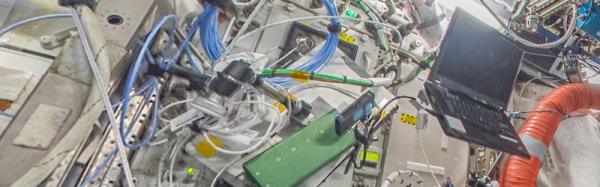
[Thomas Pesquet] in a true hack used bungee cords and existing cameras to take panoramas of all 15 ISS modules. Google did their magic, and you can enjoy the results. You can also see a video on how it was all done, below.

Continue reading “Ok Google. Navigate To The International Space Station”

Play It Again, Arduino

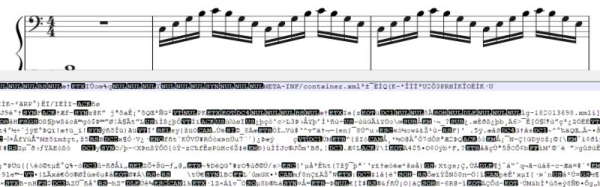
[MrRedBeard] wanted to play a particular song from an Arduino program and got tired of trying to hand transcribe the notes. A little research turned up that there was a project to convert Music XML (MXL) files to the Arduino. However, [MrRedBeard] wasn’t a fan of the language it used, so he created his own means of doing the same thing. He learned a lot along the way and was willing to share it in a tutorial that will help you if you want to do the same thing. You can see a video of his results, below.

Continue reading “Play It Again, Arduino”

Virtual CPU Stays On Script

Some will see it as a great thing, and others as an example of how JavaScript is being abused daily, but [Francis Stokes] decided to design his own CPU architecture and implemented a virtual version of it using JavaScript. The CPU is a 16-bit affair and has a simplified assembly language. The code is on GitHub, but the real value is [Francis’] exposition of the design in the original post.

While discussing the design, [Francis] reveals his first pass at the instruction set, discussed what he found wrong about it, and then reveals the final set composed of real instructions and some macros to handle other common cases.

Continue reading “Virtual CPU Stays On Script”

VexRiscv: A Modular RISC-V Implementation For FPGA

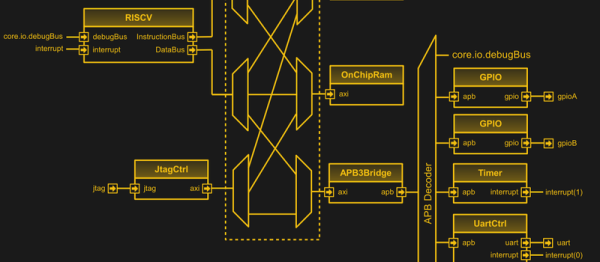
Since an FPGA is just a sea of digital logic components on a chip, it isn’t uncommon to build a CPU using at least part of the FPGA’s circuitry. VexRiscv is an implementation of the RISC-V CPU architecture using a language called SpinalHDL.

SpinalHDL is a high-level language conceptually similar to Verilog or VHDL and can compile to Verilog or VHDL, so it should be compatible with most tool chains. VexRiscv shows off well in this project since it is very modular. You can add instructions, an MMU, JTAG debugging, caches and more.

Continue reading “VexRiscv: A Modular RISC-V Implementation For FPGA”

Linux Fu: Better Bash Scripting

It is easy to dismiss bash — the typical Linux shell program — as just a command prompt that allows scripting. Bash, however, is a full-blown programming language. I wouldn’t presume to tell you that it is as fast as a compiled C program, but that’s not why it exists. While a lot of people use shell scripts as an analog to a batch file in MSDOS, it can do so much more than that. Contrary to what you might think after a casual glance, it is entirely possible to write scripts that are reliable and robust enough to use in many embedded systems on a Raspberry Pi or similar computer.

I say that because sometimes bash gets a bad reputation. For one thing, it emphasizes ease-of-use. So while it has features that can promote making a robust script, you have to know to turn those features on. Another issue is that a lot of the functionality you’ll use in writing a bash script doesn’t come from bash, it comes from Linux commands (or whatever environment you are using; I’m going to assume some Linux distribution). If those programs do bad things, that isn’t a problem specific to bash.

One other limiting issue to bash is that many people (and I’m one of them) tend to write scripts using constructs that are compatible with older shells. Often times bash can do things better or neater, but we still use the older ways. For example:

Continue reading “Linux Fu: Better Bash Scripting”