Apparently Time IS Money

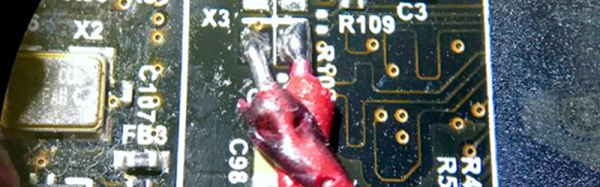
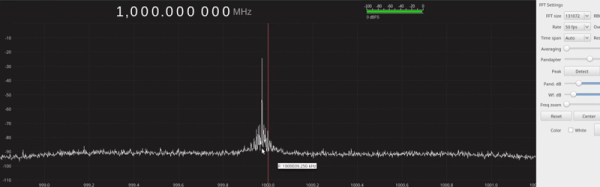
Some people like to tweak cars. Some like to overclock PCs. Then there are the guys like [Jack Zimmermann] who are obsessed with accurate time. He’s working on a project that will deploy NTP (Network Time Protocol) servers in different African countries and needed small, cheap, energy-efficient, and accurate servers. What he wound up with is a very accurate setup for around $200. Along the way, he built some custom hardware, and hacked a computer to sync to the GPS clock reference.

His original attempt was with a Raspberry Pi 3. However, the network adapter isn’t the fastest possible, both because it is 100 MBPS and, primarily, because it is connected via the USB bus. Network latency due to these limitations makes it difficult to serve accurate time.

His solution includes an Odroid C2. For $50 it is a very capable computer with four cores, gigabit Ethernet, and can even use eMMC storage which is faster than the usual SD card. You can still use a conventional SD card, though, if you prefer.
Continue reading “Apparently Time IS Money”

4.4 GHz Frequency Synthesis Made Easy

How hard is it to create a synthesizer to generate frequencies between 35 MHz to 4.4 GHz? [OpenTechLab] noticed a rash of boards based on the ADF4351 that could do just that priced at under $30. He decided to get one and try it out and you can find his video results below.

At that price point, he didn’t expect much from it, but he did want to experiment with it to see if he could use it as an inexpensive piece of test gear. The video is quite comprehensive (and weighs in at nearly an hour and a half). It covers not just the device from a software and output perspective but also talks about the theory behind these devices.  [OpenTechLab] even sniffed the USB connection to find the protocol used to talk to the device. He wasn’t overly impressed with the performance of the board but was happy enough with the results at the price and he plans to make some projects with it.

Continue reading “4.4 GHz Frequency Synthesis Made Easy”

ESP32 WiFi Hits 10km With A Little Help

[Jeija] was playing with some ESP32s and in true hacker fashion, he wondered how far he could pull them apart and still get data flowing. His video answer to that question covers the Friis equation and has a lot of good examples of using the equation, decibels, and even a practical example that covers about 10km. You can see the video below.

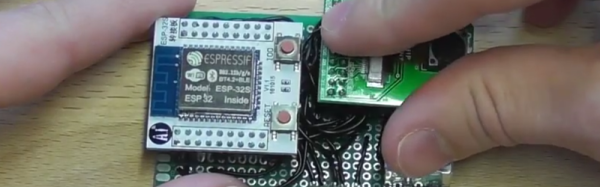
Of course, to get that kind of range you need a directional antenna. To avoid violating regulations that control transmit power, he’s using the antenna on the receiving end. That also means he had to hack the ESP32 WiFi stack to make the device listen only on one side. The hack involves putting the device in promiscuous mode and only monitoring the signals being sent. You can find the code involved on GitHub (complete with a rickrolling application).

Continue reading “ESP32 WiFi Hits 10km With A Little Help”

8-Bit Breadboard Computer Is Up To 8 Hours

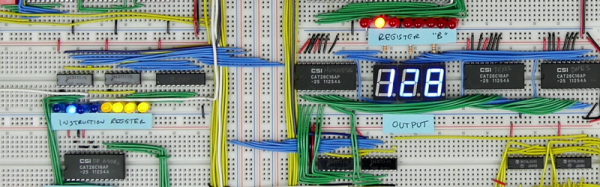
[Ben Eater] posted some videos of an 8-bit computer with no CPU chip that he built completely on a breadboard a few years ago. After being asked for schematics, he finally admitted that he didn’t have any. So, instead, he decided to rebuild it and keep a video log of each step in the process. You can see his kickoff video, below, but you can also find 30 more recent videos covering topics from the ALU design and troubleshooting to the decimal LED display. He even uses an Arduino to program a EEPROM that he uses to replace a lot of logic.

You probably want to wait until you have some free time as there are around eight hours of videos so far. The videos start off with a simple 555 timer and work up from there. Each piece gets a test separate from the whole, so with luck you won’t have an impossible job trying to troubleshoot the whole thing at the end.

Continue reading “8-Bit Breadboard Computer Is Up To 8 Hours”

FreeRTOS Gets Class

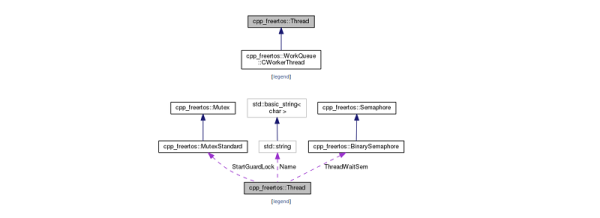
[Michael Becker] has been using FreeRTOS for about seven years. He decided to start adding some features and has a very interesting C++ class wrapper for the OS available.

Real Time Operating Systems (RTOS) add functionality for single-thread microcontrollers to run multiple programs at the same time without threatening the firmware developer’s sanity. This project adds C++ to the rest of the FreeRTOS benefits. We know that people have strong feelings one way or the other about using C++ in embedded systems. However, as the 24 demo projects illustrate, it is possible.

One nice thing about the library is that it is carefully documented. A large number of examples don’t hurt either. The library is clean with just under 30 classes. It seems to have resisted the trend of having classes for everything. You know the kind of library we mean. To create an Integer object, just build a configuration object to pass to the class factory generator which…. This library doesn’t entertain any of that. It has simple abstractions around threads and timers, queues, and mutexes.

Continue reading “FreeRTOS Gets Class”

Popping The Top Of A Ceramic IC

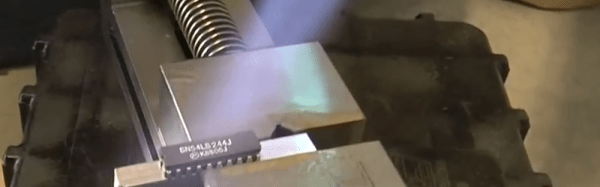
If you’ve ever wanted to open up an IC to see what’s inside it, you have a few options. The ceramic packages with a metal lid will succumb to a hobby knife. That’s easy. The common epoxy packages are harder, and usually require a mix of mechanical milling and the use of an acid (like fuming nitric, for example). [Robert Baruch] wanted to open a fully ceramic package so he used the “cooler” part of a MAP gas torch. If you like seeing things get hot in an open flame, you might enjoy the video below.

Spoiler alert: [Robert] found out the hard way that dropping the hot part isn’t a great idea. Also, we are not sure what the heat does if you want to do more than just inspect the die. It would be interesting to measure a junction on the die during the process to see how much heat actually goes to the device.

Continue reading “Popping The Top Of A Ceramic IC”

PlatformIO And Visual Studio Take Over The World

In a recent post, I talked about using the “Blue Pill” STM32 module with the Arduino IDE. I’m not a big fan of the Arduino IDE, but I will admit it is simple to use which makes it good for simple things.

I’m not a big fan of integrated development environments (IDE), in general. I’ve used plenty of them, especially when they are tightly tied to the tool I’m trying to use at the time. But when I’m not doing anything special, I tend to just write my code in emacs. Thinking about it, I suppose I really don’t mind an IDE if it has tools that actually help me. But if it is just a text editor and launches a few commands, I can do that from emacs or another editor of my choice. The chances that your favorite IDE is going to have as much editing capability and customization as emacs are close to zero. Even if you don’t like emacs, why learn another editor if there isn’t a clear benefit in doing so?

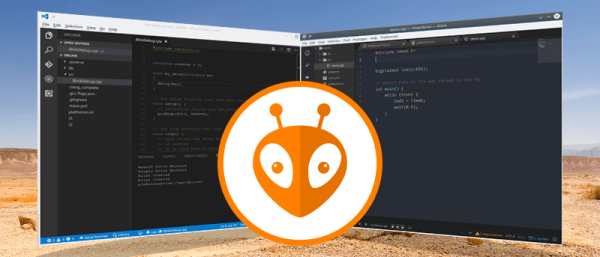
There are ways, of course, to use other tools with the Arduino and other frameworks and I decided to start looking at them. After all, how hard can it be to build Arduino code? If you want to jump straight to the punch line, you can check out the video, below.

Continue reading “PlatformIO And Visual Studio Take Over The World”